Product Overview
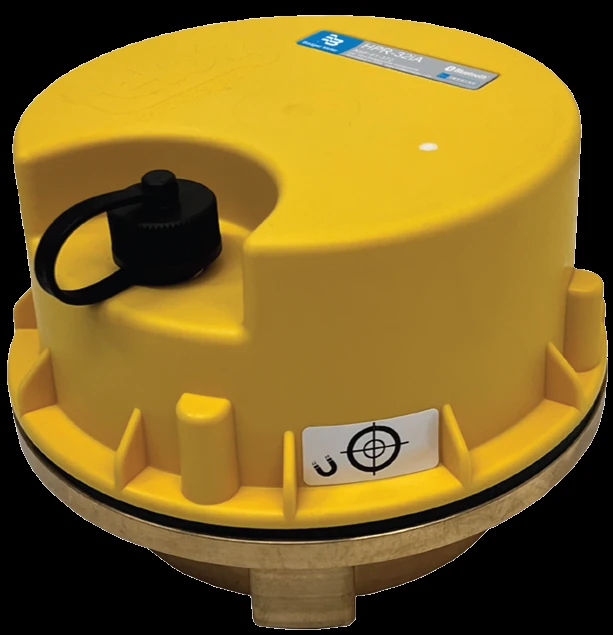
The Telog HPR-32A is Badger Meter’s battery-powered hydrant pressure recorder — a self-contained logger that threads onto a hydrant hose-nozzle outlet and records distribution pressure to internal memory for months at a time. It is the field tool for fire-flow tests, pressure-zone surveys and hydraulic-model calibration: mount it on a hydrant, leave it running on its BP-4 lithium battery, and collect the data on a schedule. The isolated strain-gauge sensor reads to ±0.25% of full scale, and 168,000 values of storage span the whole survey. Where fast transients matter, the HPR-32iA build samples to 256/sec and captures pre- and post-event waveforms for surge and water-hammer analysis. Both download locally over RS-232 or Bluetooth, or report on a scheduled call over the internal cellular (LTE Cat M1) modem to the Telog RM cloud — no external gateway required.
Key Features & Benefits
- Standalone field recorder — records to internal memory and runs on its own, so a survey site needs no power and no network
- Years on one battery — the field-replaceable BP-4 lithium pack runs up to about 6 years at a daily call and 4 samples/sec, and stores 168,000 values between visits
- Impulse build for transients — the HPR-32iA records full transient waveforms with pre- and post-event data at up to 256 samples/sec, logging surge and water hammer that a standard recorder would miss
- Mounts on the hydrant — threads onto a 2.50 in hose-nozzle outlet — no excavation, no tap; an optional nylon security cover deters vandalism
- Wireless by design — the internal cellular (LTE Cat M1) modem transmits data on a scheduled call so a site can report unattended without any external gateway
- Local or cloud collection — pull data on site over RS-232 or Bluetooth (BLE 4.1), or have it report to the Telog RM cloud / Remote Monitoring over its integral cellular link
Specifications
- Function
- Self-contained, battery-powered wireless pressure recorder that mounts directly on a hydrant and logs distribution pressure to local memory for portable field studies
- Measures
- Water-distribution / hydrant pressure via an isolated strain-gauge sensor. Accuracy ±0.25% of full scale at constant temperature; resolution 0.025% of full scale (12-bit). Ranges: HPR-32A 100, 200 or 300 psi; HPR-32iA -15…200 or -15…300 psi (vacuum-capable)
- Variants
- HPR-32A standard (4 samples/sec up to 8-hour intervals); HPR-32iA adds high-speed impulse capture — programmable to 256 samples/sec with pre- and post-event transient waveforms (up to 250 events) for surge and water-hammer analysis
- Recording & memory
- Logs to internal memory and runs standalone for months, holding the survey record until it is collected. 168,000 data values total (selectable min / max / average per interval); the HPR-32iA shares that pool with up to 84,000 impulse values, oldest-overwritten-first
- Power
- Factory-installed, field-replaceable Telog BP-4 lithium battery pack — up to 2,800 data calls to the host (about 6 years at one daily transfer and 4 samples/sec; high-speed impulse sampling shortens this)
- Telemetry / download
- Downloaded locally over RS-232 (5-pin connector) or Bluetooth (BLE 4.1, max ~20 ft), or transmits on a schedule over its internal cellular LTE Cat M1 modem (Verizon US / Bell Canada; FirstNet available in the US). No external gateway is required
- Outputs
- When networked, the recorder calls a Telog host over its integral cellular (LTE Cat M1) modem — the Telog RM cloud / Remote Monitoring or Telogers for Windows; local data download is via RS-232 or Bluetooth
- Enclosure / protection
- NEMA 4X / IEC IP65 housing (surface hydrant unit, not submersible); 5 in (127 mm) diameter × 3.5 in (89 mm). Operating 40…150°F (4…66°C), 0–100% RH
- Mounting
- Threads onto a 2.50 in NHT hydrant hose-nozzle outlet; internal sensor mount 1/4 in NPT. Optional high-impact nylon security cover (gray, red or yellow) with lockout hasps
- Platform compatibility
- Optional Telog RM cloud; works standalone otherwise
Common Applications
- Fire-flow testing on the distribution network
- Pressure-zone surveys across a service area
- Hydraulic-model calibration with field pressure data
- Surge and water-hammer investigations with the HPR-32iA impulse build
Design & Selection Considerations
- Log locally first — no power or signal required — every Telog device records to local memory and runs standalone indefinitely, so a site keeps recording even with no power and no network. Connectivity is optional at the start — a standalone logger can be promoted to live telemetry later without re-engineering.
- Recorder or cellular RTU? — battery recorders (HPR-32A, PR-32A, RG-32A) suit surveys and temporary studies you collect on a schedule; cellular RTUs (Ru-32, Ru-35, RS-45) transmit to the Telog RM cloud for permanent, real-time monitoring and alarming. Recorder for portable or temporary work; RTU for fixed sites you watch continuously.
- Match power and housing to the site — choose a multi-year lithium battery, solar, or AC power, and an IP68 submersible housing for vaults and sewers. The RS-45 runs continuous AC/solar duty; the Ru-35 is the submersible choice. Power and ingress rating decide where a site can go — spec them with the measurement.
- Open-channel: radar or submerged ultrasonic? — for sewers and partially-full pipes Telog uses the area-velocity method. The Raven-Eye 2 is non-contact radar (±0.5% velocity) — nothing touches the stream, so no fouling and no confined-space entry; the Beluga is submerged ultrasonic (±1%) that works even when the pipe surcharges, with integrated level and shallow-flow capability. Radar when you can see the surface and want the highest velocity accuracy; ultrasonic when it surcharges or radar can’t see in.
- Capture transients when they matter — for surge and water-hammer analysis specify the high-speed impulse variants — HPR-32iA, PR-32iA and the Ru-32iMA — which capture fast pressure transients a standard recorder would miss. Routine pressure logging and transient capture are different jobs — pick the impulse build when surge is the question.
- Plan the data path — cloud, SCADA, or both — Telog devices report to the Telog RM cloud (built on Esri ArcGIS) over their cellular link; the line-powered RTUs and gateways can also export to your SCADA over Modbus RTU, 4–20 mA or SDI-12, while the battery cellular recorders deliver through the cloud. Decide the destination — and confirm the outputs your specific device carries — up front.
To size & select the right Telog HPR-32A:
Use the input form to tell us what you need to measure and where, how the site is powered (battery, solar or AC), and how you want the data (the Telog RM cloud, your SCADA, or both) — and we’ll spec the recorder, RTU, sensor and outputs for your monitoring program.
Flow Meter Application Sheet ›Talk to an engineer directly — Scott Prater, Principal · 917-580-0878 · scott@pratertechnical.com
Specifications compiled by Prater Technical Partners from Badger Meter Telog product datasheets.