Product Overview
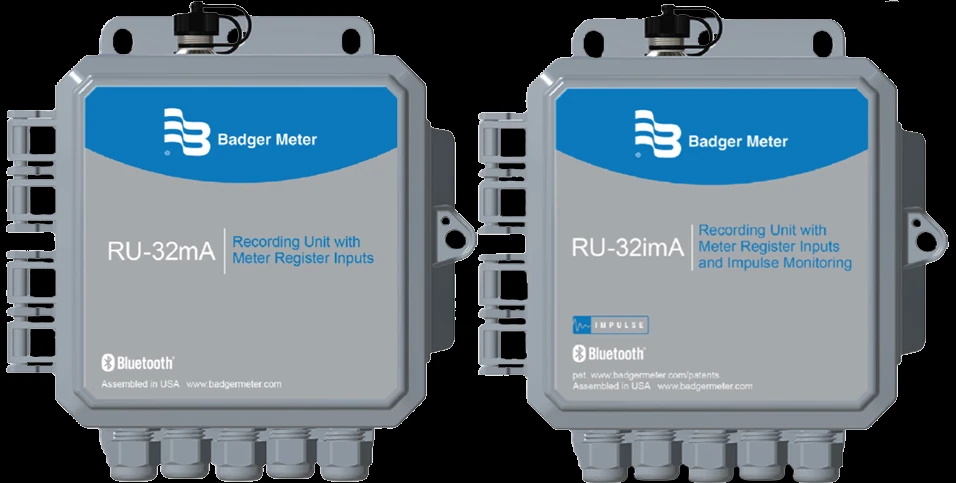
The Telog Cellular RTUs are Badger Meter’s eight-channel recording telemetry units for underground pressure, flow and meter monitoring across a water-distribution or wastewater-collection network. A single unit takes one or two strain-gauge pressure sensors, a 4–20 mA loop, a 0–5V analog input, two pulse / event inputs and two encoded water-meter registers — so pressure, valve flow and metered consumption come back on one site. The Ru-32mA covers routine logging in an IP67 housing; the Ru-32iMA steps its two pressure channels up to 30 samples per second, storing up to 125 transient events, to resolve the surge and water hammer a standard logger averages out, and is sealed to IP68. Both write to onboard memory first and call out over LTE cellular to the Telog RM cloud — on a schedule or on alarm — buffering through coverage gaps so no readings are lost. They run on the field-replaceable BP-4 lithium pack for up to about five years, with optional 9–30V DC or customer-supplied solar where a site needs continuous duty.
Key Features & Benefits
- Two builds, one platform — both are eight-channel telemetry units; the iMA adds high-rate impulse sampling on its pressure channels to catch fast transients the mA build would average away
- Eight mixed-signal channels — one unit takes one or two pressure sensors, a 4–20 mA loop, a 0–5V analog input, two pulse / event inputs, and two encoded water-meter registers
- Log-first, buffer-on-gap — readings are written to onboard memory before they are sent, so a dropout in cellular coverage does not cost you data
- Powered for the site — runs on the field-replaceable BP-4 lithium pack — up to ~5 years between changes — and takes optional 9–30V DC or solar where the program needs continuous duty
- Underground-rated housing — a watertight polycarbonate enclosure rated to 9.8 ft (3 m) of submergence — IP67 on the Ru-32mA, IP68 on the Ru-32iMA — for vaults and below-grade pits
- Surge-ready on the iMA — the iMA captures up to 125 transient events — up to 20 minutes of waveform at 30 samples / second — resolving water hammer that routine logging misses
Specifications
- Function
- Eight-channel cellular recording telemetry units (RTUs) — the Ru-32mA and Ru-32iMA — for underground pressure, flow and meter monitoring in water-distribution and wastewater-collection sites
- Inputs / channels
- Eight channels on both builds: two I2C pressure sensors (Ch 1–2, ±0.075% of full scale), one 4–20 mA current loop (Ch 3), one 0–5V DC analog (Ch 4), two digital pulse / event inputs (Ch 5–6), and two encoded meter-register inputs (Ch 7–8). On the iMA, the two pressure channels also sample at up to 30 samples / second to capture transients
- Sensor interfaces
- I2C strain-gauge pressure (one or two sensors), 4–20 mA current loop, 0–5V DC analog, pulse / event digital inputs, and 3-wire encoded register reads from single or dual water meters (Sensus ECR, Neptune ProRead, Badger Meter ADE / HR-E)
- Telemetry
- LTE Category M cellular (certified for Verizon Wireless) on a scheduled or alarm-triggered call; local RS-232 and Bluetooth BLE 4.1. Records to onboard memory (80,000 data values, first-in / first-out) and buffers when coverage drops
- Power
- Field-replaceable Telog BP-4 lithium battery pack, up to ~5 years of life depending on the call and sampling schedule; optional customer-supplied 9–30V DC or solar (battery becomes backup if external power is lost)
- Enclosure / protection
- Polycarbonate housing, watertight to 9.8 ft (3 m): the Ru-32mA enclosure is NEMA 6 (IP67); the Ru-32iMA enclosure is NEMA 6 (IP68)
- Application focus
- Multichannel pressure, flow and meter-register telemetry across a distribution or collection network, with pressure-transient capture (iMA) for surge and water-hammer analysis
- Platform & integration
- Reports to the Telog RM cloud Remote Monitoring platform over its cellular link; also compatible with Telog Enterprise and the Telogers for Windows desktop application
Common Applications
- Water-distribution pressure and underground level monitoring at vaults and unattended remote sites
- Pressure-reducing-valve flow and pressure monitoring, and mag-meter / register reads for non-revenue-water work
- Pressure-transient and water-hammer detection with the Ru-32iMA impulse channels
- Consolidating single or dual encoded water meters plus field signals onto one transmitting unit
Design & Selection Considerations
- Log locally first — no power or signal required — every Telog device records to local memory and runs standalone indefinitely, so a site keeps recording even with no power and no network. Connectivity is optional at the start — a standalone logger can be promoted to live telemetry later without re-engineering.
- Recorder or cellular RTU? — battery recorders (HPR-32A, PR-32A, RG-32A) suit surveys and temporary studies you collect on a schedule; cellular RTUs (Ru-32, Ru-35, RS-45) transmit to the Telog RM cloud for permanent, real-time monitoring and alarming. Recorder for portable or temporary work; RTU for fixed sites you watch continuously.
- Match power and housing to the site — choose a multi-year lithium battery, solar, or AC power, and an IP68 submersible housing for vaults and sewers. The RS-45 runs continuous AC/solar duty; the Ru-35 is the submersible choice. Power and ingress rating decide where a site can go — spec them with the measurement.
- Open-channel: radar or submerged ultrasonic? — for sewers and partially-full pipes Telog uses the area-velocity method. The Raven-Eye 2 is non-contact radar (±0.5% velocity) — nothing touches the stream, so no fouling and no confined-space entry; the Beluga is submerged ultrasonic (±1%) that works even when the pipe surcharges, with integrated level and shallow-flow capability. Radar when you can see the surface and want the highest velocity accuracy; ultrasonic when it surcharges or radar can’t see in.
- Capture transients when they matter — for surge and water-hammer analysis specify the high-speed impulse variants — HPR-32iA, PR-32iA and the Ru-32iMA — which capture fast pressure transients a standard recorder would miss. Routine pressure logging and transient capture are different jobs — pick the impulse build when surge is the question.
- Plan the data path — cloud, SCADA, or both — Telog devices report to the Telog RM cloud (built on Esri ArcGIS) over their cellular link; the line-powered RTUs and gateways can also export to your SCADA over Modbus RTU, 4–20 mA or SDI-12, while the battery cellular recorders deliver through the cloud. Decide the destination — and confirm the outputs your specific device carries — up front.
To size & select the right Telog Cellular RTUs:
Use the input form to tell us what you need to measure and where, how the site is powered (battery, solar or AC), and how you want the data (the Telog RM cloud, your SCADA, or both) — and we’ll spec the recorder, RTU, sensor and outputs for your monitoring program.
Flow Meter Application Sheet ›Talk to an engineer directly — Scott Prater, Principal · 917-580-0878 · scott@pratertechnical.com
Specifications compiled by Prater Technical Partners from Badger Meter Telog product datasheets.