Product Overview
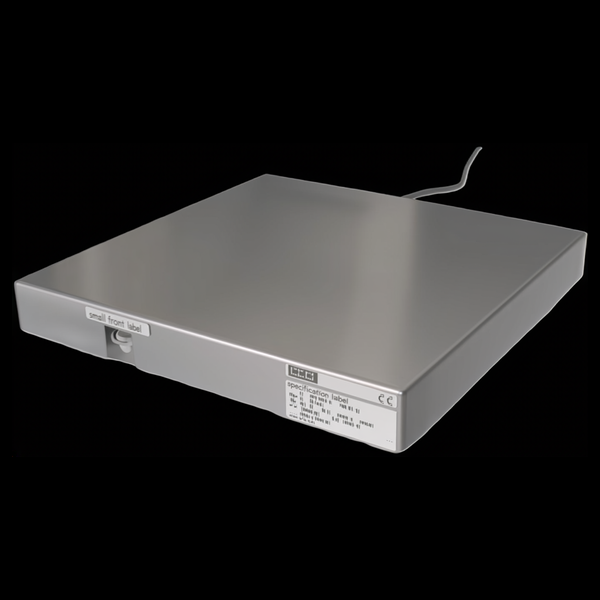
The WIKA LGS-1 liquid gas scale answers one recurring question in industrial and specialty gas work: how much is actually left in the cylinder? A 235-mm stainless platform with the sensor built in weighs the cylinder continuously — 0–300 lb on a 2-wire 4–20 mA loop — so chemical-delivery systems and gas panels see contents by weight instead of trusting a vapor-pressure gauge that reads full until nearly empty. IP54 and weather-resistant, 200% overload with drop-impact resistance for real cylinder handling, ±5% zero/span potentiometers for taring, and a 6-m integral cable. A finished scale: unbox, wire the loop, tare, monitor.
Key Features & Benefits
- Contents by weight, not by pressure — a liquefied gas holds its vapor pressure until it is nearly empty, so a pressure gauge lies about how much is left — weight is the honest inventory signal. The LGS-1 turns cylinder weight into a continuous 4–20 mA loop the gas panel can alarm on before the process starves. Change the cylinder on schedule, not on surprise.
- A scale, not a weighing project — sensor, platform, and 6-m cable ship as one sealed unit — no cell selection, mount design, corner loading, or junction box. Set the cylinder on it, wire two conductors, tare, done. The whole weighing system is the thing you unbox.
- Survives the cylinder swap — rated 200% overload (600 lb) and impact-resistant to a 90-kg load dropped from 10 cm — which is exactly what a cylinder change looks like on a bad day. Specified for how cylinders actually get handled.
- Loop wiring that reaches the classified boundary — the connection scheme is drawn for installations where the scale sits at a hazardous-area boundary with the supply and readout on the safe side — the wiring pattern specialty-gas rooms need. Planned for the gas cabinet, not adapted to it.
- Signal-grade electronics under a utility scale — the analogue output is specified like a transmitter — ≤0.1% of span with ≤0.05% BFSL non-linearity and ≤0.04%/month stability — so the trend line you log is worth logging. Utility form factor, instrument spec sheet.
Specifications
- Operating principle
- A finished, self-contained cylinder scale: a low-profile stainless platform the gas cylinder stands on, with the sensor, case, and cable built in. The weight reads out as a continuous 4–20 mA loop signal — contents of the cylinder, by weight, straight into the gas panel, monitor, or PLC.
- Capacity / measuring range
- 0–300 lb (0–136.08 kg), single range.
- Accuracy & repeatability
- 0.5% FS standard grade; the analogue signal itself is specified ≤0.1% of span (non-linearity ≤0.05% BFSL per IEC 61298-2), with long-term stability ≤0.04% of span per month.
- Output & excitation
- 4–20 mA, 2-wire; max output current ≤35 mA; load ≤(supply − 10 V)/0.02 A. Short-circuit and reverse-polarity protected; insulation voltage DC 500 V.
- Overload & breaking force
- Overload safety to 200% — 0–600 lb (270 kg); impact-resistant to 90 kg dropped from 10 cm.
- Body material
- Stainless-steel case and base plate; aluminium sensor.
- Sealing & protection class
- IP54, weather-resistant (IEC 60529) — indoor and protected-outdoor use.
- Dimensions / fit
- 235 × 235 mm platform, low-profile; approx. 13 lb (6 kg); integral 6-m (≈20-ft) cable.
- Mounting / load introduction
- Sits flat and horizontal under the cylinder (nominal position horizontal); shield bonded to case, ground conductor by the installer. The connection diagram covers wiring across a non-hazardous / hazardous-area boundary with the supply and load on the safe side.
- Temperature range
- Operating −10 to +50°C; storage −20 to +60°C. Temperature coefficients ≤±0.2% of span/10 K on zero and span.
- Approvals & options
- Meets EMC requirements; measured error per IEC 61298-2, reference conditions per IEC 61298-1.
- Calibration & traceability
- Zero and span adjustable ±5% via built-in potentiometers — tare the empty-cylinder weight at the scale.
- Build & lead time
- A complete scale — no separate load cell, mount, or junction box to engineer. Pair it with your own loop indicator or controller. Quote-only, no public price list.
Common Applications
- Force measurement of liquid gases in industrial & specialty gas applications
- Level measurement in chemical delivery systems — contents of the source cylinder by weight
- Industrial weight measurement on a compact platform
- Cylinder change-out scheduling — low-contents alarming through the 4–20 mA loop
Design & Selection Considerations
- Budget the readout — the LGS-1 is the sensor end of the loop — output is a bare 4–20 mA signal with no local display or relays: the alarm point, display, and logging live in whatever reads the loop. Pair it with a loop indicator or your PLC (see the displays & amplifiers group). Plan both ends of the two wires.
- Tare the real cylinder, not the nameplate — the ±5% zero adjustment is the taring mechanism — set zero with the actual empty cylinder (or offset in the PLC), because tare weights vary cylinder to cylinder more than the measurement error does. The biggest error source is administrative, not electrical.
- IP54 is weather-resistant, not washdown — indoor and protected-outdoor duty is the design point; a hose-down gas room or standing water calls for a different approach — ask us before putting it under a sprinkler head or on a wet pad. Match the sealing to the room, not the brochure photo.
- Keep the platform flat, level, and clear — nominal position is horizontal, and anything bridging the cylinder to the floor or wall — hoses, chains, a lean — steals weight from the reading. Rigid pigtails should be dressed so the cylinder floats on the platform. A cylinder restraint that carries load is a calibration error.
- One range, one duty — the LGS-1 is a single-range 300-lb cylinder scale — not a platform-scale family to size up or down. Bulk vessels, hoppers, and tanks belong on load-cell weighing (see the SLM weighing modules and the vessel weighing cells). Pick the product for the vessel, not the vessel for the product.
- Check the area classification path early — the wiring diagram anticipates hazardous-area boundaries, but the certification strategy for a classified gas room — barriers, location of supply and load — is an application review, not a catalog line. Use the input form to send the room classification with the inquiry.
To spec the right WIKA-ST cylinder scale:
To configure the right WIKA-ST force sensor, have these ready: the capacity (and the worst-case peak load); whether the force is tension, compression, or both; how the load is introduced (through an existing pin, a ring in the force path, or a threaded line); the output you need (4–20 mA, 0–10 V, mV/V, CANopen, or wireless) and the cable run; the environment (temperature, washdown, classified area); any certification (ATEX/IECEx, functional safety); and, for a load pin, the existing pin dimensions to match. A legacy tecsis part number is fine — send it and we cross-reference the current WIKA-ST equivalent.
Force & Pressure Application Sheet ›Talk to an engineer directly — Scott Prater, Principal · 917-580-0878 · scott@pratertechnical.com
Specifications compiled by Prater Technical Partners from WIKA product datasheets.