Product Overview
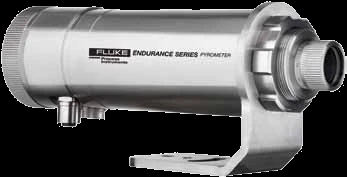
The Endurance integrated pyrometer puts both measurement principles in one stainless-steel housing: a 2-color (ratio) line (E1R, E2R) that reads accurately through a dirty window, a partially obscured path, or a target that underfills the spot, and a single-color line (E1M, E2M, E3M) that delivers the highest absolute accuracy on a clean, well-defined target. It sights and focuses through the lens — by laser, onboard video camera, or LED — covers 50 to 3200 °C, and talks Ethernet/PoE, Profinet, EtherNet/IP, 4–20 mA, and RS485 out of one terminal. Choose ratio when the path or the target is unreliable; choose single-color when it is clean and full — one platform, configured to which.
Key Features & Benefits
- Ratio and single-color in one platform — order the same sensor as a 2-color ratio instrument when the path is dirty or the target underfills, or as a single-color when the target is clean and full — same housing, sighting, and interface either way. You pick the measurement principle, not a different product line.
- You see what the detector sees — through-the-lens sighting — laser, onboard video over Ethernet, or LED — lets you aim and focus on the actual measured spot, so a misaimed sensor never quietly reads the wrong thing. Sighting and measurement share one optical path.
- A dirty-window alarm that tells you before the reading drifts — the optics self-monitor and raise an alarm when they need cleaning, instead of letting a filmed lens bleed the reading low unnoticed. The instrument flags its own maintenance.
- One sensor, every common fieldbus — Ethernet with PoE, Profinet, EtherNet/IP, 4–20 mA, RS485, and a programmable relay come out of the same terminal, with an onboard webserver for setup. It drops onto whatever control network the plant already runs.
- Stays in service in a hot install — the stainless IP65 body takes air-, water-, or ThermoJacket cooling to push the usable ambient well past what the bare electronics tolerate (the figures are in the specs). Cooling accessories extend the envelope rather than forcing a relocation.
Specifications
- Measurement principle
- Both principles in one integrated housing. The R models (E1R, E2R) are 2-color (ratio) instruments — they measure at two adjacent wavelengths at once and read the ratio, so the measurement survives a dirty window, a partially obscured path, or a target that underfills the spot. The M models (E1M, E2M, E3M) are single-color — one wavelength, highest absolute accuracy on a clean, well-filled target. Both share the same electronics, through-the-lens sighting, and interface.
- Models & temperature range
- Ratio (2-color): E1RL 600–1800 °C (2-color) / 550–1800 °C (1-color), E1RH 1000–3200 °C, E2RL 250–1200 °C. Single-color: E1ML 400–1740 °C, E1MH 540–3000 °C, E2ML 250–1100 °C, E2MH 450–2250 °C, E3ML 50–1000 °C, E3MH 150–1800 °C. Family envelope 50 to 3200 °C (122 to 5792 °F).
- Spectral response (wavelength)
- 1.0 µm nominal (E1R one/two-color, E1M single-color) · 1.6 µm (E2R one/two-color, E2M single-color) · 2.4 µm (E3M single-color). Short-wavelength bands suit high-temperature metals, molten metal, induction-heated parts, and semiconductors, where short wavelengths reduce the temperature error from emissivity uncertainty.
- Optical resolution (D:S)
- To 300:1 — by model: E1RL 100:1, E1RH 150:1, E2RL 75:1, E1ML 160:1, E1MH 300:1, E2ML 160:1, E2MH 300:1, E3ML 100:1, E3MH 300:1.
- Focus & lens options
- Manual variable focus through the lens. Three lens groups: F2 600 mm to ∞, F1 300–600 mm, F0 190–300 mm — you focus on the target through the same optical path you sight through.
- Accuracy
- Ratio (E1R / E2R): ±(0.5% Tmeas + 2 °C) with no attenuation. Single-color (E?M, in range): to ±(0.3% Tmeas + 1 °C). (Below each model’s lower threshold the tolerance widens — see the datasheet by model.)
- Repeatability
- Ratio: ±(0.3% Tmeas + 1 °C) with no attenuation. Single-color: to ±(0.1% Tmeas + 1 °C) in range.
- Response time
- 2 ms (95%) on the single-color E1M / E2M; 10 ms on E1R, 20 ms on E2R and E3M.
- Temperature resolution
- Digital output 0.1 °C; current output <0.03 °C / 16-bit.
- Emissivity & e-slope
- Emissivity 0.100 to 1.150; e-slope (ratio models) 0.850 to 1.150.
- Signal processing
- Peak hold, valley hold, and averaging on board; a unique “dirty window” alarm warns when the optics need cleaning.
- Sighting / aiming
- Through-the-lens sighting — you see exactly what the detector sees. Three options: laser, video camera (onboard, viewable over Ethernet), or LED, each paired with visible through-the-lens manual variable focus.
- Display & interface
- Integrated user interface with a temperature display, browse/raise/lower keys, and a visual sighting port; an onboard webserver serves video and configuration over the LAN.
- Outputs & communications
- Ethernet/LAN with PoE (ASCII, video, webserver), Profinet and EtherNet/IP options, 0/4–20 mA (max load 500 Ω), RS485 (2-wire half-duplex, networkable), and a programmable relay (48 V, 300 mA) with fail-safe alarm.
- Inputs
- Contact input (peak/valley reset, laser, LED) and isolated analog input (emissivity, e-slope, background temperature) 0/4–20 mA.
- Power supply
- 20 to 48 VDC, 500 mA, or Power-over-Ethernet (PoE).
- Ambient temperature & cooling
- 0 to 65 °C uncooled (E2R 0–60 °C); with air cooling to 120 °C, with water cooling to 175 °C, and with the ThermoJacket enclosure to 315 °C (600 °F). Storage −20 to 70 °C.
- Enclosure & environmental rating
- Rugged stainless-steel housing, IP65 (NEMA-4) rated; 10–95% RH non-condensing. Optical head 1220 g; 2980 g with the air/water-cooled housing.
- Shock & vibration
- Shock to IEC 68-2-27; vibration to IEC 68-2-6.
- Software
- Endurance software for remote configuration, remote monitoring, and field calibration. A 4-year warranty backs the series.
- Warranty
- 4-year warranty.
- Mounting & accessories
- Mounting nut, fixed and adjustable brackets, air-purge collar, pipe / right-angle-mirror adapters, sighting tubes (stainless / ceramic / carbon-steel), SpotScan line-scan accessory, polarizing-filter end cap, ThermoJacket, and an adapter kit (E-AK-7) to drop into existing WJ-5 water-jacket installations.
Common Applications
- Molten-metal and induction-heated metal temperature — foundry, forging, heat-treat
- Semiconductor and crystal-growth process temperature at short wavelength
- Hot-rolled metal and billet temperature where a dirty path argues for a ratio model
- Continuous-casting and ladle / tundish monitoring
- Furnace and kiln interior targets through a sight tube
- Any control point where one sensor must cover both clean and obscured conditions over time
Design & Selection Considerations
- Decide ratio vs single-color from the path, not the price — a 2-color (ratio) E?R cancels common-mode attenuation, so it reads through a dirty window, steam, dust, or a target too small to fill the field of view; a single-color E?M gives higher absolute accuracy and faster response on a clean, full target. Match the model to the worst path condition the process will see. Specify ratio for an unreliable sightline — never route that need to a single-color sensor.
- Fill the spot — on the single-color models especially — a single-color reading is only as good as a fully-filled measured spot; if the target is smaller than the spot at the working distance, the sensor averages in the background. Set the lens (F0/F1/F2) and standoff so the spot lands inside the target. A ratio model tolerates an underfilled spot; a single-color one does not.
- Match the wavelength to the material, then the optics to the distance — the 1.0 / 1.6 / 2.4 µm short-wave bands are for hot metals and similar high-temperature targets; pick the band first, then the lens group for the standoff and the smallest target. Wrong band reads the wrong layer no matter how the emissivity is set.
- Protect the electronics in a hot install — uncooled the head is rated to 65 °C; past that, plan the air-, water-, or ThermoJacket cooling at design time and route clean instrument air or cooling water to the mount. Cooling is a mounting decision, not an afterthought.
- Megger and warm a unit that has been in storage — as with any precision sensor, let a cold-stored instrument equilibrate before trusting an early reading, and keep the front window clean — the dirty-window alarm helps, but a purge collar prevents the problem. Good first readings start with a clean, settled sensor.
To spec the right Endurance pyrometer:
Use the input form to tell us about the measurement and the configuration follows from it: target material and its emissivity (and surface finish / oxidation); the process temperature range; the wavelength / spectral fit for the material; the working distance and smallest target so we set the optics and D:S (spot size at distance); whether the path argues for 2-color (ratio) or single-color; the mounting and ambient (and any cooling or purge needed); and the output / comms your control system expects (4–20 mA, RS485, Profinet, EtherNet/IP, relay).
IR Pyrometer Application Sheet ›Talk to an engineer directly — Scott Prater, Principal · 917-580-0878 · scott@pratertechnical.com
Specifications compiled by Prater Technical Partners from Fluke Process Instruments product datasheets.