Product Overview
The Thermalert 4.0 is the single-color fixed-mount spot sensor that does the everyday work: a compact stainless instrument spanning −40 to 2300 °C across a broad family of spectral models — 8–14 µm general-purpose, 5 µm glass, 7.9 and 3.43 µm thin-film plastics, short-wave 1/2/3M metals, and dedicated flame sensors. It carries a wide −20 to 85 °C uncooled ambient rating — among the highest in the category — with laser sighting and analog plus digital interfaces from a simple 2-wire loop up to PROFINET and EtherNet/IP. Choose Thermalert for a single clean control point; for a target seen through dust, steam, or a dirty window, step up to an Endurance ratio model.
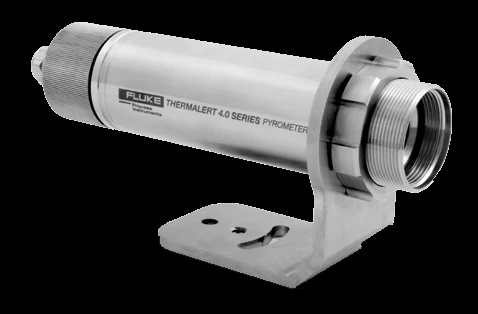
Key Features & Benefits
- A spectral model for the material in front of it — the same platform ships in 8–14 µm general-purpose, 5 µm glass, thin-film plastic, short-wave metal, and flame versions — you buy the wavelength the target reads correctly at. One workhorse line covers metals, glass, plastics, and flame.
- Runs hot without a cooling jacket — the uncooled ambient rating is among the highest in the category, so many installs that would force cooling on a lesser sensor need none here. Fewer accessories, one less thing to plumb.
- Wires the way your system wants — from a simple 2-wire 4–20 mA loop up to a 4-wire PROFINET / EtherNet/IP head with PoE, the same sensor matches a legacy loop or a modern fieldbus. It fits the control system you have, not the one you wish you had.
- Certified for explosive atmospheres when you need it — intrinsically-safe ATEX / IECEx models drop the sensor into hazardous dust or gas areas without a separate purge enclosure (the certification detail is in the specs). The classified-area version is a catalog option, not a custom build.
- Built for the dirty corners of a plant — the LTD model is made for extreme dust, real-time background compensation steadies the reading, and the galvanic-isolated outputs survive ground-loop-prone wiring. It expects a plant floor, not a lab bench.
Specifications
- Measurement principle
- Single-color spot measurement — one wavelength matched to the material, across a wide model range. Thermalert 4.0 is the fixed-mount workhorse: pick the spectral model for the target (metals, glass, plastics, flame), the optics for the standoff, and the output for the control system. For ratio (2-color) measurement through dirty or obstructed paths, the Endurance R / EF-R lines are the answer — not this platform.
- Models & temperature range
- LT general-purpose (LTD-04 −20–500 °C, LT-07/15/30 −20–600 °C, LT-50/70 −40–1000 °C) · G5 glass (G5-30 250–1650 °C, G5-70 450–2250 °C) · G7 (G7-70 300–900 °C) · P7 / P3 thin-film plastics (P7-30 10–360 °C, P3-20 25–450 °C) · MT metals (MT-30 200–1000 °C, MT-70 450–2250 °C) · HT (500–2000 °C) · 1M / 2M / 3M short-wave metals (3M-70 100–600, 2M-150 250–1400, 1ML-150 500–1650, 1MH-150 650–2300 °C) · flame models (CO2 / CO / NOX). Family envelope −40 to 2300 °C (−40 to 4172 °F).
- Spectral response (wavelength)
- 8–14 µm (LT general-purpose) · 5 µm (G5 glass) · 7.9 µm (G7, P7 thin film) · 3.43 µm (P3 polyolefin film) · 3.9 µm (MT) · 2.2 µm (HT) · 2.3 / 1.6 / 1 µm (3M / 2M / 1M short-wave metals) · 4.24 / 4.64 / 4.47 µm (CO2 / CO / NOX flame). Match the band to the material.
- Optical resolution (D:S)
- By model: LTD-04 4:1, LT-07 7:1, LT-15 15:1, LT-30/G5-30/P7-30/MT-30/CO-flame 33:1, LT-50 50:1, LT-70/G5-70/G7-70/3M-70 70:1, HT-60 60:1, P3-20 20:1, 1M/2M-150 150:1.
- Focus & lens options
- Wide choice of optics per model: close-focus (CF), standard-focus to 1520 mm (SF0), and far-focus (SF2/SF4) variants — e.g. LT-30 CF1 76 mm / CF2 200 mm / SF0 1520 mm.
- Smallest measurement spot
- Smallest spots reach 1.1 mm (MT-70 CF1); examples: LT-30 CF1 2.3 mm, LT-50 CF2 4 mm, 2M/1M SF0 10.1 mm / CF2 1.3 mm.
- Accuracy
- LT / G / P general-purpose: ±1% of reading or ±1.0 °C (whichever is greater) for Tmeas > 0 °C; below 0 °C the tolerance widens per the datasheet formula. The short-wave metal (3M/2M/1M, MT/HT) and flame models carry their own model-specific tolerances — see the datasheet by model.
- Repeatability
- ±0.3 °C or 0.3% of reading (whichever is greater) on most models.
- Response time
- Down to 10 ms (90%) — e.g. 2M/1M 10 ms, 3M 20 ms, LT-30 30 ms; longer on the far-focus and flame models.
- Emissivity & e-slope
- Real-time background-temperature compensation; emissivity set locally or by analog input (12-wire model, 0–10 V).
- Sighting / aiming
- Laser sighting standard on most models (not on LT-07, LT-15, LTB-30, LTD-04, P3, or the flame models). The LTD model is built for extreme dusty environments.
- Outputs & communications
- Multiple analog and digital interfaces by wiring option: 2-wire 4–20 mA; 4-wire Ethernet, EtherNet/IP, PROFINET IO (full-duplex 100 Mbit/s) with PoE; 6-wire 0/4–20 mA, 0–10 V, J/K thermocouple, RS485; 12-wire 0/4–20 mA, 0–10 V, RS485, alarm output, trigger input. HART protocol optional.
- Power supply
- 2-wire 12 to 28.8 VDC; 4-wire Power-over-Ethernet; 6/12-wire 24 VDC nominal (20 to 48 VDC, 100 mA @ 24 V).
- Ambient temperature & cooling
- −20 to 85 °C (−4 to 185 °F) uncooled — among the highest in the category. With air cooling to 120 °C, with water cooling to 175 °C, with the ThermoJacket to 315 °C (599 °F).
- Enclosure & environmental rating
- Compact, rugged stainless-steel design, IP65 / NEMA-4; galvanic-isolated outputs; 10–95% RH non-condensing; 500 g.
- Hazardous-area / intrinsic safety
- Intrinsically-safe models (T40-…-IS) for potentially explosive dust or gas atmospheres: ATEX II 2G Ex ib IIC T4 Gb (gas), II 2D Ex ib IIIC T135°C Db (dust), with the matching IECEx and CCC-IS certifications, −20 °C ≤ Ta ≤ +80 °C. Not available with the plastic-lens option.
- Software
- Software for remote configuration, monitoring, and field calibration.
- Warranty
- 2-year warranty.
Common Applications
- Extruder-melt and plastic web/film temperature — choose the 7.9 or 3.43 µm model to the polymer
- Flat-glass and container-glass surface temperature with the 5 µm G-series
- General machinery, bearing, and surface temperature on the 8–14 µm LT models
- Hot-metal and induction-billet temperature on the short-wave 1M / 2M / 3M models
- Flame detection and combustion monitoring with the CO2 / CO / NOX models
- Single-point process control in hot, dusty plant areas (LTD) and classified zones (IS models)
Design & Selection Considerations
- Pick the spectral model by material — this is the first decision — the wavelength, not the emissivity knob, is what makes a thin-film or glass or metal reading correct: 8–14 µm for general surfaces, 5 µm for glass, 7.9 / 3.43 µm for plastic films, short-wave 1/2/3M for hot metals. The wrong band reads the wrong layer entirely.
- Single-color means a clean, full sightline — Thermalert is a single-color platform, so it needs the target to fill the spot and the path to stay clear of heavy dust or steam; where the path is unreliable, the measurement belongs on an Endurance ratio model, not here. Match the platform to the path before you size optics.
- Set optics from standoff and target size — the model range spans 4:1 to 150:1 with close-, standard-, and far-focus variants; the measured spot must land fully inside the target at the working distance. Two fixed facts — how far and how small — pick the optic.
- Use the wide uncooled rating before reaching for cooling — the −20 to 85 °C uncooled envelope clears many installs without a jacket; add air, water, or ThermoJacket cooling only where the ambient genuinely exceeds it. Confirm the real ambient before specifying a cooling accessory.
- Specify intrinsic safety up front for a classified area — the T40-…-IS ATEX / IECEx models are a configuration choice, and they cannot carry the plastic-lens option — decide the area classification and lens before ordering. IS is ordered, not retrofitted.
To spec the right Thermalert 4.0 pyrometer:
Use the input form to tell us about the measurement and the configuration follows from it: target material and its emissivity (and surface finish / oxidation); the process temperature range; the wavelength / spectral fit for the material; the working distance and smallest target so we set the optics and D:S (spot size at distance); whether the path argues for 2-color (ratio) or single-color; the mounting and ambient (and any cooling or purge needed); and the output / comms your control system expects (4–20 mA, RS485, Profinet, EtherNet/IP, relay).
IR Pyrometer Application Sheet ›Talk to an engineer directly — Scott Prater, Principal · 917-580-0878 · scott@pratertechnical.com
Specifications compiled by Prater Technical Partners from Fluke Process Instruments product datasheets.