Product Overview
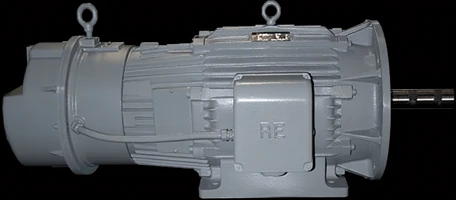
A Mil-Spec marine and military motor is qualified against a stack of shipboard and military standards that ordinary industrial motors are not. Reuland builds its marine and military motors to IEEE-45 and U.S. Navy Service A, with MIL-STD-901 shock, MIL-STD-167-1 vibration, and MIL-STD-740-1, -2 noise qualification, plus MIL-M-17060G and related specs — and they are ABS (American Bureau of Shipping) and U.S. Coast Guard certified. Construction uses marine-duty enclosures with sealed insulation systems and corrosion-resistant materials to survive salt, humidity, shock, and vibration at sea. The qualification is specific, so the vessel, the service, and the governing standards have to be identified up front.
Key Features & Benefits
- Qualified against the full shipboard standards stack — shock, vibration, noise, and shipboard electrical are all qualified to the governing military standards, not approximated — the designations are in the specifications. A motor your shipbuilder’s qualification matrix can actually accept.
- Certified for the classification society and the Coast Guard — ABS and USCG certification means the motor clears the marine approvals a commercial or government vessel inspection asks for. The marine paperwork is already in hand.
- The sea is designed in, not bolted on — sealed insulation, corrosion-resistant hardware and coatings, and a totally enclosed marine enclosure are built in for life at sea rather than added afterward. The environment is the design input, not an afterthought.
- The qualification spans the whole motor line — single-speed, multi-speed, wound-rotor, inverter-duty, high-speed, and synchronous designs can all carry the marine and Mil-Spec build, so the right motor for the load does not force a compromise on qualification. Pick the motor the load needs; the qualification follows it.
- Material traceability through one quality program — corrosion-proof hardware, Navy Service A coatings, and material traceability are managed under a single QA program, foundry through test. One source of record for a part a vessel survey will scrutinize.
Specifications
- Military / shipboard standards
- Built and tested against the shipboard / military stack: IEEE-45 and U.S. Navy Service A, with MIL-M-17060G (Navy shipboard motors), MIL-STD-167-1 (vibration), MIL-STD-901 (shock), MIL-STD-740-1, -2 (noise), MIL-STD-2037, and MIL-B-17931E (shock-qualified bearings). IEC 60092 shipboard-electrical compliance is also available.
- Marine certifications
- American Bureau of Shipping (ABS) and U.S. Coast Guard (USCG) certified for marine duty.
- Shock qualification
- High-impact shock qualification per MIL-STD-901 — the shipboard shock standard for equipment that must keep running through a hull shock event.
- Vibration
- Vibration qualified per MIL-STD-167-1.
- Airborne & structure-borne noise
- Airborne and structure-borne noise limited per MIL-STD-740-1, -2 — the shipboard noise-control standard.
- Enclosure
- Totally enclosed marine-duty construction, including dripproof-watertight (DTWP) enclosures for shipboard service. Totally enclosed fan-cooled (TEFC) and open drip-proof (ODP) are also available on the Navy Service A&C builds.
- Sealed insulation system
- A sealed insulation system (SIS) on the Navy builds, designed to survive salt, humidity, and condensation at sea.
- Corrosion protection & materials traceability
- Corrosion-proof hardware and corrosion-resistant coatings meeting Navy Service A requirements, with material traceability through the quality-assurance program.
- Power range
- 1–400 HP standard on the MIL-SPEC series (larger horsepowers available); up to 300 HP on the Navy Service A&C and marine builds.
- Voltage / phase
- Up to 600 volts, 3-phase.
- Frequency
- 60 Hz standard; up to 133 Hz with an inverter on the Navy Service A&C builds (up to 2,000 Hz with an inverter on the marine-duty high-speed builds).
- Speeds
- 3600, 1800, 1200, 900, 720, 600, 450, and 300 rpm, plus multi-speed and variable-speed.
- Frame range
- NEMA 56 through 449.
- Frame & rotor materials
- Steel or ductile-iron frame and end bells (cast-iron or cast-aluminum on the marine-duty line); M-19 electrical-steel laminations with hand-wound stators and die-cast aluminum, copper, or copper-alloy rotors.
- Insulation class
- Class H with VPI on the Navy builds; Class B, F, H, and VPI across the marine-duty range.
- Bearings
- Heavy-duty steel ball, ceramic ball, or roller bearings; shock-qualified bearings per MIL-B-17931E where required.
- Motor types available
- Available as single-speed, multi-speed, wound-rotor, SS-100 inverter/vector-duty, high-speed liquid-cooled, high-speed air-cooled, AC synchronous, and partial (stator/rotor set) motors.
- Build & lead time
- Custom-engineered to order against drawing and qualification review — foundry through final test in-house, with no minimum quantity. No published price list, quote-only; lead time is set per job. Made in USA.
Common Applications
- Shipboard winches, cranes, and hoists on military and commercial vessels
- Pumps, fans, and air-handling equipment for shipboard ventilation and climate systems
- Shipboard compressors and refrigeration drives
- Military shipboard and submarine auxiliary systems
- Commercial and cruise-ship auxiliary and propulsion-support systems
- U.S. Coast Guard and ABS-classed vessel drives requiring certified marine motors
Design & Selection Considerations
- Pin the governing standards before you spec anything else — shipboard and military motors are qualified against a specific stack — IEEE-45, Navy Service A, the applicable MIL-STDs, ABS, USCG — and the motor has to be built and tested to those, not to a generic "marine" label. Name the standards and certifications the vessel requires up front; they drive the whole package.
- Shock and vibration are pass/fail, not nice-to-have — a shipboard motor has to survive a hull shock event and a vibration spectrum that would loosen an ordinary motor — that drives the bearings, the winding bracing, and the construction. Use the input form to tell us the shock and vibration class so the motor is qualified, not just rated.
- The enclosure and insulation are about the sea, not the dust — salt, humidity, and condensation are the marine failure mode, so a sealed insulation system and a marine-duty enclosure with corrosion-resistant construction matter more than the indoor-vs-outdoor call. Spec for salt and water, not for plant dust.
- Separate the commercial-marine path from the Navy path — an ABS / USCG commercial-vessel motor and a Navy Service A Mil-Spec motor carry different standards, documentation, and cost. Use the input form to tell us which approval regime applies so the qualification scope is right-sized. Do not buy Navy shock qualification for a commercial workboat, or skip it on a combatant.
- Account for the inverter case on a variable-speed drive — the high-speed and variable-speed builds run on an inverter; a drive imposes voltage stress and shaft currents the VPI winding and bearings must be specified for, on top of the shock/vibration qualification. Name the drive and duty so the winding and bearing protection are set with the marine build.
To spec the right Reuland marine or Mil-Spec motor:
Use the input form to send the vessel and service, the governing standards and certifications (IEEE-45, Navy Service A, the applicable MIL-STDs, ABS, USCG), the shock and vibration class, the horsepower and speed, voltage and phase, duty cycle, mounting and frame, and whether the motor runs across the line or on a drive — and we’ll engineer the right Reuland marine or Mil-Spec motor for your vessel.
Specialty Motors Application Sheet ›Talk to an engineer directly — Scott Prater, Principal · 917-580-0878 · scott@pratertechnical.com
Specifications compiled by Prater Technical Partners from Reuland Electric published product specifications.