Product Overview
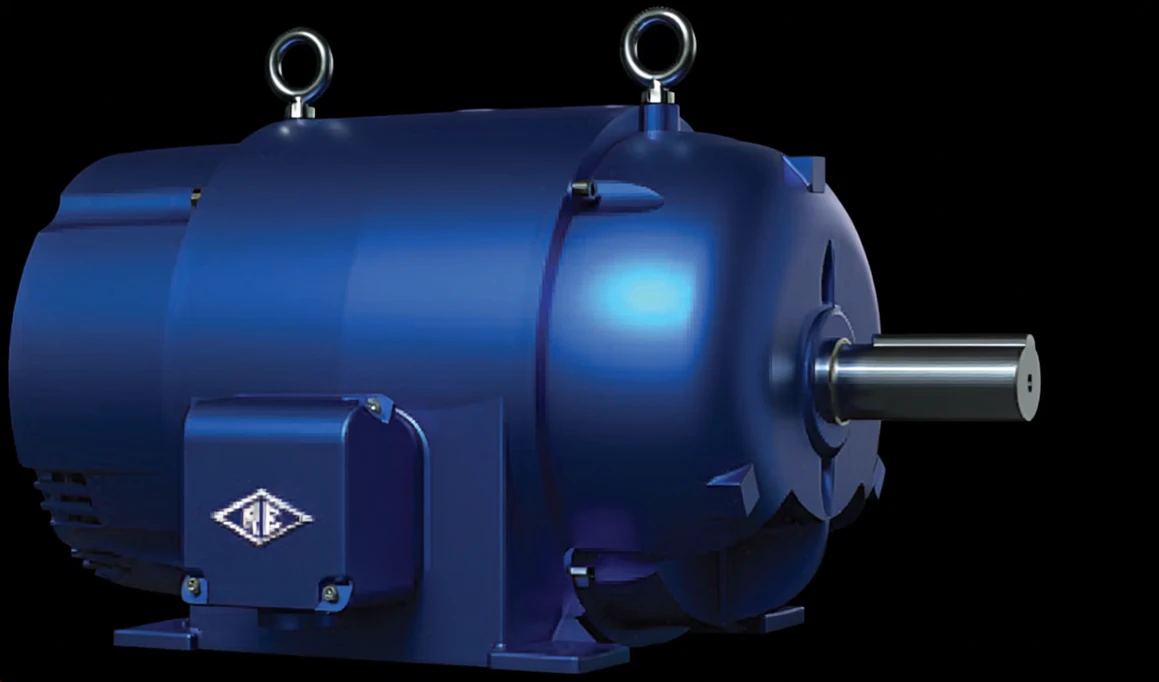
A nuclear-rated AC motor is one proven to perform in a reactor-service environment — engineered to survive a lifetime radiation dose that would degrade an ordinary motor’s insulation and materials. Reuland builds its nuclear motors to withstand 3.5 × 10&sup9; rads for the life of the unit, using a proprietary insulation system, a cast-iron frame and end bells, a stainless-steel shaft, metal tags, and no Teflon or silicone rubber (both degrade under radiation). The rating is available across the full motor line — single-speed, multi-speed, wound-rotor, inverter-duty, and high-speed — and is matched and documented to the specific service under 10 CFR 50 Appendix B QA and the IEEE-323 / IEEE-344 qualification standards. Full application data is required for every nuclear quote.
Key Features & Benefits
- Qualified for reactor service, not just rated for it — the motor is engineered and documented to survive a lifetime radiation dose, tied to the nuclear QA and equipment-qualification standards your safety case is built on. A motor your qualification package can actually cite.
- Radiation-survivable materials chosen up front — the insulation system, the metal frame and shaft, and the deliberate absence of the polymers that break down under radiation are all designed in — not value-engineered out at quote time. The materials decision is made for radiation life, not for cost.
- The nuclear rating spans the whole motor line — single-speed, multi-speed, wound-rotor, inverter-duty, and high-speed designs can all carry the rating, so the right motor for the load does not force a compromise on qualification. Pick the motor the application needs; the rating follows it.
- Built and tested under one roof — Reuland casts, machines, winds, assembles, and tests in-house, so the qualification, the documentation, and the as-built motor stay tied together through one quality program. One source of record for a part that lives or dies on its paperwork.
- Engineered to your installation, with the data to prove it — every nuclear motor is quoted against full application data and documented to the specific service, so the qualification matches the plant rather than a generic catalog claim. The qualification is married to your installation, on paper.
Specifications
- Nuclear qualification basis
- Qualification ties to 10 CFR 50 Appendix B quality assurance and the IEEE-323 (equipment qualification) and IEEE-344 (seismic qualification) standards — matched to the specific service and documented per job, not carried as a generic catalog label. Confirm the governing standards for your service before anything else.
- Radiation dose rating (TID)
- Built to withstand a radiation exposure of 3.5 × 10&sup9; rads for the life of the unit — the total integrated dose (TID) the motor and its insulation are qualified to survive.
- Insulation system
- A proprietary insulation system rated for the full lifetime dose — the component that defines the nuclear rating, since insulation is the first thing radiation attacks.
- Frame, shaft & materials
- Cast-iron frame and end bells, a stainless-steel shaft, and metal tags — a materials set chosen to hold up over the qualified life under radiation.
- Excluded materials
- No Teflon or silicone rubber anywhere in the build — both degrade under radiation, so they are excluded by design rather than substituted at quote time.
- Power range
- Up to 300 HP.
- Voltage / phase
- Up to 600 volts, 3-phase.
- Frequency
- 60 Hz standard, up to 2,000 Hz with an inverter on the high-speed builds.
- NEMA torque designs & slip
- NEMA torque designs A, B, C, and D — including high-slip designs at 5–8% slip and 8–13% slip — so the torque-speed curve is matched to the driven load.
- Frame range
- NEMA 56 through 449.
- Enclosure
- Totally enclosed construction.
- Insulation class
- Class B, F, and H, with VPI (vacuum-pressure impregnation) for a void-free, moisture-resistant winding.
- Motor types available
- The nuclear rating is available across the Reuland range: single-speed, multi-speed, wound-rotor, SS-100 inverter/vector-duty, high-speed liquid-cooled, high-speed air-cooled, and partial motors (stator/rotor sets) — so the qualification can be applied to whatever motor the application needs.
- Qualification documentation
- Documentation-intensive by nature: the qualification package is built and traced under the governing 10 CFR 50 Appendix B QA program and the IEEE-323 / IEEE-344 standards, tied to the as-built motor. Because the qualification is married to the actual installation, full application data drives every quote.
- Build & lead time
- Custom-engineered to order against drawing and qualification review — foundry through final test in-house, with no minimum quantity. No published price list, quote-only; lead time is set per job. Made in USA.
Common Applications
- Safety-related and balance-of-plant drives in commercial nuclear power stations
- Pump, fan, and valve-actuator motors inside the qualified boundary
- Reactor-service auxiliaries that must survive a lifetime radiation dose
- Like-for-like qualified replacements for aging or obsolete nuclear-plant motors
- High-speed or wound-rotor reactor-service loads needing the rating on a non-standard motor
Design & Selection Considerations
- Confirm the qualification basis your plant actually requires — a safety-related application is governed by a specific QA program and equipment-qualification standards — 10 CFR 50 Appendix B, IEEE-323, IEEE-344 — and the motor has to be qualified and documented to those, not to a generic "nuclear" label. Pin the governing standards before anything else; they drive the whole package.
- Radiation is what ends an ordinary motor — check the dose — the total integrated dose over the qualified life is the design driver, because radiation degrades organic insulation and polymers first. Use the input form to give us the expected lifetime dose so the insulation system and materials are matched to it. The dose, not the horsepower, sets whether a stock motor can survive.
- Specify safety-related vs balance-of-plant — a motor inside the qualified boundary carries the full QA and documentation burden; a balance-of-plant motor may not. Use the input form to tell us which side of the line the motor sits on so the qualification scope — and its cost and lead time — is right-sized. Do not pay for safety-related qualification on a non-safety load, or skip it on a safety one.
- Send full application data — the quote depends on it — because the qualification is tied to the actual service, a nuclear motor cannot be quoted from a catalog line. Load, duty, environment, dose, and the governing standards all have to be on the table. Incomplete data is the most common reason a nuclear quote stalls.
- Plan for the inverter case if the motor runs on a drive — the high-speed builds reach 2,000 Hz on an inverter; a drive imposes voltage stress and shaft currents the winding and bearings must be specified for, on top of the radiation qualification. Name the drive and the duty so the VPI winding and bearing protection are set with the rating.
To spec the right Reuland nuclear-rated motor:
Use the input form to send the governing standards (the plant’s QA program and the IEEE qualification basis), the expected lifetime radiation dose, the horsepower and speed, voltage and phase, duty cycle, enclosure environment, frame and mounting, and whether the motor is safety-related or balance-of-plant — and we’ll engineer and document the right Reuland nuclear-rated motor for your installation. Full application data is required for every nuclear quote.
Specialty Motors Application Sheet ›Talk to an engineer directly — Scott Prater, Principal · 917-580-0878 · scott@pratertechnical.com
Specifications compiled by Prater Technical Partners from Reuland Electric published product specifications.