Product Overview
A VVVF elevator-duty motor is an AC induction traction motor wound for variable-voltage / variable-frequency inverter control and built as a drop-in modernization replacement for legacy elevator hoist motors — including the DC-to-AC conversion that retires an old motor-generator machine. Reuland matches the new motor to the existing mounting, shaft, and electricals (documented drop-ins for Otis, Westinghouse, Dover and others), so the car gets a modern drive without rebuilding the hoistway. Choose it to modernize an elevator machine — CSA and NYC Housing Authority approved, engineered to the existing installation, with no minimum quantity.
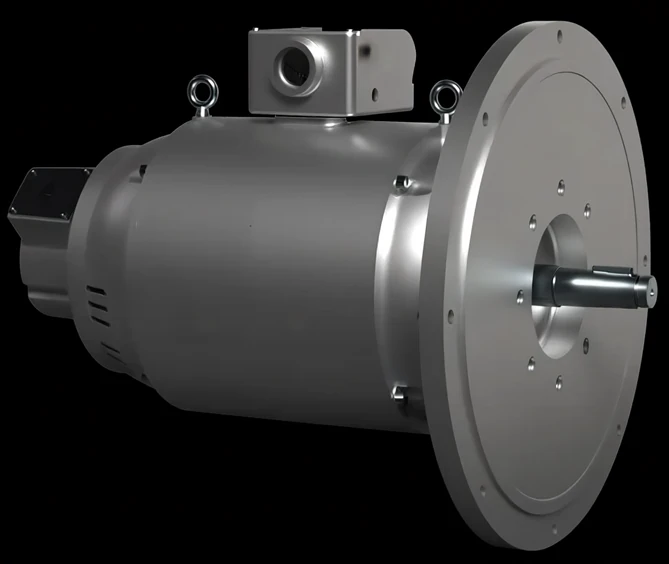
Key Features & Benefits
- Drops into the machine you already have — engineered to the existing installation — including obsolete OEM frames from Otis, Westinghouse, Dover and others — so the swap needs no adapter, no re-alignment, and no fabricated base, riser block, or new coupling. The whole point of a mod job: change the motor, not the machine bed.
- Converts a legacy DC machine to AC — an AC/VVVF motor on a modern drive replaces the old motor-generator DC hoist arrangement, retiring the rotating DC equipment and its maintenance. The path off a DC machine that no one wants to keep running.
- Holds ride quality across the whole speed range — wound for variable-frequency control with closed-loop feedback and under 3% slip, the motor levels smoothly and starts and stops cleanly across the 2000:1 closed-loop range. The leveling and the ride are in the motor, not just the drive.
- Built for the inverter, not just compatible with one — VPI insulation handles the drive’s voltage stress and the winding can be matched to the drive’s actual output voltage, which can trim drive and feeder cost. Specified for the drive it will actually run on.
- Approved for the buildings that demand it — CSA and NYC Housing Authority approval clear the motor for the elevator and public-housing work where those approvals are a gate. The paperwork the AHJ and the housing authority expect, in hand.
Specifications
- Motor type
- AC induction traction motor wound for variable-voltage / variable-frequency (VVVF) inverter control. Reuland builds these as AC induction, 1- or 2-speed, and special variable-speed (VVVF) designs — the AC motor that, on a modern drive, replaces the legacy DC and across-the-line AC hoist motors in elevator service.
- OEM drop-in & modernization
- Built as a drop-in modernization replacement — the new AC/VVVF motor is matched to the existing mounting, shaft, and electrical characteristics so it lands in the machine with no adapter and no alignment work. Documented drop-in coverage for Westinghouse, Otis, Titan, Northern, Armor, and Dover, with ready flange designs (e.g. Otis 17CT/22CT/29CT, Dover GD-105, Northern TW-151/160/280/340, Armor #2/#3, Titan 1, and the Westinghouse #18/#28/#35/#37/#38/#53/#57/#58/#61 flanges). Where the original is a DC machine, this is the DC-to-AC conversion path; obsolete frames are reverse-engineered from the old motor where drawings are lost.
- Power range
- 5–200 HP; 250 HP at 1200 rpm on request.
- Speed / poles
- 3600, 1800, 1200, 900, and 720 rpm (4-, 6-, 8-, or 10-pole), plus multi-speed and variable-speed builds.
- Variable-speed range (VVVF)
- On a VVVF drive: 1000:1 constant torque, open loop, or 2000:1 constant torque, closed loop — the closed-loop range (with feedback) is what holds leveling and ride quality at the floor.
- Slip
- Less than 3% slip on all VVVF designs — the low slip is what gives the inverter a tight, predictable speed-vs-load curve to level against.
- Voltage / phase / frequency
- Up to 600 V, 3-phase; 60 Hz, and up to 133 Hz on an inverter. The motor can be wound for the drive’s actual output voltage rather than full line voltage.
- Frame size
- NEMA frames 56 through 449; custom and obsolete frames also available so the motor matches the existing machine bed.
- Frame & rotor construction
- Cast-iron or cast-aluminum frame (stainless steel on request). Rotor options: die-cast aluminum, copper, copper-alloy, or wound rotor — selected for the torque and thermal duty of the hoist cycle.
- Enclosure
- TEFC (totally enclosed fan-cooled), TENV (totally enclosed non-ventilated), or ODP (open drip-proof) — matched to the machine room.
- Insulation class
- Class B, F, or H, with VPI (vacuum-pressure impregnation) for a void-free, moisture- and contamination-resistant winding. VPI also withstands the voltage stress an inverter waveform imposes.
- Bearings
- Heavy-duty steel ball, ceramic ball, or roller bearings — the roller option carries the radial sheave load on a geared machine.
- Mounting
- Foot or footless, precision bracket mounting, conventional C- or D-flange, and special / custom flanges — including a match to the obsolete OEM mounting on a modernization.
- Feedback & sensors
- Encoders, resolvers, and temperature sensors are available — the encoder or resolver closes the loop on a VVVF drive for the 2000:1 closed-loop range (a typical Reuland encoder is a shaft-mount 1024 PPR, 5–30 V unit on the non-drive end). A normally-closed thermal protector embedded in the winding guards against the heat the start-reverse-rest duty cycle builds.
- Brake
- Brakes, vibration mounts, and vibration sensors are available; a holding brake is integral to elevator hoist duty. Reuland also builds dedicated integrated-brake motors as a separate series.
- Approvals
- CSA and New York City Housing Authority (NYCHA) approved for elevator service.
- Build & lead time
- Custom build-to-order, engineered against drawing / nameplate review — no published price list, quote-only. No minimum quantity (one motor or a building’s worth). Foundry through final test in-house; expedited lead times available based on factory capacity.
Common Applications
- Elevator modernization — VVVF replacement of legacy AC and DC hoist motors (Otis, Westinghouse, Dover and other OEM machines)
- DC-to-AC conversions retiring motor-generator hoist arrangements
- Geared and gearless traction elevator drives in commercial and residential buildings
- NYC public-housing and code-gated elevator work requiring CSA / NYCHA approval
- Drop-in replacement of an obsolete elevator motor whose original maker or frame is gone
Design & Selection Considerations
- Open loop or closed loop decides the ride — the 1000:1 open-loop range moves the car, but elevator leveling and a smooth ride want the 2000:1 closed-loop range — which means an encoder or resolver on the motor. Decide the feedback before you pick the frame. Ride quality is bought with the feedback device, not assumed.
- Match the motor to the drive’s actual voltage — winding the motor to the inverter’s output can trim drive and feeder cost, but only if the drive model is known at order time. Use the input form to tell us the drive, and the winding is set to it.
- On a mod job, the old motor IS the spec — matching mounting, shaft, and electricals to an obsolete OEM frame depends on real data — the old nameplate, frame dimensions, mounting details, and photos of the full machine. Where drawings are lost the motor is reverse-engineered from the unit. Use the input form to send the old motor’s data; the more there is, the cleaner the drop-in.
- Geared machines load the bearings radially — a geared traction machine puts the sheave load on the shaft, so the bearing choice (roller vs ball) follows the machine type. Use the input form to tell us geared or gearless so the bearing carries the real load.
- Hoist duty is a thermal cycle, not a steady run — an elevator motor starts, reverses, and rests constantly; the insulation class, enclosure, and any temperature sensors are specified to that cycle, not to a continuous nameplate. Spec the duty cycle, not just the horsepower.
To spec the right Reuland VVVF elevator-duty motor:
Use the input form to send the old motor’s nameplate and frame / mounting dimensions (or the OEM make and model), whether the machine is geared or gearless and AC or DC today, the drive make and model you are pairing it with, the HP and speed, the voltage available, and any approval requirement (CSA / NYCHA) — plus photos of the full machine from about 5′ away — and we’ll spec the right Reuland VVVF elevator-duty motor and feedback package for the modernization.
Specialty Motors Application Sheet ›Talk to an engineer directly — Scott Prater, Principal · 917-580-0878 · scott@pratertechnical.com
Specifications compiled by Prater Technical Partners from Reuland Electric published product specifications.