Product Overview
Indeeco cooling-tower basin heaters keep a tower or sump basin from freezing during winter shutdown or standby. The spoke is a matched system: one or more electric immersion heaters in the basin, a 874Z control panel, and a single combination temperature / liquid-level probe that both holds the basin at its 45°F preset and acts as the low-water cutoff. Every part is rated for the wet, cold, outdoor location a cooling tower lives in — a weatherproof heater and a NEMA 4X panel. It protects the basin at standby; it is not designed to de-ice tower components while the tower is running.
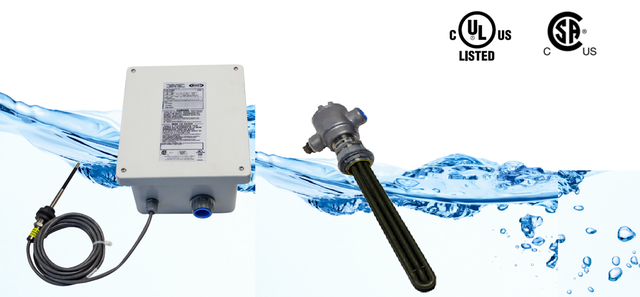
Key Features & Benefits
- One probe senses both temperature and water level — a single combination probe replaces a separate thermostat and low-water cutoff, so there is one device to mount through the basin wall and one cord to run. Less to install, less to fail, and the heater can never run dry.
- A matched heater-and-panel system, not loose parts — the immersion heater, the 874Z control panel, and the probe are engineered to work together and ordered as one package sized to your tower, basin, and climate. You specify the basin; we ship a freeze-protection system that fits it.
- Fails to the safe state — if the probe goes open- or short-circuited the output relay de-energizes, so a sensor fault shuts the heaters off rather than letting them run unattended. A broken sensor cannot become a burned-out heater.
- Built for the weather it lives in — the heater enclosure is cast-aluminum weatherproof and the panel is NEMA 4X — both liquid-proof and corrosion-proof for an outdoor basin. Rated for the wet, cold, outdoor spot a cooling tower actually occupies.
- Grows from a preset board to a networked controller — the standard preset 45°F board covers most basins; an adjustable board or a digital controller with display, adjustable setpoint, and RS-485 adds remote monitoring and control when a site wants it. Start simple; add visibility and remote control only where it earns its keep.
Specifications
- Operating principle
- Electric resistance (immersion) heating — one or more electric immersion heaters sit in the cooling-tower or sump basin and warm the standing water; a matched 874Z control panel cycles them to hold the basin above freezing. The system protects the basin during shutdown or standby only — it is not designed to prevent icing of tower components while the tower is running.
- Mounting / installation
- Basin-mounted immersion heater with a 2″ NPT fitting standard (other fitting sizes available); wire-lead connections and a cast-aluminum weatherproof enclosure. Heaters are offered in several mounting configurations and the heater is sized (kW, voltage, phase, immersion length) to the specific tower, basin size, and climate.
- Low-water cut-off brackets
- Freeze protection is governed by a single combination temperature / liquid-level probe — 316 stainless tubing with a 304 stainless ½″ NPT fitting, rated 15 psi, mountable horizontally or vertically. It senses both basin water temperature and level, and attaches through the basin wall with the supplied PVC hub connector. The probe ships with a 12 ft outdoor-rated cord pre-wired to the control board (custom cord lengths to 125 ft; direct-immersion / DI cords available).
- Element construction
- Tubular immersion elements with 360° repressed U-bends for added dielectric strength, .035″ element walls for corrosion resistance, and element spacers that hold the elements apart to reduce the hot spots that shorten element life. An optional single-blow thermal fuse adds over-temperature protection at the heater.
- Sheath materials
- Stainless-steel and brass / copper units are available; additional element sheaths are offered for corrosive environments. It is the user’s responsibility to confirm the sheath material suits the basin water chemistry (treated cooling-tower water can be corrosive).
- Cold (unheated) section length
- On higher-temperature builds an extended terminal box is furnished so the heating elements carry moisture seals and the field wiring avoids costly high-temperature wire — the terminal-box temperature tracks the process fluid temperature (for liquids, roughly the fluid temperature minus 50°F).
- Process / fluid temperature
- Basin freeze-protection duty — the 874Z control holds the basin at its 45°F preset on/off point (adjustable 0–100°F board optional). The immersion-heater hardware itself is rated for far higher process temperatures, but on a cooling-tower basin the control setpoint, not the element, sets the operating temperature.
- Watt density
- Watt densities up to 75 W/in². Watt density is matched to the basin water and the heater immersion length so the element runs cool enough to avoid scaling and premature failure in treated tower water.
- Fluid & sheath compatibility
- Sized for cooling-tower / sump basin water. Treated tower water varies widely in chemistry, so the sheath material (stainless, brass/copper, or a special alloy) is selected to the water analysis — supply it with the inquiry.
- Wattage range
- Up to 18 kW on stocked units; custom wattages available. The matched 874Z panels are cataloged from 16 A through 96 A maximum panel rating — sized to the connected heater load (see Circuiting for how a single panel switches the heaters).
- Voltage / phase
- Heaters to 600 V. The 874Z panels are cataloged for 120/208/240/480 V single-phase and 208/240/480 V three-phase via the catalog voltage/phase code.
- Circuiting
- A single 874Z control panel can switch more than one heater up to its nameplate voltage, phase, and kW rating through its magnetic contactor(s); a 24 V control transformer powers the temperature/level board and the contactor coil(s).
- Thermostat options
- Solid-state control: a pre-set 45°F on/off point with a built-in low-water cutoff. An adjustable 0–100°F control board and a digital controller with temperature display and adjustable setpoint are optional (the digital controller requires the RTD probe option).
- Control integration
- Catalog panel options: door disconnect, fusing, circuit breaker, and their combinations. Digital-controller-only options add RS-485 communication (remote setpoint / monitoring), low-temperature alarm, and low-water alarm contacts; further options include a heater-“ON” pilot light or dry contact, an enclosure drain, an integrated enclosure heater for cold ambients, and a 304 stainless enclosure. A remote-interlock terminal block prevents operation when an interlock is open.
- Terminal enclosure
- Both the heater and the control panel use a liquid-proof, corrosion-proof enclosure suitable for outdoor locations: the heater enclosure is cast aluminum (weatherproof); the 874Z panel is NEMA 4X with pre-mounted conduit hubs (optional 304 stainless). Panel ambient range −10°F to 104°F.
- Approvals & listings
- 874Z catalog panels are built UL and CSA cataloged (the catalog agency-status code also lists UL-only, CSA-only, and non-listed build options). The user is responsible for the basin low-water / low-flow safeguards and for installation per the National Electrical Code and local codes.
- Build & lead time
- Custom build-to-order — no published price list, quote-only. Lead times typically run about 3 to 14 weeks depending on configuration, hazardous-area documentation, and code-stamp requirements.
Common Applications
- Cooling-tower basin freeze protection during winter shutdown or standby
- Sump and remote-basin freeze protection where standing water must stay above freezing
- Evaporative-condenser and closed-circuit-cooler basins in cold climates
- Retrofit of an existing basin with a single-probe, pre-engineered control package
- Sites needing remote basin temperature / level visibility via RS-485 (digital controller)
- Rooftop cooling towers on commercial buildings — see the basin heater in context on the Submetering & Building Systems industry page
Design & Selection Considerations
- This protects a basin at standby — not the tower in operation — the job is to hold standing basin water above freezing during shutdown or standby; fill, louvers, and distribution piping that ice up while the fans run are outside its scope. Plan separately for operating-mode ice if your climate demands it.
- Keep the probe submerged — the low-water cutoff depends on conductive water — the cutoff works by passing a small 12 VAC current through the basin water between the probe and its fitting; if the probe is exposed (or iced in), the circuit breaks and the heaters stay off by design. Mount the probe at the right depth and keep the basin treatment conductive. The safety feature and the on/off control are the same circuit — respect the probe placement.
- Size the heater to the basin, the make-up water, and the climate — freeze-protection load is set by basin surface area, exposure, wind, the coldest expected ambient, and any cold make-up water — not by the tower’s thermal tonnage. Use the input form to give us those numbers and the kW falls out. An undersized basin heater loses to a cold snap; an oversized one wastes panel capacity.
- Match the sheath to treated tower water — cooling-tower water is chemically treated and can be aggressive; the standard stainless or brass/copper sheath may not suit every water analysis, and a corrosive water wants a special sheath alloy. Use the input form to send the water chemistry so the sheath survives the basin it lives in.
- Pick the controller for the visibility you need — the preset 45°F board is set-and-forget; a site that wants a temperature readout, an adjustable setpoint, or remote monitoring needs the digital controller (with its RTD probe) for the RS-485, alarm, and display options. Decide up front — the alarm and RS-485 features are digital-controller-only.
- Size the panel enclosure with the options you choose — adding fusing, a circuit breaker, or a door disconnect grows the enclosure (small / medium / large / metal per the catalog) — confirm the physical envelope fits the mounting spot before you finalize the option string. The option you add today is the box you mount tomorrow.
- Megger and bake out after storage — the magnesium-oxide insulation in the element is hygroscopic, so a heater off the shelf can read low insulation resistance. Megger it and bake out the absorbed moisture before energizing. A “bad” new heater is usually just damp MgO.
To spec the right Indeeco cooling-tower basin heater:
Use the input form to send your basin dimensions (surface area / volume) and lowest expected ambient temperature, the make-up water condition, basin water chemistry, available voltage and phase, the control features you want (preset vs. adjustable vs. digital, fusing / disconnect / breaker, alarms or RS-485), and any required listings — and we’ll spec the right Indeeco heater(s), 874Z panel, and probe for your tower.
Electric Heating Application Sheet ›Talk to an engineer directly — Scott Prater, Principal · 917-580-0878 · scott@pratertechnical.com
Specifications compiled by Prater Technical Partners from Aspeq Heating Group product datasheets.