Product Overview
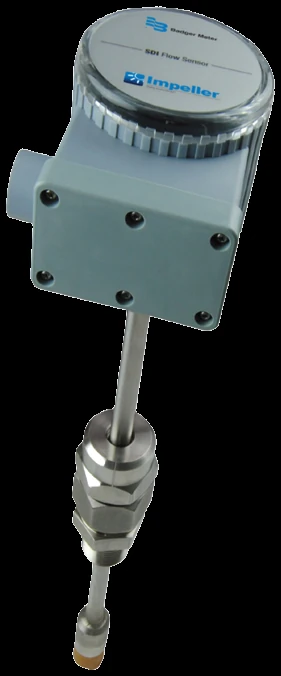
The SDI Series is the Impeller line’s preferred insertion meter — a lead-free, certified-potable-water sensor that taps a single 1 in. point to meter pipe from 1½ to 60 in. Its four-bladed, non-fouling impeller and patented digital detection circuit hold ±1% of rate with ±0.5% repeatability whatever the conductivity or turbidity of the liquid. The stainless build is NSF/ANSI/CAN 61 and 372 certified for drinking water; a brass build covers general service at lower cost. The stainless version is the configurable one: order it direct-insert or hot-tap, single-direction or bidirectional (4–20 mA plus a flow-direction contact); the brass version is direct-insert and single-direction. Both offer an on-board LCD, or a battery build that drives a local or remote display at sites without power. The raw square-wave frequency carries 2000 ft without amplification, and every meter is factory-calibrated — the powered versions then field-program to your pipe size and units with the USB kit.
Key Features & Benefits
- Lead-free, certified for potable water — the stainless SDI is NSF/ANSI/CAN 61 and 372 certified and meets the Safe Drinking Water Act lead-free rule — the insertion meter for drinking-water service
- One tap covers 1-1/2 to 60 in. — three stem lengths in direct-insert and hot-tap versions meter pipe from 1-1/2 to 60 in. through a single 1 in. tap, with no full-bore body or spool piece
- Reads any liquid, clean and economical — the SDI senses a spinning rotor rather than the fluid itself, so it holds ±1% of rate on conductive or non-conductive, clear or turbid water alike — no minimum conductivity and no custom calibration needed
- Direct-insert or hot-tap on the stainless build — order the stainless SDI for a drained line, or as the hot-tap version that inserts and removes through an isolation valve on a live main without shutting it down
- Bidirectional, display and battery options — the stainless version adds bidirectional flow (4–20 mA plus a direction contact); both builds offer an on-board LCD, and a C-cell battery build reads out on a local or wall-mounted remote LCD where no line power runs
- Signal travels 2000 ft — the raw square-wave frequency carries up to 2000 ft without amplification to a transmitter, display or PLC
Specifications
- Measurement principle
- Single-point insertion impeller (paddle-wheel) — a four-bladed stainless-steel impeller set in the stream through a 1 in. tap turns at a speed proportional to velocity; a proprietary patented digital detection circuit reads it regardless of the conductivity or turbidity of the liquid (unidirectional versions use non-magnetic detection, bidirectional versions magnetic detection)
- Service / fluids
- General clean-liquid flow in closed pipe; the stainless version is lead-free and certified for potable / drinking water
- Accuracy
- ±1% of rate over the optimum flow range, installed with the correct straight run and insertion depth
- Repeatability
- ±0.5%
- Flow range
- Optimum design range 1 to 20 ft/sec (0.30 to 6 m/sec); extended detection below 0.5 to 20 ft/sec
- Pipe sizes
- 1½ to 60 in. (38 mm and up) in three stem lengths, direct-insert or hot-tap; tap or saddle size sets the largest pipe (consult factory above the rated stem)
- Insertion / installation
- Direct-insert through a 1 in. tap with the line drained; the stainless version is also available as a hot-tap build that installs and removes under pressure through an isolation valve (the small stem inserts by hand without a tool). Install with at least 10 pipe diameters of straight run upstream and 5 downstream
- Wetted materials
- 316 stainless steel stem, mounting adapter and nipple — plus the isolation valve on the hot-tap build — on the stainless version, or brass (B16, UNS C36000) stem, adapter and nipple on the brass version; PPS or PEEK sensor tip; o-ring, shaft, impeller and bearing per the ordering matrix (tungsten-carbide shaft and stainless impeller standard, Torlon bearing; Ketron bearing optional on brass)
- O-rings / seals
- Viton or EPDM o-rings; AFLAS also available on the brass version
- Process / fluid temperature
- Maximum fluid temperature follows the pressure rating — rated to 180°F (82°C); electronics operate 14 to 150°F (−10 to 65°C), LCD −4 to 150°F (−20 to 65°C)
- Pressure rating
- Stainless (non-shock) 1,000 psi at 70°F, 900 psi at 100°F, 670 psi at 140°F, 225 psi at 180°F; brass 600 psi up to 140°F, 225 psi at 180°F
- Tap / mounting connection
- 1 in. NPT tap, wet or dry installation
- Signal / outputs
- Standard frequency (raw pulse), or a powered output — 4–20 mA analog or scaled pulse; the stainless version adds bidirectional 4–20 mA with a flow-direction contact, or bidirectional scaled pulse
- Signal transmission
- Low-impedance square-wave frequency travels up to 2000 ft (610 m) without amplification
- Enclosure
- NEMA 4X (line-powered versions); NEMA 6P (battery version); remote display NEMA 4X
- Display
- Optional integral 8-character STN LCD — rate, total or both, plus flow direction on bidirectional units; for the battery version a remote wall-mount LCD up to 50 ft (15 m) away is available
- Power
- Line / loop powered (8–35V DC raw pulse; 12–30V AC or 12–35V DC scaled pulse; 8–25V DC analog loop), or a C-size lithium battery with a five-year life on the battery version
- Certifications
- Stainless version certified to NSF/ANSI/CAN Standards 61 and 372 and compliant with the lead-free provisions of the Safe Drinking Water Act; the brass version is the economical, non-certified build
- Options
- PEEK tip (stainless); hot-tap build (stainless); bidirectional flow (stainless); integral or remote LCD; battery power; Viton, EPDM or (brass) AFLAS seals
- Calibration
- Factory-calibrated — the four-bladed impeller needs no custom calibration; the powered and bidirectional versions are field-programmable for pipe size, flow scale and units with the USB programming kit
Common Applications
- Potable and drinking-water metering and distribution (NSF 61/372 stainless version)
- Process- and city-water flow on large mains (1-1/2 to 60 in.) through a single tap
- Building chilled- and hot-water, cooling-tower and condenser-loop flow
- Bidirectional flow on loops and interties — 4–20 mA plus a direction contact
- Battery-powered metering, with a local or remote readout where no power is run
Design & Selection Considerations
- Set the insertion depth and give the meter straight run — an impeller meter reads the velocity at a single point in the profile, so it reads true only at the correct insertion depth and with developed flow: the rule is at least 10 pipe diameters of straight run upstream and 5 downstream of any elbow, valve, pump or transition. The positioning hardware sets the standard depth; more straight run is better after two close elbows or a pump. Use the input form to send us the pipe run and we’ll confirm the meter will see a clean velocity profile where you want to tap it.
- Match the wetted stack to the fluid — and to the pressure — the body sets the duty: brass / bronze for water, condenser and cooling-tower service, 316 stainless for aggressive or higher-purity water, and all-plastic PVC for corrosive lines. Within the sensor the o-ring (Viton, EPDM, Buna-N or AFLAS), shaft (tungsten carbide standard, with zirconia or 316 stainless on the models that offer them) and impeller / bearing are configurable, and the pressure rating follows the body alloy and temperature. Use the input form to give us the fluid, the working pressure and the peak temperature together — they set the alloy and the full wetted stack.
- Keep the fluid clean and the pipe full — the impeller is a moving rotor, so grit, debris and heavy solids are the wear enemy and a partially full pipe under-reads. These impeller sensors tolerate the fine rust particles found in steel and iron pipe, but a strainer upstream of the meter still pays off on debris-prone water. Use the input form to tell us the water quality — if it carries solids we’ll recommend the filtration that protects the bearing.
- Decide direct-insert vs. hot-tap for installation and service — a standard insertion meter needs the line out of service and drained to install or pull the sensor; on a main that cannot be shut down, the Hot-Tap 225 / 226 (and the SDI hot-tap) install and remove under pressure through an isolation valve — spec the ball-valve 226 for a true live hot tap. Use the input form to tell us whether the line can be drained and we’ll point you at the direct-insert or the hot-tap build.
- Pick the electronics for the signal you need — the Series 200 sensor is a two-wire raw-pulse device that pairs with a 300-series transmitter (4–20 mA, scaled pulse or relay) or an FC-5000 display; the SDI instead carries its own powered analog, scaled-pulse, display and battery options on board. Use the input form to tell us whether the reading goes to a local display, a PLC loop or a building network and we’ll match the electronics.
To size & select the right SDI Series:
Use the input form to send your pipe size and material, the fluid with its temperature and pressure, and the flow range — with whether you need a local display, an analog or pulse output, or a Modbus / BACnet signal — and we’ll spec the insertion style or tee, the wetted materials and the electronics.
Flow Meter Application Sheet ›Talk to an engineer directly — Scott Prater, Principal · 917-580-0878 · scott@pratertechnical.com
Specifications compiled by Prater Technical Partners from Badger Meter Data Industrial impeller flow-sensor product literature.