Product Overview
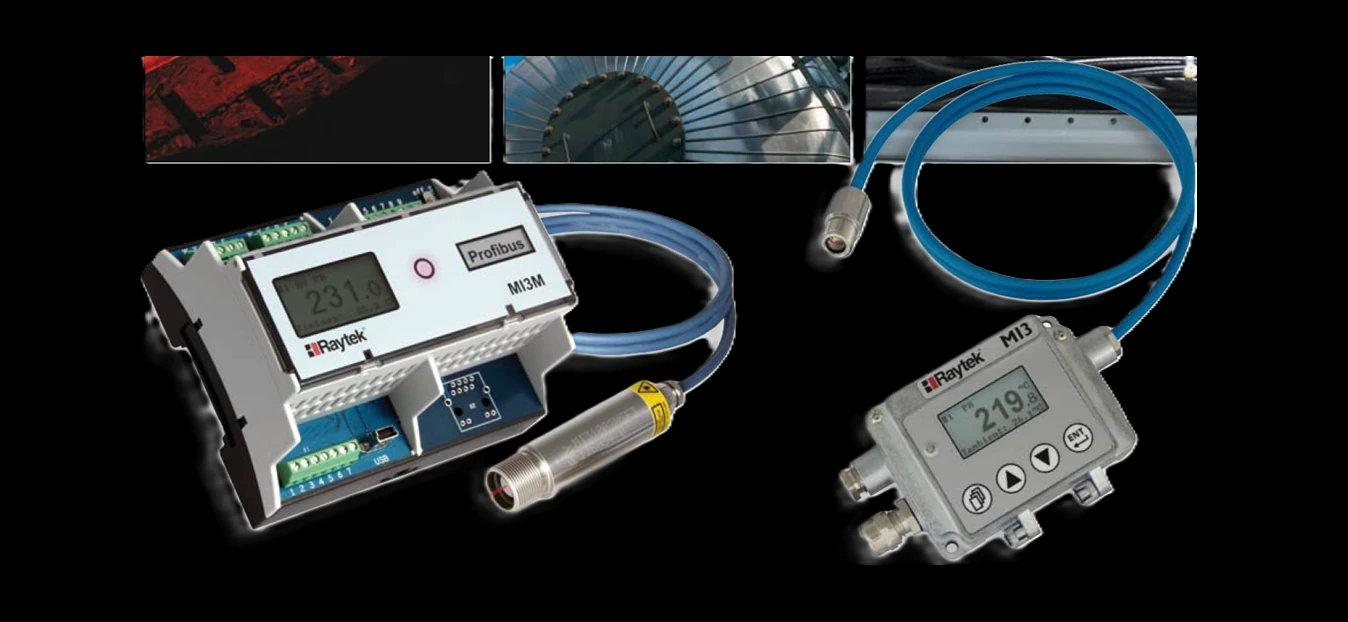
The Raytek Mi3 is a two-piece modular IR sensor: a miniature single-color sensing head on a 1 m cable plugs into a separate communication box that the head is auto-detected by (plug & play), and one 4-channel box networks up to eight heads. The same head model spans several spectral ranges — LT (8–14 µm), G5 (5 µm glass), and the 2M / 1M short-wave metals heads — so a single platform covers organics, glass, and high-temperature metal by head choice. Heads are tiny (down to a 0.5 mm spot with the Close Focus Lens) and tolerate up to 180°C uncooled, which is what makes the Mi3 the OEM and multi-point embedding sensor in the compact line. It is sold through authorized distribution — nationwide, with unit pricing on our webstore and select SKUs stocked at Brooklyn.
Key Features & Benefits
- Separate the head from the electronics — the small sensing head goes where the heat and the tight space are, on a rugged cable, while the comm box with the display and outputs mounts somewhere cooler and accessible. The form factor for embedding a sensor in a machine or a hot, cramped spot.
- One box, up to eight heads, plug & play — a 4-channel modular box auto-detects each head and supports up to eight on one networked enclosure, so a multi-zone or multi-point install wires back to a single box instead of one transmitter per point. Cuts the panel count on a multi-point measurement.
- One head model, many wavelengths — the same Mi3 platform is offered in 8–14 µm, 5 µm glass, and 1.6 / 1 µm metals heads, so you standardize on one sensor family across very different targets. Match the head to the material without changing platforms.
- Runs hot without cooling — the high-ambient LTH head holds up to 180°C uncooled, and air or water cooling extends the envelope further — so the sensor survives near the process before you reach for a cooling jacket. Fewer accessories to keep a small sensor alive on a hot line.
- Pick the box to fit the network — the comm box carries the analog, thermocouple, relay, and fieldbus outputs, so USB, RS485/Modbus/Profibus, or Profinet/Ethernet is a box choice rather than a sensor change. The interface is configured at the box, not baked into the head.
Specifications
- Form factor
- Two-piece modular sensor — a miniature infrared sensing head on a 1 m (3.3 ft) cable plus a separate communication box; the two are ordered as separate items. The box detects the head automatically (plug & play), and a 4-channel modular box supports up to 8 sensing heads on one box, so a multi-point install runs from a single networked enclosure.
- Measurement principle
- Single-color (1-color) non-contact infrared pyrometer. The same head model covers multiple spectral ranges, so one platform serves low-temperature organics, glass, and high-temperature metals by head selection.
- Models / spectral variants
- LT (8–14 µm general purpose, in LTS standard, LTF fast, and LTH high-ambient heads), G5 (5 µm, dedicated glass), 2M (1.6 µm, metals), and 1M (1 µm, high-temperature metals). The LT head reaches 1000°C in the LTS20 (22:1), LTF, and LTH20 variants.
- Temperature range
- LTS02 / LTS10 / LTH10: −40 to 600°C (−40 to 1112°F)
LTS20 / LTF / LTH20: 0 to 1000°C (32 to 1832°F)
G5: 250 to 1650°C (482 to 3002°F)
2M: 250 to 1400°C (482 to 2552°F)
1M: 500 to 1800°C (932 to 3272°F) - Spectral response (wavelength)
- LT 8–14 µm · G5 5 µm · 2M 1.6 µm · 1M 1 µm — match the head wavelength to the target material.
- Optical resolution (D:S)
- At 90% energy: LTS 2:1, 10:1, or 22:1 typ. (21:1 guaranteed) · LTH 10:1, 22:1 typ. · LTF 10:1 · G5 10:1 · 1M / 2M 100:1. A Close Focus Lens (LT, G5) reads spots down to 0.5 mm (0.02 in).
- Accuracy
- LT, G5: ±(1% of reading or 1°C), whichever is greater (±2°C below 20°C target)
1M, 2M: ±(0.5% of reading + 2°C). At 23°C ±5°C ambient, ε = 1.0, and calibration geometry. - Repeatability
- LT, G5: ±0.5% of reading or ±0.5°C
1M, 2M: ±(0.25% of reading + 1°C). - Response time
- LTS (standard), LTH, G5: 130 ms (90% value)
LTF (fast): 20 ms
1M, 2M: 10 ms. - Emissivity / transmissivity
- Emissivity ε adjustable 0.100 to 1.100; transmission 0.100 to 1.000. Set per material (or use the published emissivity table).
- Signal processing
- Peak hold, valley hold (adjustable up to 998 s), and a variable averaging (flicker) filter on the box; user-configurable inputs allow remote emissivity, background-radiation compensation, and trigger/hold or laser switching.
- Outputs
- Box-dependent: 4–20 mA, 0–20 mA, 0–5 V, or 0–10 V analog; J / K / R / S thermocouple emulation; a 0–5 V head-ambient signal; and an isolated solid-state alarm relay (48 V / 300 mA). The DIN-6TE analog box provides 4 galvanically isolated analog channels.
- Communications
- USB 2.0 standard on every box; optional RS485 (ASCII), Profibus DP-V0, Modbus RTU, Profinet IO, and Ethernet TCP/IP (with HTTP server and a 64 MB data logger), depending on box model.
- Display & user interface
- Metal box (MI3COMM) and the user-interface DIN-rail boxes carry a high-resolution LCD display and button interface; a no-interface DIN box (MI3MCOMMN) is available for purely remote installs.
- Sighting / aiming
- Laser sighting on the 1M and 2M heads (automatic switch-off at 65°C ambient).
- Ambient temperature / cooling
- Head ambient (uncooled): LT / G5 −10 to 120°C, LTH to 180°C, 1M / 2M 0 to 120°C. An air-cooling jacket (LT, G5) extends the head to 200°C (392°F); a water-cooled housing is available for the 1M / 2M heads. The communication box is rated −10 to 65°C.
- Environmental & IP rating
- Head and metal box IP65 (NEMA-4); EMC per EN 61326-1. Rugged PUR head cable, silicone- and halogen-free, resistant to oil, bases, and acids.
- Housing & mounting
- Threaded miniature head with mounting nut; adjustable / fixed brackets, air-purge collar, and protective window are stock accessories. The box is a die-cast-zinc metal enclosure (MI3COMM) or a DIN-rail mountable plastic box (3TE / 4TE / 6TE widths).
- Power
- Communication box: 8 to 32 VDC, 5 W.
- Software
- DataTemp Multidrop PC software for remote monitoring, configuration, and data logging across a network of boxes.
- Hazardous-area option
- Intrinsically safe sensing heads (MI3…IS) rated II 2G Ex ib IIC T4 Gb (gas) / II 2D Ex ib IIIC T135°C Db (dust), with a dedicated Ex power supply (MI3ACIS). Specify the area classification with the order.
- Ordering & stock
- Authorized Raytek distribution — sold nationwide with unit pricing published on our webstore and shipped from the Brooklyn warehouse; select Mi3 SKUs are stocked for same / next-day shipment while others are special order. The head and the comm box are ordered separately; longer head cables (3, 8, 15, 30 m) are specified at order.
Common Applications
- Embedding a non-contact sensor inside OEM machinery where space and heat rule out a transmitter
- Multi-point or multi-zone monitoring run back to one 8-head networked box
- Glass surface temperature with the dedicated 5 µm G5 head
- Induction-heated and high-temperature metal targets with the 1M / 2M short-wave heads
- Small-target measurement (down to 0.5 mm) with the Close Focus Lens
- Hazardous-area points using the intrinsically safe MI3…IS heads
Design & Selection Considerations
- Order the head and the box as two line items — an Mi3 system is one sensing head plus one communication box, ordered separately — the head sets the wavelength, temperature range, and optics; the box sets the outputs and fieldbus. Decide both before you order. A head with no box (or the wrong box) does not measure.
- Choose the spectral head by the target, not by habit — an 8–14 µm LT head reads organics and painted surfaces; glass wants the 5 µm G5; hot metal wants the 1M / 2M short-wave head. The wrong wavelength reads the wrong layer no matter how you set emissivity. Wavelength is the first decision, before optics or output.
- Size the optics so the spot fits the target — a single-color sensor averages in whatever surrounds an underfilled spot, so the measured spot at the working distance must sit fully within the target — the Close Focus Lens reaches 0.5 mm for small targets, and the 1M / 2M heads run 100:1 for long standoffs. Confirm the spot size at your actual mounting distance.
- Keep the head in its ambient band, then cool — a head past its rated ambient drifts and ages; use the high-ambient LTH head, an air-cooling jacket (to 200°C on LT / G5), or a water-cooled housing on the 1M / 2M before the install sees more heat than the head is rated for. Cooling is cheaper than a cooked sensor.
- Match the comm box to the control system up front — analog 4–20 mA, thermocouple emulation, Modbus, Profibus, Profinet, or Ethernet are box options — pick the box that speaks to your PLC or DCS, and the DIN-6TE analog box if you need four isolated analog channels. The box, not the head, decides how the data leaves the sensor.
To spec the right Raytek Mi3 sensor:
To spec the right sensor, have ready: the target material and its emissivity (or whether it is a bare / oxidized metal), the process temperature range, the wavelength / spectral fit for that material, the working distance and target size (which set the optics / D:S and the spot size at distance), whether a fixed or handheld instrument suits, the mounting and ambient conditions (and any cooling or air-purge need), and the required output and communications. The more complete the application data, the faster and tighter the configuration.
IR Pyrometer Application Sheet ›Talk to an engineer directly — Scott Prater, Principal · 917-580-0878 · scott@pratertechnical.com
Specifications compiled by Prater Technical Partners from Fluke Process Instruments product datasheets.