Product Overview
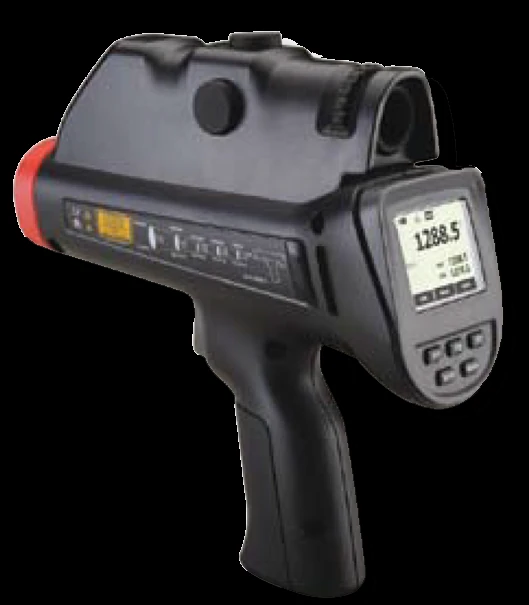
The Raytek Raynger 3i Plus is a portable handheld single-color pyrometer for the hot end of the plant — a high-temperature spot-check and fault-preview tool rather than a fixed control sensor. The 1M (1.0 µm) and 2M (1.6 µm) models cover 400 to 3000°C, and a 250:1 distance-to-spot ratio reads small red-hot targets from a safe standoff. Dual-laser targeting, a scope “Red Dot” option for targets too bright to see a laser on, and a “Red Nose” over-temperature alarm keep the operator safe near molten metal and furnaces. It is drop-rated to 1 m, runs 24 hours on a charge, and transfers data over USB or Bluetooth to a PC or the mobile app. Sold through authorized distribution — nationwide, with unit pricing on our webstore.
Key Features & Benefits
- A safe-standoff tool for the hot end — a 250:1 distance-to-spot ratio and a 400–3000°C range let an operator read molten metal, a furnace, or a red-hot billet from a distance instead of up close. Built for the spot-checks you do not want to do with your hand near the heat.
- Aim it even when the target is too bright to see a laser — dual lasers bracket the spot on a normal target, while the scope “Red Dot” option marks the aim point inside the optics when a glowing, red-hot target washes a laser out. You can still aim at a glowing target.
- Warns you before it cooks itself — the heat-resistant “Red Nose” senses the instrument’s own temperature and alarms before the sensor overheats near a hot process — protecting the operator and the tool. An over-temperature alarm built into the nose.
- A full shift on one charge, drop-rated — 24-hour rechargeable battery life and a 1 m drop rating suit a tool that lives in a pocket and gets dropped on a plant floor. Rugged and long-running for field use.
- Capture, trend, and email the reading on site — MAX/MIN/DIF/AVG functions and 4,900-point logging on the instrument, plus USB / Bluetooth to DataTemp PC software or the smartphone app, let you record and share a reading without going back to a desk. The data leaves the tool the moment you take it.
Specifications
- Form factor
- Portable handheld infrared thermometer — an ergonomic comfort-grip gun with a backlit LCD, locking trigger, and tripod mount, for field spot-checks and process fault previewing rather than a fixed control point.
- Measurement principle
- Single-color (1-color) short-wavelength non-contact pyrometer for high-temperature targets.
- Models / spectral variants
- 1M — 1.0 µm, 700 to 3000°C (1292 to 5432°F)
2M — 1.6 µm, 400 to 2000°C (752 to 3632°F). - Temperature range
- 400 to 3000°C (752 to 5432°F) across the 1M and 2M models — a high-temperature instrument for molten and red-hot metal, furnaces, and ceramics.
- Spectral response (wavelength)
- 1M: 1.0 µm · 2M: 1.6 µm — short wavelengths that minimize the temperature error from emissivity uncertainty on hot metals.
- Optical resolution (D:S)
- D:S 250:1 — a high distance-to-spot ratio that reads small high-temperature targets from a safe standoff (e.g. a 50 mm spot at 8 m).
- Accuracy
- ±(0.5% of reading + 1°C) below 2700°C (4892°F), at calibration conditions.
- Repeatability
- ±(0.3% of reading ± 1°C).
- Response time
- 40 ms exposure time — fast capture for moving or transient high-temperature targets.
- Emissivity / transmissivity
- Emissivity adjustable 0.10 to 1.00, with reflected-energy (background) compensation.
- Signal processing
- MAX, MIN, DIF (differential), and AVG temperature functions; audible alarms on target temperature, ambient temperature, and low battery; up to 4,900 data points of on-board logging.
- Outputs
- USB 2.0, with optional Bluetooth 4.0 (Bluetooth and USB are standard on USA / Canada units) for transfer to a PC or the smartphone app.
- Display & user interface
- Backlit LCD with value and trend; °C or °F selectable; 0.1°C display resolution below 1000°C; intuitive on-instrument interface for parameter setup and on-site trending.
- Sighting / aiming
- Dual-laser targeting (the spot is bracketed by two laser points); a scope “Red Dot” sighting option highlights the measured area when the target is too bright / red-hot to see a laser; a “Red Nose” heat-resistant nose detects and alarms on the instrument’s own over-temperature for operator safety.
- Ambient temperature / cooling
- Operating 0 to 50°C (32 to 120°F); storage −20 to 60°C (without batteries); 10 to 90% RH non-condensing at 30°C.
- Housing & mounting
- Rugged design rated to a 1 m (3.2 ft) drop; tripod mountable; locking trigger. Laser models 218×172×74 mm / 700 g; scope models 218×222×74 mm / 950 g.
- Power
- Single-cell lithium-ion 3.6 V, 2500 mAh (rechargeable) or via USB 2.0; 24-hour battery life. Ships with a multi-country charger and spare battery.
- Software
- DataTemp Windows PC software for real-time communication, data storage, graphing, and analysis; a mobile app captures and emails the temperature report on site.
- Ordering & stock
- Authorized Raytek distribution — sold nationwide with unit pricing published on our webstore and shipped from the Brooklyn warehouse. Choose the 1M or 2M model by temperature range, and the laser or scope (Red Dot) sighting variant by whether the target is visibly red-hot.
Common Applications
- Iron, steel, and metal-refining spot-checks and surveys
- Foundry and processing-operation temperature verification
- Ceramics and semiconductor process spot measurement
- Chemical and petrochemical furnace temperature previewing
- Field verification of a fixed pyrometer’s reading
- Safe-standoff reading of molten or red-hot targets with the Red Dot scope
Design & Selection Considerations
- Pick 1M or 2M by the temperature you measure — the 2M (1.6 µm) covers 400–2000°C and the 1M (1.0 µm) 700–3000°C — a hotter process wants the 1M, and the shorter wavelength further reduces emissivity error on metal. Match the model to your hot end, not the other way round.
- Choose laser or scope (Red Dot) sighting by the target — dual-laser sighting is fine on a normal target, but a red-hot glowing target washes a laser out — for those, the scope “Red Dot” variant is the one that lets you aim. If the target glows, order the scope model.
- It is a spot-check tool, not a fixed control sensor — the 3i Plus is a handheld for surveys, fault previews, and verification; a continuous control point wants a fixed Endurance, Thermalert, Mi3, or CM / CI sensor wired to the control system. Use the handheld to check, a fixed sensor to control.
- Mind the spot size at distance even at 250:1 — a high D:S still grows the spot with distance — for a small red-hot target read from far away, confirm the spot at that range fits the target, or the reading averages the surroundings. High D:S buys standoff, not an infinitely small spot.
- Set emissivity and use background compensation on bare metal — short-wave helps, but a bare or oxidized metal surface still needs the emissivity set and, where a hotter surround reflects in, the reflected-energy compensation enabled. The defaults are a starting point, not an answer, on metal.
To spec the right Raynger 3i Plus handheld:
To spec the right sensor, have ready: the target material and its emissivity (or whether it is a bare / oxidized metal), the process temperature range, the wavelength / spectral fit for that material, the working distance and target size (which set the optics / D:S and the spot size at distance), whether a fixed or handheld instrument suits, the mounting and ambient conditions (and any cooling or air-purge need), and the required output and communications. The more complete the application data, the faster and tighter the configuration.
IR Pyrometer Application Sheet ›Talk to an engineer directly — Scott Prater, Principal · 917-580-0878 · scott@pratertechnical.com
Specifications compiled by Prater Technical Partners from Fluke Process Instruments product datasheets.