Product Overview
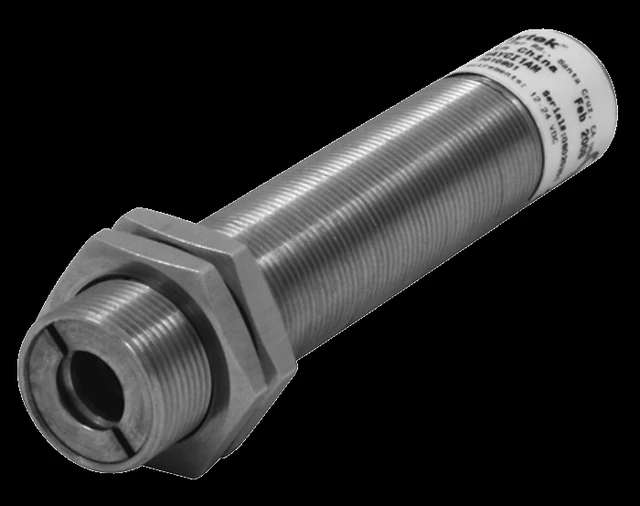
The Raytek CM and CI are embedded OEM infrared sensors — one compact stainless-steel threaded body with the optics and electronics integrated, no separate box, built to drop into a machine or straight into a contact-probe socket. Both give a thermocouple (J or K) or a scaled-voltage output, so they replace a touching probe on a moving, energized, or hard-to-reach surface. The CM is the higher-performance choice: −20 to 500°C, 13:1 optics, adjustable emissivity, RS232 setup, and self-diagnostics. The CI is the low-cost companion: fixed 0.95 emissivity, 4:1 optics, and a 50-ohm output that drops into thermocouple-break-protected controllers cleanly. Both are sold through authorized distribution — nationwide, with unit pricing on our webstore.
Key Features & Benefits
- One body, no box — built to embed — everything lives in one small stainless threaded housing, so the sensor screws into a machine, a fixture, or an old contact-probe boss and reports temperature straight out, with no enclosure to find room for. The simplest way to put a non-contact reading where a touching probe used to be.
- Drops in as a thermocouple replacement — the J / K thermocouple output (and the CI’s 50-ohm thermocouple-matched impedance) lets these sensors feed the same controller input a probe did, without offset error or a new transmitter. Re-use the existing controller channel.
- Pick performance or price — CM or CI — the CM brings the wider range, tighter optics, adjustable emissivity, and RS232 diagnostics; the CI strips cost out for high-volume OEM use where 0.95 emissivity and 4:1 optics are enough. Two tiers off one OEM-sensor platform.
- Rugged for the plant floor — an IP65 stainless housing qualified to MIL-STD-810D shock (50 g) and vibration (3 g) survives machinery vibration and washdown without a cooling jacket up to 70°C. Built to live inside running equipment.
- Cool it to push the ambient envelope (CI) — the CI takes an air-cooling jacket to 90°C or a water-cooled jacket to 260°C, so a low-cost sensor can still sit close to a hot process. A cooling jacket buys a lot of ambient headroom on the CI.
Specifications
- Form factor
- Single-piece embedded OEM sensor — the optics and electronics are integrated in one compact stainless-steel threaded body on a 1 m cable, with no separate box. Both the CM and the CI are built to drop into a machine or a contact-probe socket and report temperature directly.
- Measurement principle
- Single-color (1-color) non-contact infrared sensor. Designed to replace a contact thermocouple probe with a thermocouple or scaled-voltage output.
- Models / spectral variants
- CM — the higher-performance OEM sensor: wider range, 13:1 optics, adjustable emissivity, and RS232 setup. CI — the low-cost companion: fixed 0.95 emissivity, 4:1 optics, two temperature-range models (CI…A / CI…B).
- Temperature range
- CM: −20 to 500°C (−4 to 932°F)
CI: 0 to 500°C (32 to 932°F) across the A and B range models (CI…A optimized 0–115°C, CI…B 100–500°C). - Spectral response (wavelength)
- CM: 8 to 14 µm · CI: 7 to 18 µm — longwave bands for general-purpose surfaces (plastics, paper, painted and organic targets) below ~500°C.
- Optical resolution (D:S)
- At 90% energy: CM 13:1 at the focal point (9:1 far field); CI 4:1. Choose the working distance so the measured spot stays within the target.
- Accuracy
- CM (voltage / RS232): ±1.5% of reading or ±2°C, whichever is greater (±3.5°C below 0°C); the thermocouple output adds a ±4°C floor.
CI: larger of ±2% or ±3°C over its rated band. At 23°C ±5°C ambient, ε = 0.95, and calibration geometry. - Repeatability
- CM: ±0.5% of reading or ±2°C (voltage / digital), whichever is greater
CI: ±1% of measured value or ±1°C, whichever is greater. - Response time
- CM: 150 ms (95%) · CI: 350 ms (95%).
- Emissivity / transmissivity
- CM: emissivity 0.10 to 1.10 and transmissivity 0.10 to 1.00, both adjustable over RS232
CI: emissivity fixed at 0.95 (no field adjustment). - Signal processing
- CM: peak hold, valley hold, and variable averaging, configured over RS232; self-diagnostic sensor-status reporting (normal, alarm, out of range, unstable, sensor fault). The CI carries no on-board signal processing.
- Outputs
- CM: model-specific Type J or Type K thermocouple, or a user-scalable 0–5 V output; a 24 VDC alarm output (shares a wire with the digital line).
CI: user-selectable Type J or Type K thermocouple, or 10 mV/°C voltage output. The CI’s 50-ohm output impedance matches a thermocouple, so it works with thermocouple-break protection in most controllers without offset error. - Communications
- CM: two-way RS232 for setup and monitoring (shares a wire with the alarm output; the user selects alarm or RS232). The CI has no digital comms.
- Sighting / aiming
- Bore-sight (no laser); CM bore-sight tolerance 3° at the focal point. A right-angle mirror accessory eases sighting into tight locations.
- Ambient temperature / cooling
- CM: −10 to 70°C (14 to 160°F) uncooled.
CI: 0 to 70°C uncooled; 0 to 90°C with air cooling; 0 to 260°C (500°F) with the water-cooled jacket. An air-purge jacket keeps the lens clean on either sensor. - Environmental & IP rating
- Both IP65 (NEMA-4) stainless-steel housing. Qualified to IEC 68-2-27 / MIL-STD-810D — shock 50 g (11 ms, any axis) and vibration 3 g (11–200 Hz, any axis); 10–95% RH non-condensing.
- Housing & mounting
- Threaded stainless body (standard 0.75-16 UNF; metric 18 M×1 option) with two mounting nuts and 1 m cable (3 m optional; CI to 15 m). Adjustable / fixed brackets, right-angle mirror, air-purge jacket, and protective window are stock accessories. CM weight <200 g; CI ~130 g.
- Power
- CM: 24 VDC ±20% @ 20 mA
CI: 12–24 VDC @ 20 mA. - Software
- CM: DataTemp Multidrop PC software (included) over RS232 for configuration and monitoring. The CI is configured by output/model selection at order — no software.
- Ordering & stock
- Authorized Raytek distribution — sold nationwide with unit pricing published on our webstore and shipped from the Brooklyn warehouse. The output type (J / K / voltage), temperature range (CI), thread, and cable length are selected by model number at order.
Common Applications
- Replacing a contact thermocouple probe on a moving or hard-to-reach surface
- Embedding a low-cost non-contact reading in high-volume OEM machinery (CI)
- General-purpose low-temperature surface measurement on non-metallic and coated process targets
- Feeding an existing controller’s thermocouple input without a separate transmitter
- Close-coupled measurement in tight machine spaces using the right-angle mirror
- Hot-ambient mounting using the CI water-cooled jacket (to 260°C)
Design & Selection Considerations
- CM for adjustable emissivity; CI only when 0.95 is correct — the CI’s emissivity is fixed at 0.95, which is fine for many organic and painted surfaces but wrong for bare or oxidized metal — if the target is not near 0.95, choose the CM and set emissivity over RS232. A fixed-emissivity sensor on a low-emissivity metal reads far low.
- Confirm the spot at the mounting distance — the CM is 13:1 and the CI 4:1, so the measured spot grows quickly with distance — a single-color sensor averages whatever surrounds an underfilled spot, so mount close enough that the target fills it. Modest optics mean mount close.
- Pick the output that the controller expects — J or K thermocouple emulation re-uses a probe input directly; the scaled-voltage output resists electrical noise on long runs. Decide which the controller and the cable run call for before ordering the model. The output is set by model number, not in the field.
- Plan cooling for a hot ambient (CI) — past 70°C the CI needs an air (90°C) or water (260°C) jacket; the CM has no cooled-housing option, so a very hot mounting location points to the CI with cooling or to a different head in the line. Read the ambient at the actual mounting point, then size cooling.
- Keep the lens clean with an air purge — these are general-purpose longwave sensors whose optics are the vulnerable part; an air-purge jacket and, in tight spots, a right-angle mirror keep dust and overspray off the lens. A filmed lens reads low long before the sensor fails.
To spec the right Raytek CM or CI OEM sensor:
To spec the right sensor, have ready: the target material and its emissivity (or whether it is a bare / oxidized metal), the process temperature range, the wavelength / spectral fit for that material, the working distance and target size (which set the optics / D:S and the spot size at distance), whether a fixed or handheld instrument suits, the mounting and ambient conditions (and any cooling or air-purge need), and the required output and communications. The more complete the application data, the faster and tighter the configuration.
IR Pyrometer Application Sheet ›Talk to an engineer directly — Scott Prater, Principal · 917-580-0878 · scott@pratertechnical.com
Specifications compiled by Prater Technical Partners from Fluke Process Instruments product datasheets.