Product Overview
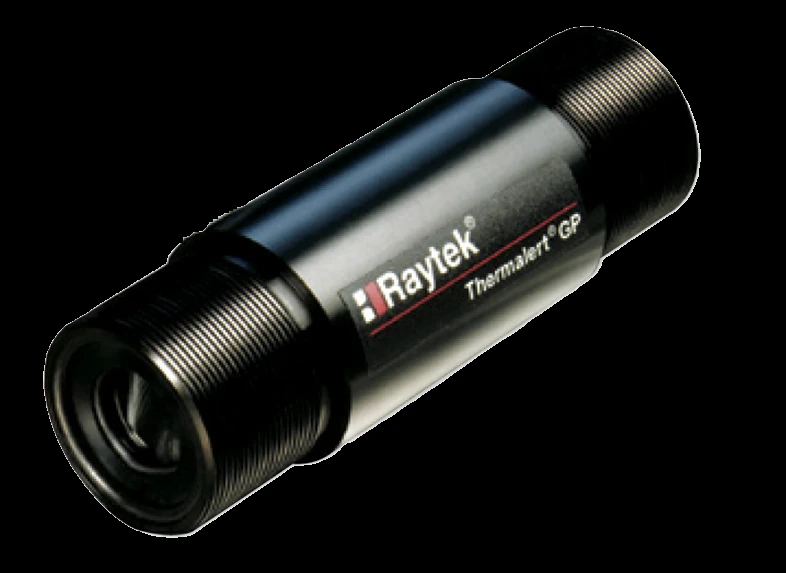
The GP Series is Raytek’s compact, value-priced infrared spot sensing head — the measuring half of a two-piece system that pairs with the GP Monitor display. The GPR (35:1 optics) and laser-sighted GPS (50:1) heads read a single target point in the general-purpose 8–14 µm band from −18°C to 538°C with 1% accuracy, in a rugged threaded IP65/NEMA-4 body qualified to MIL-STD-810 shock and vibration. Field-interchangeable heads, standard or close-focus optics, and air-purge and air/water cooling (to 177°C ambient) make it a durable, economical fixed spot sensor for a single control point. It is a sensor, not a display — order it with a GP Monitor, or run it into a compatible monitor you already have.
Key Features & Benefits
- A rugged, low-cost spot sensor for a single control point — the GPR / GPS head reads one target point with 1% accuracy and a current-loop output, in a compact threaded body built for the plant floor — the measuring half of a value-priced two-piece system. The economical answer when you need a reliable fixed reading at one place on a machine or line.
- Field-interchangeable heads, standard or close focus — GPR (35:1) and GPS (50:1) heads swap in the field, and close-focus optics resolve a 3–4.5 mm spot up close — so the optics follow the target without re-engineering the install. Re-aim or re-optic a station by changing the head, not the system.
- Laser sighting on the GPS for fast, sure aim — the GPS head’s built-in laser puts the spot exactly on the target during setup, which matters most on small or distant targets where a mis-aim reads the wrong thing. Aim it once, correctly, and walk away.
- Survives heat and vibration commercial sensors will not — an IP65/NEMA-4 head qualified to MIL-STD-810 shock and vibration, with air-purge and air/water cooling options to 177°C ambient, holds up in the conditions the GP head is meant for. An industrial fixture, cooled and purged into a hot, dirty mount.
Specifications
- Instrument type
- Compact infrared spot sensing head — a small, value-priced fixed sensor that reads the temperature of a single target point and outputs a current-loop signal. Paired with the GP Monitor display (a separate item), the two form a two-piece monitoring system; the GP head is the measuring part.
- Measurement principle
- Single-color (one-wavelength) 8–14 µm.
- Temperature range
- −18°C to 538°C (0°F to 1000°F) (GPR / GPS heads).
- Spectral response / wavelength
- 8–14 µm — the general-purpose longwave band for opaque, low-to-medium-temperature surfaces (plastics, paint, organics, most solids).
- Models & spectral variants
- GPR — standard or close-focus sensing head, 35:1 optics. GPS — laser-sighted head, 50:1 optics (standard focus). Heads are field-interchangeable; the GPR head is a Thermalert-class sensor.
- Optical resolution (D:S)
- GPR 35:1 standard focus (close-focus to a 3 mm spot at 76 mm); GPS 50:1 standard focus (close-focus to a 4.5 mm spot at 200 mm), at 90% energy.
- Emissivity adjustment
- 0.1 to 1.0, digitally adjustable in 0.01 increments, with fixed-background ambient-temperature (T-ambient) compensation — set at the GP Monitor.
- Accuracy
- ±1% of reading or ±1°C (2°F), whichever is greater (mA output, at 23°C ±5°C).
- Repeatability
- ±0.5% of reading or ±1°C (2°F), whichever is greater.
- Response time
- 300 ms (95%) at the sensing head.
- Outputs
- Current-loop signal to the GP Monitor, which provides the user-defined 4–20 mA or thermocouple output, setpoint alarms, and signal processing for the system.
- Sighting / alignment
- GPS: built-in laser sighting for aiming (auto-off at 50°C); the GPR is aimed mechanically.
- Ambient operating temperature
- Sensing head 0°C to 65°C (32°F to 150°F); with optional air cooling to 120°C, with air/water cooling to 177°C (350°F).
- Cooling & air purge
- Optional air/water-cooled housing (with integral air-purge collar) for ambients to 177°C; an air-purge collar (XXXTXXACAP) keeps the lens clean.
- Enclosure / rating
- Sensing head IP65 (IEC 529) / NEMA-4 (with adapter and compression fitting); humidity 10–95% non-condensing.
- Shock & vibration
- Vibration MIL-STD-810 / IEC 68-2-6: 3 g, 11–200 Hz, any axis; shock MIL-STD-810 / IEC 68-2-27: 50 g, 11 ms, any axis.
- Mounting & fittings
- Threaded sensing head; accessory conduit adapter (.5″ NPT), pipe adapter (1.5″ NPT), and a right-angle mirror for a perpendicular view in tight installs.
- Options & accessories
- Air-purge collar, air/water-cooled housing, conduit and pipe adapters, right-angle mirror, and an optional NIST-traceable calibration certificate; GPS adds laser sighting; close-focus optics on both heads.
- Standards & calibration
- Optional NIST-traceable calibration certificate.
- Lead time & warranty
- Configured to the GPR / GPS head, focus option (standard / close), and cooling and connector options; quoted per application. Specify the matching GP Monitor with the head.
Common Applications
- A fixed single-point temperature reading on a machine, oven, or process line
- Plastics, paint, and organic-surface monitoring in the 8–14 µm band
- OEM-integrated spot sensing where a compact, low-cost current-loop head is needed
- Close-focus measurement of a small target (3–4.5 mm spot) at short range
- Laser-aimed (GPS) setup on small or distant targets where mis-aim would mis-read
Design & Selection Considerations
- This is the sensing head — it pairs with the GP Monitor display — the GP Series is the sensor; the reading, the outputs, the alarms, and the emissivity setting live on the GP Monitor (a separate page). Order them together, or run a GP head into a monitor you already have. Spec the sensor and its display as one system so the signal and excitation match.
- The 8–14 µm band is for opaque surfaces, not glass, film, or shiny metal — longwave 8–14 µm reads plastics, paint, and most solids well, but it mis-reads thin plastic film, glass surface temperature, and low-emissivity bare metal, and the −18 to 538°C ceiling rules out high-temperature metals. If the target is film, glass, or hot metal, a different wavelength sensor is the right answer — ask us.
- Fill the spot — choose GPR vs. GPS and focus by target size and distance — a single-color sensor must have its measured spot fully covered by the target. Pick GPR (35:1) or GPS (50:1) and standard vs. close focus from how far the head mounts and how small the target is, so the spot lands entirely on it. An underfilled spot averages in whatever surrounds the target.
- Cool and purge the head above its ambient limit — the head is rated to 65°C; the air-cooled (120°C) or air/water-cooled (177°C) housing and the air-purge collar are what let it sit near a hot process with a clean lens. Plan the cooling and purge air into the mount, not after.
To spec the right GP Series sensor:
Use the input form to send the target material and its emissivity (known or to be established), the lowest and highest target temperatures, the wavelength / spectral fit if you know it, the working distance and the size of the target (or smallest hot spot) you need to resolve, the ambient temperature and any line-of-sight obstruction at the mount, and the output or protocol your control system expects (4–20 mA, relay/alarm, Ethernet, fieldbus, or OPC) — and we’ll spec the right FPI / Raytek instrument and optics for your application.
IR Pyrometer Application Sheet ›Talk to an engineer directly — Scott Prater, Principal · 917-580-0878 · scott@pratertechnical.com
Specifications compiled by Prater Technical Partners from Fluke Process Instruments product datasheets.