Product Overview
The Fire Series is RecordALL’s UL Certified, FM 1044-approved fire-service meter, built to AWWA C703 in an epoxy-coated ductile-iron body with a lead-free bronze cover. The FSMA is a single floating-rotor turbine with an integral fire-service strainer for a fire-only line, in 3 to 10 in. On a multi-use main the FSAA assembly puts a bypass meter — a 1, 1-1/2 or 2 in. positive-displacement disc, or a 2 in. turbine — behind a spring-loaded clapper check: domestic and stand-by flow registers on the bypass for billing, while a fire-flow demand lifts the clapper to pass full pipe capacity at low head loss. The element is factory-calibrated, unitized, and adjustable in line through the calibration vane, and the meter reads on a sealed magnetic-drive register or ORION / AquaCUE cellular AMI. Rated to 175 psi and 120°F, certified NSF/ANSI/CAN 61 & 372 on the potable side; the disc-bypass assembly covers 4 to 10 in. and the turbine-bypass assembly 4 to 12 in.
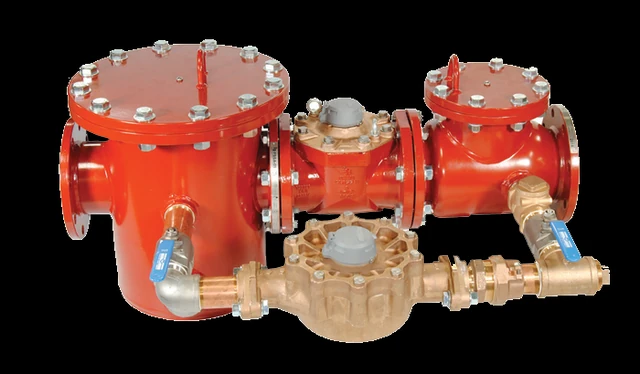
One platform, three configurations
All three share the same AWWA C703 floating-rotor turbine and UL Certified / FM 1044 fire-service rating. They differ only in whether a low-flow bypass is added and how it meters — pick by whether the main is fire-only or also carries domestic service.
- Sizes 3, 4, 6, 8, 10 in.
- Typical range 6–550 gpm (3 in.) to 50–7,000 gpm (10 in.)
- Use on a fire-only line, or a multi-use main where the domestic draw does not need metering
- Sizes 4, 6, 8, 10 in.; 1, 1-1/2 or 2 in. disc bypass meter by size
- Captures domestic flow down to about 0.75 gpm at 95% minimum
- Best low-flow capture — the disc reads the smallest trickle
- Sizes 4, 6, 8, 10, 12 in. — the only configuration offered in 12 in.
- Bypass captures domestic flow down to about 2.5 gpm at 95% minimum
- Two isolation valves with test tee optional
Key Features & Benefits
- UL Certified, FM 1044 — a fire-service turbine meter approved for protection mains, with low head loss so it does not rob pressure during a fire event
- FSMA for fire-only mains — a single main meter for a line dedicated to fire protection, in epoxy-coated ductile iron with an integral fire-service strainer
- FSAA meters the fire main’s domestic draw — the assembly adds a bypass meter and a check valve, so low-volume domestic use, leakage or misuse on the fire main is captured and billed while full fire flow still passes
- Calibrate under pressure — a tamper-resistant calibration vane allows in-line accuracy adjustment without taking the main down
- AMR/AMI ready — reads on ORION endpoints and AquaCUE cellular AMI as well as a sealed mechanical or encoder register
- Lead-free and AWWA C703 — NSF/ANSI/CAN 61 & 372 certified for the potable side of the fire main
Specifications
- Measurement principle
- Direct-magnetic-drive floating-rotor turbine (AWWA Class II measuring chamber). FSMA meters the whole line through the main turbine; FSAA adds a downstream bypass meter (disc or turbine) behind a clapper check that diverts low flow to the bypass and opens on fire demand
- Service
- Potable cold water on fire-protection mains — fire-only (FSMA) or multi-use fire plus domestic (FSAA)
- Standards & certifications
- Meets AWWA C703 and is UL Certified / FM 1044 approved for fire service; certified to NSF/ANSI/CAN 61 & 372 (Trade Designation FSMA-01 / FSAA-01), with the NSF-61 mark on the housing. The meter conforms to UL 327, the integral strainer to UL 321 / FM 5551, and the FSAA check valve to UL 312 / FM 1044
- Sizes
- FSMA main meter 3 to 10 in.; FSAA disc-bypass assembly 4 to 10 in.; FSAA turbine-bypass assembly 4 to 12 in.
- Models
- FSMA single main meter; FSAA assembly with a 1, 1-1/2 or 2 in. disc bypass meter, or a 2 in. turbine bypass meter, behind a check valve
- Operating (normal) range
- Sized by pipe — FSMA typical operating range 6–550 gpm (3 in.) up to 50–7,000 gpm (10 in.); FSAA assemblies reach 7,000 gpm on the larger sizes
- Low-flow registration
- FSMA typical low flow (95% minimum) is 4 gpm on the 3 in.; FSAA bypass low-flow registration reaches 0.75 gpm on the disc and 2.5 gpm on the turbine bypass
- Max continuous flow
- To the size rating — FSMA 450 gpm (3 in.) up to 5,500 gpm (10 in.)
- Accuracy
- AWWA C703 registration — 100% ± 1.5% over the typical operating range and 95% minimum at the low-flow point; on the FSAA the disc/turbine bypass captures low-volume domestic use, leakage or misuse on the fire main as billed use
- Pressure / head loss
- Low head loss for optimum pressure during fire extinguishing; FSAA pressure loss at crossover 3 psi
- Housing material
- Fusion-bonded epoxy-coated ductile cast iron housing with lead-free bronze cover (FSMA); the FSAA pairs the cast-iron primary turbine with a lead-free bronze-alloy bypass meter
- Measuring element
- Direct-coupled multi-vaned rotor on a sapphire-jewel thrust bearing with passivated 316 stainless bearing pivots, thermoplastic nose cone and straightening vanes; the unitized element is factory-calibrated and trimmable in service via the tamper-resistant calibration vane
- Temperature rating
- Potable cold water; 120°F (49°C) maximum operating temperature
- Working pressure
- 175 psi (12 bar) maximum operating pressure
- Strainer
- Integral fire-service strainer (UL 321 / FM 5551), open area at least six times the nominal pipe area, with a flushing port; optional flush valve assembly
- End connections
- AWWA C207 Class D flanged ends; cast-iron or NL-bronze companion flanges optional
- Read-out / registers
- Sealed straight-reading magnetic-drive mechanical register (six-wheel odometer, 360° test circle, leak-detecting flow finder), or an encoder; lifts off without disrupting service
- AMR / AMI
- ORION family of endpoints and AquaCUE cellular AMI/AMR; compatible with other approved reading technologies
- Serviceability
- The unitized, factory-calibrated element and the register/encoder remove without pulling the housing from the line; the in-line calibration vane adjusts accuracy under pressure
Common Applications
- Dedicated fire-protection mains — FSMA
- Multi-use mains carrying both fire and domestic service — FSAA
- Campus, hospital and industrial fire-service supply
- Capturing unbilled domestic use on fire mains
- New fire-service taps requiring UL / FM-approved metering
Design & Selection Considerations
- Size to the demand profile, not just the pipe — the family follows the flow pattern, not the pipe diameter: the Disc Series for low-to-medium, intermittent flow that reads down to a trickle; the Turbo Series for consistent medium-to-high flow at low pressure loss; the Compound Series where demand swings between very low and very high in one body; and the Fire Series for UL/FM fire-protection mains. Use the input form to send the normal and peak flow with the line size and we’ll size the meter.
- Protect the measuring element with a strainer — grit and debris are what pull a turbine or compound reading off and wear the bearing. The Turbo carries an integral strainer as standard on the 1-1/2 in. size and as an option on 2–4 in.; for the larger and fire lines an external plate strainer (bronze NSF, steel or UL-FM, 2–12 in.) protects the element upstream. Use the input form to tell us the water quality and we’ll spec the strainer with the meter.
- Decide the read-out and AMI up front — the same meter takes a sealed mechanical RCDL totalizer, an HR-E LCD encoder, an ER counter, a PFT pulse / 4–20 mA transmitter, or AquaCUE cellular AMI/AMR — and any register or encoder lifts off without disrupting water service. Use the input form to tell us how you read it (local, PLC / SCADA, or cloud) and we’ll match the read-out.
- Lead-free and AWWA compliance is built in — every family meets its AWWA standard (Disc C700 / C710, Turbo C701 Class II, Compound C702, Fire C703) and is certified to NSF/ANSI/CAN 61 & 372, carrying the NSF-61 mark on the housing, and complies with the Safe Drinking Water Act lead-free rule. For a potable-water spec we confirm the certified configuration on the order.
- Service it in line — on every family the register or encoder and the unitized measuring element lift out for service or recalibration without removing the meter housing from the line, so the spool stays in place and downtime stays short. We can quote spare elements and registers so a swap is minutes.
To size & select the right fire-series meter:
Use the input form to send the line size, your normal and peak flow, and how you read it — a local total, a PLC / SCADA signal, or cellular AMI — and we’ll size the meter, the read-out and any strainer or AMI endpoint to the application.
Flow Meter Application Sheet ›Talk to an engineer directly — Scott Prater, Principal · 917-580-0878 · scott@pratertechnical.com
Specifications compiled by Prater Technical Partners from Badger Meter RecordALL commercial & industrial water-meter product literature.