Product Overview
The Cox Exact is Badger Meter’s dual-rotor precision turbine flow meter — two hydraulically coupled, counter-rotating helical rotors whose averaged signal cancels fluid swirl and extends rangeability dramatically. With a flow computer it holds ±0.1% of reading at ±0.02% repeatability, with turndown from 120:1 up to 500:1 and Strouhal-Roshko viscosity compensation, so one meter often covers a span that would otherwise take a multi-meter manifold. RF-carrier pickoffs sense the rotors without magnetic drag, and the ratio between the two rotors doubles as a built-in bearing-health check. Electronics mount remotely (CDL) or integrally (CDX), and every meter ships with a NIST-traceable wet calibration from the NVLAP-accredited Flow Dynamics lab. It is the Cox choice for aerospace fuel flow, custody transfer, and variable-viscosity service.
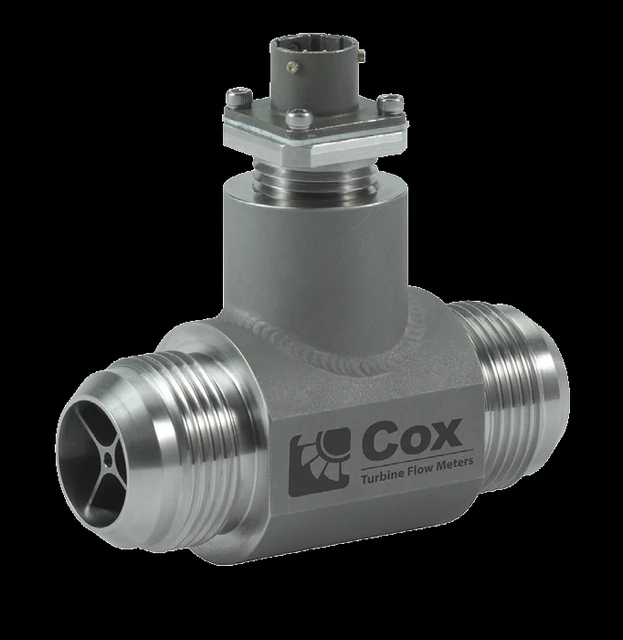
Key Features & Benefits
- ±0.1% accuracy — aerospace test-stand precision with a flow computer, at ±0.02% repeatability
- Dual-rotor swirl cancellation — averaging two counter-rotating rotors rejects swirl, so a separate straightener is rarely required
- Widest single-meter range — turndown to 500:1 often replaces a costly multi-meter manifold
- Built-in bearing-health check — the ratio between the two rotors flags bearing wear before it shows up as drift
- RF carrier pickoff — senses the rotors with no magnetic drag — friction-free, vibration-immune and linear into low flow
- Remote or integral electronics — CDL remote-mount or CDX integral-mount to suit the installation
- Calibrated and traceable — wet calibration at the NVLAP-accredited Flow Dynamics lab, NIST-traceable
Specifications
- Measurement principle
- Dual-rotor turbine — two hydraulically coupled, counter-rotating helical rotors. The trailing rotor sits at a high incidence angle, which extends the range; summing the two cancels swirl effects (so the meter usually needs no straightener), and their ratio reveals bearing health.
- Accuracy
- ±0.1% of reading (linearity, with a flow processor)
- Repeatability
- ±0.02% of reading
- Turndown (rangeability)
- 120:1 on the smallest meter to 500:1 on larger meters; the universal viscosity curve blends over a 60:1 range
- Fitting / line sizes
- 1/2–4 in. (1/2, 5/8, 3/4, 1, 1-1/4, 1-1/2, 2, 2-1/2, 3 and 4 in.)
- Bore sizes
- 1/2 in. body available in 1/4, 3/8 or 1/2 in. bore
- Compatible fluids
- Clean, low-viscosity liquids — aerospace and turbine fuels, hydrocarbons, solvents, water and other clean process liquids
- Process / fluid temperature
- Standard −150 to +330°F (−101 to +165°C); wider on request
- Pressure rating
- 3000 psig standard (other pressures available, depending on end fitting)
- Wetted materials
- 316 stainless-steel body and shafts; 17-4 PH stainless rotors; 300-series stainless supports, spacers and transitions
- Bearings
- Hybrid ceramic ball bearings — harder, lighter and more dimensionally stable than steel, and able to run in non-lubricating fluids
- Rotor
- Two counter-rotating helical rotors (dual-rotor)
- Pickoff (rotor sensing)
- RF (radio-frequency) carrier, in three configurations — RFA (no temperature sensor), RFB (with thermistor) or RFR (with RTD, for temperature-compensated flow computing)
- End-fitting / process connections
- 37° MS flare (AN) or NPT; 150# ANSI raised-face flange on 1 in. and larger (smaller sizes consult factory)
- Electronics mounting
- CDL — remote-mount electronics (MS connector); CDX — integral-mount electronics
- Viscosity / temperature compensation
- Strouhal-Roshko viscosity compensation and a self-compensating dual-rotor design, with a Universal Viscosity Curve (UVC) applied by the flow computer
- Signal output
- RF-carrier pulse to the paired flow computer
- Compatible flow computers
- EC80 (rate & total), FC-5000 (UVC temperature compensation, batching, energy) or FC30 (compact panel)
- Calibration (standard)
- Wet calibration with a unique K-factor at the NVLAP-accredited (Lab Code 200668-0) Flow Dynamics lab, NIST-traceable; single-fluid or multi-viscosity UVC and custom-fluid calibrations available
- Standards & traceability
- Calibrated on primary-standard calibrators at an NVLAP-accredited lab, traceable to NIST
Common Applications
- Engine test cells, test stands, and OEM flight / hydraulic component testing
- On-board aerospace and automotive fuel-flow testing
- Custody transfer of refined fuels and hydrocarbons
- Correlation standards and flow-transfer master meters
- Variable-viscosity fluids needing the widest single-meter range
- Precision industrial blending and batching of clean process liquids
Design & Selection Considerations
- Match the meter to the fluid — and keep it clean — a turbine meter reads a clean, low-viscosity liquid or gas: suspended solids and debris abrade the bearings and rotor and pull the K-factor off over time. Filter dirty service and confirm the fluid suits a turbine before sizing. Clean fluid in, accurate pulse out — protect the rotor and bearings with upstream filtration.
- Give a single-rotor meter straight run — or a straightener — swirl and a distorted velocity profile off elbows, pumps and valves bias a turbine reading. The single-rotor CPT and LoFlo want straight run or an AN / 150# flow straightener; the dual-rotor Exact averages two counter-rotating rotors to cancel swirl, so it usually needs none. Design the run in, fit a straightener, or specify the dual-rotor meter that self-corrects.
- Size to the flow band — don’t over-range — turbine accuracy and bearing life are best inside the rated band, and sustained over-speed wears the bearings. Cox turndown runs from 120:1 on the smallest Exact up to 500:1 on the larger meters — size to the actual flow, not the pipe. Run the meter in its band; chronic over-ranging is a bearing-wear problem, not just an accuracy one.
- Pick the pickoff: RF carrier or magnetic — the RF (radio-frequency) carrier pickoff senses the blades with no magnetic drag, so the rotor turns nearly friction-free and stays linear well into low flow — and it is embedded and vibration-immune, which is why Cox goes onboard vehicles and aircraft. A magnetic (MAG) pickoff is the rugged alternative and covers the full −450 to +450°F range. RF for low-flow linearity and vibration; MAG where the application calls for it.
- Compensate for viscosity and temperature — a turbine’s output shifts with viscosity, and viscosity shifts with temperature. Cox characterizes each meter across viscosities to build a Universal Viscosity Curve (UVC); a flow computer tracks process temperature and applies it, so the reading holds as the fluid warms or cools. The dual-rotor Exact reduces the dependence further by self-compensating hydraulically. Variable viscosity means a UVC and a flow computer — tell us the fluid and its temperature range.
- Plan the electronics chain — the meter outputs a pulse; what reads it depends on the duty. The EC80 gives rate and total; the FC-5000 adds UVC temperature compensation, batching, energy / BTU and communications; the FC30 is a compact panel flow computer. A signal conditioner preamplifies or converts the pulse to 4–20 mA where the receiver needs it. Choose the readout for the job — rate / total, viscosity-corrected, or analog into a PLC / DCS.
- Match calibration to your fluid — every Cox meter ships with a 10-point MIL-PRF-7024 wet calibration at 1.12 cSt; when your process fluid differs, order a multi-viscosity UVC or custom-fluid calibration so the K-factor reflects the real service. The standard cal is a solvent reference — calibrate to your actual fluid when it matters.
To size & select the right Cox Exact CDL / CDX:
Use the input form to send your fluid, flow range, line size and accuracy target — with the process temperature and pressure — and we’ll spec the meter, pickoff, flow computer and calibration for your application.
Flow Meter Application Sheet ›Talk to an engineer directly — Scott Prater, Principal · 917-580-0878 · scott@pratertechnical.com
Specifications compiled by Prater Technical Partners from Badger Meter Cox precision turbine product literature.