Product Overview
The Cox Precision CPT is the single-rotor member of the Cox precision turbine family — the lighter-cost choice when the service is steadier and a second rotor is not needed. One helical rotor reads ±0.50% of reading on its own and tightens to ±0.1% over the repeatable range when a flow processor applies temperature / viscosity compensation, at ±0.02% repeatability. The rotor turns on hybrid ceramic bearings that run unlubricated from cryogenic through hot duty, so a magnetic pickoff carries the meter across a −450 to +450°F window; an RF-carrier pickoff senses the rotor without magnetic drag for friction-free linearity into low flow, with RTD options for temperature-compensated flow computing. Built in 316 stainless with a 17-4 PH rotor, offered 1/2–2 in. with bores from 1/4 in. and AN, NPT or 150# flange ends, it pairs with the EC80, FC-5000 or FC30 and ships with a wet calibration from the NVLAP-accredited Flow Dynamics lab, NIST-traceable, with a unique K-factor. It is the Cox choice for clean fuels, solvents, water and chemical batching.
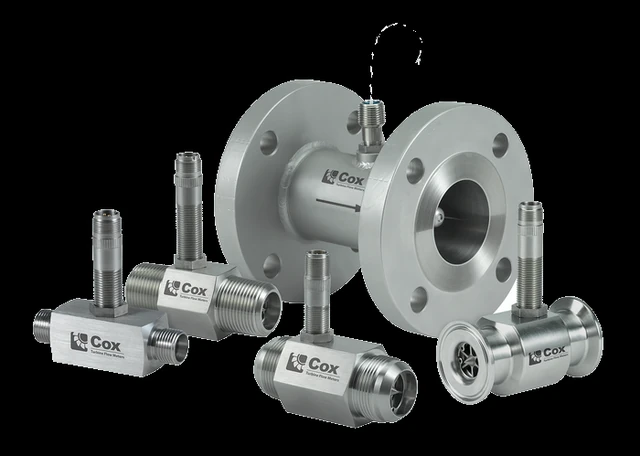
Key Features & Benefits
- Single-rotor simplicity — one helical rotor on hybrid ceramic bearings keeps the meter the lighter-cost choice for steadier service
- ±0.1% with a flow processor — linearity tightens from the standard ±0.50% to ±0.1% of reading over the repeatable range at ±0.02% repeatability
- Wide temperature range — a magnetic pickoff spans −450 to +450°F — cryogenic fuels through hot process liquids
- RF or magnetic pickoff — RF carrier for friction-free low-flow linearity, or MAG for the full temperature window; RF-RTD versions feed temperature-compensated flow computing
- Expanded mechanical linearity — the rotor and bore are profiled to flatten the K-factor, so viscosity and temperature shift the reading less
- UVC-correctable — a flow computer applies the Universal Viscosity Curve so the meter holds across the calibrated range
- Calibrated and traceable — wet calibration at the NVLAP-accredited Flow Dynamics lab, NIST-traceable
Specifications
- Measurement principle
- Single-rotor turbine — one helical rotor spins in proportion to flow, its blades passing through a magnetic or radio-frequency field to generate a pulse train proportional to flow
- Accuracy
- Linearity ±0.50% of reading as standard; ±0.1% of reading over the repeatable flow range when paired with a flow processor, which also applies temperature / viscosity compensation
- Repeatability
- ±0.02% of reading
- Turndown (rangeability)
- Mechanical (RF carrier) linearity up to 100:1 depending on meter size; the non-linear-but-repeatable range extends further (to 150:1 on some sizes)
- Fitting / line sizes
- 1/2–2 in. (1/2, 5/8, 3/4, 1, 1-1/4, 1-1/2 and 2 in.)
- Bore sizes
- Bore sizes from 1/4 in.; the 1/2 in. body is offered in 1/4, 3/8 or 1/2 in. bore (sizes 8-4 / 8-6 / 8)
- Compatible fluids
- Clean, low-viscosity liquids — hydrocarbons and fuels, solvents, water and other clean process liquids
- Process / fluid temperature
- −450 to +450°F with a magnetic pickoff; RF-carrier pickoffs run from −330°F up to +450°F depending on the pickoff option
- Pressure rating
- Set by end-fitting, size and temperature — AN flare working pressure to 7000 psig (size 8 at 100°F, derating with size and temperature); 150# ANSI flange 275 psig
- Wetted materials
- 316 stainless-steel body and shafts; 17-4 PH stainless rotor
- Bearings
- Hybrid ceramic ball bearings on most sizes — harder, lighter and more temperature-tolerant than 440C steel, and able to run in non-lubricating fluids from cryogenic through hot service; the size-8 (1/2 in. bore) meter uses a stainless-steel ball bearing for hydrocarbon service
- Rotor
- Single helical rotor
- Pickoff (rotor sensing)
- RF (radio-frequency) carrier or magnetic (MAG); RF options include RTD versions for temperature-compensated flow computing
- End-fitting / process connections
- 37° MS flare (AN, standard), NPT, or 150# ANSI raised-face flange
- Viscosity / temperature compensation
- Universal Viscosity Curve (UVC) applied by the flow computer; expanded mechanical linearity and Strouhal-Roshko bore-thermal-expansion correction reduce viscosity / temperature drift
- Signal output
- RF or MAG pulse (frequency output 1200–1500 Hz) to a signal conditioner or flow computer
- Compatible flow computers
- EC80, FC-5000 or FC30
- Calibration (standard)
- Wet calibration on NVLAP-accredited primary-standard calibrators (Flow Dynamics, Lab Code 200668-0, Racine WI), NIST-traceable, with a unique K-factor — calibrator uncertainty ±0.05% of reading; solvent / oil blends simulate the process fluid, and multi-viscosity UVC and custom-fluid calibrations are available
- Standards & traceability
- Calibrated on primary-standard calibrators at the NVLAP-accredited Flow Dynamics lab (Lab Code 200668-0), traceable to NIST
Common Applications
- Chemical and process batching of clean liquids
- Fuel and hydrocarbon flow measurement
- Test & measurement and laboratory flow loops
- Water and other clean process liquids
- Solvent and light-product metering where a steadier, lower-cost turbine fits
Design & Selection Considerations
- Match the meter to the fluid — and keep it clean — a turbine meter reads a clean, low-viscosity liquid or gas: suspended solids and debris abrade the bearings and rotor and pull the K-factor off over time. Filter dirty service and confirm the fluid suits a turbine before sizing. Clean fluid in, accurate pulse out — protect the rotor and bearings with upstream filtration.
- Give a single-rotor meter straight run — or a straightener — swirl and a distorted velocity profile off elbows, pumps and valves bias a turbine reading. The single-rotor CPT and LoFlo want straight run or an AN / 150# flow straightener; the dual-rotor Exact averages two counter-rotating rotors to cancel swirl, so it usually needs none. Design the run in, fit a straightener, or specify the dual-rotor meter that self-corrects.
- Size to the flow band — don’t over-range — turbine accuracy and bearing life are best inside the rated band, and sustained over-speed wears the bearings. Cox turndown runs from 120:1 on the smallest Exact up to 500:1 on the larger meters — size to the actual flow, not the pipe. Run the meter in its band; chronic over-ranging is a bearing-wear problem, not just an accuracy one.
- Pick the pickoff: RF carrier or magnetic — the RF (radio-frequency) carrier pickoff senses the blades with no magnetic drag, so the rotor turns nearly friction-free and stays linear well into low flow — and it is embedded and vibration-immune, which is why Cox goes onboard vehicles and aircraft. A magnetic (MAG) pickoff is the rugged alternative and covers the full −450 to +450°F range. RF for low-flow linearity and vibration; MAG where the application calls for it.
- Compensate for viscosity and temperature — a turbine’s output shifts with viscosity, and viscosity shifts with temperature. Cox characterizes each meter across viscosities to build a Universal Viscosity Curve (UVC); a flow computer tracks process temperature and applies it, so the reading holds as the fluid warms or cools. The dual-rotor Exact reduces the dependence further by self-compensating hydraulically. Variable viscosity means a UVC and a flow computer — tell us the fluid and its temperature range.
- Plan the electronics chain — the meter outputs a pulse; what reads it depends on the duty. The EC80 gives rate and total; the FC-5000 adds UVC temperature compensation, batching, energy / BTU and communications; the FC30 is a compact panel flow computer. A signal conditioner preamplifies or converts the pulse to 4–20 mA where the receiver needs it. Choose the readout for the job — rate / total, viscosity-corrected, or analog into a PLC / DCS.
- Match calibration to your fluid — every Cox meter ships with a 10-point MIL-PRF-7024 wet calibration at 1.12 cSt; when your process fluid differs, order a multi-viscosity UVC or custom-fluid calibration so the K-factor reflects the real service. The standard cal is a solvent reference — calibrate to your actual fluid when it matters.
To size & select the right Cox Precision CPT:
Use the input form to send your fluid, flow range, line size and accuracy target — with the process temperature and pressure — and we’ll spec the meter, pickoff, flow computer and calibration for your application.
Flow Meter Application Sheet ›Talk to an engineer directly — Scott Prater, Principal · 917-580-0878 · scott@pratertechnical.com
Specifications compiled by Prater Technical Partners from Badger Meter Cox precision turbine product literature.