Product Overview
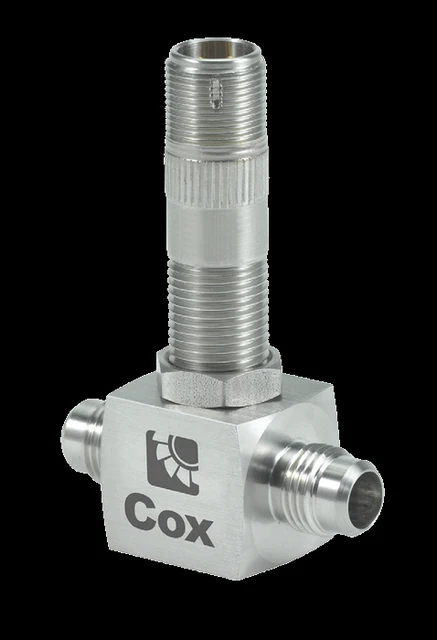
The Cox Precision LoFlo CLF is the smallest meter in the Cox turbine line — a 3/8 in. AN turbine built for very low flow rates, with a cantilever axial helical rotor on robust hybrid ceramic ball bearings and a stainless square body rated to 5000 psi. It comes in six flow-range variants (A6, B6, C6, D6, E6 and F6), each covering a narrow ultra-low-flow band, so the meter is matched to the actual rate instead of running near the bottom of an oversized one. The small-blade geometry that lets it read tiny rates also makes it inherently nonlinear, so the LoFlo is specified by its repeatability — ±0.25% of reading, with a 20–30 ms response — and a flow processor then linearizes and temperature-compensates the output, applying a multi-viscosity Universal Viscosity Curve through Strouhal-Roshko equations that track process temperature and bore thermal expansion. The rotor is read by a magnetic pickoff over the full −450 to +450°F span, or by an RF (carrier) pickoff that extends the low-flow range. Tolerant of the vibration and shock found on moving platforms, it is the Cox choice for attitude- and position-control rocket engines, exotic propellants and oxidizers, low-rate fuel monitoring, and blending, batching and leak detection. Every meter is wet-calibrated NVLAP-accredited and NIST-traceable to its own Universal Viscosity Curve.
Key Features & Benefits
- Six flow-range variants — A6, B6, C6, D6, E6 and F6 cover six narrow ultra-low-flow bands, so the meter is sized to the actual rate rather than over-ranged
- Smallest Cox turbine — a 3/8 in. AN body purpose-built for the very low rates larger turbines cannot measure
- Fast, repeatable response — ±0.25% repeatability with a 20–30 ms response time, for tight dosing, blending and leak-detection work
- Rugged for shock and vibration — a cantilever helical rotor on hybrid ceramic ball bearings shrugs off the mechanical abuse that ends other low-flow meters — built for attitude-control and test-stand duty
- 5000 psi square body — the stainless square body takes 5000 psi line pressure and gives flat wrench surfaces for install and removal
- Pick the pickoff — magnetic to −450 / +450°F, or an RF (carrier) pickoff that extends the low-flow range — RTD versions for temperature-compensated flow computing
- Linearized and viscosity-compensated — a flow processor linearizes the pulse output and applies the Universal Viscosity Curve via Strouhal-Roshko equations, tracking process temperature to keep the reading true
- Calibrated and traceable — NVLAP-accredited, NIST-traceable wet calibration on primary-standard calibrators, with a multi-viscosity Universal Viscosity Curve
Specifications
- Measurement principle
- Single-rotor turbine for ultra-low flow — a cantilever axial helical rotor whose speed tracks volumetric rate, its blades sensed through a magnetic or radio-frequency (RF) field as a pulse train proportional to flow
- Accuracy
- Inherently nonlinear by design (small-blade geometry) and repeatable to ±0.25% of reading; a flow processor linearizes and temperature-compensates the output, so realized accuracy depends on the fluid, temperature range and calibration. Use the input form to send your fluid and conditions and we will recommend the model and calibration for the best attainable accuracy.
- Repeatability
- ±0.25% of reading
- Turndown (rangeability)
- 10:1 flow ratio standard; an extended low-end range is available with the RF (carrier) pickoff
- Fitting / line sizes
- 3/8 in., 37° MS flare (AN, per AS4395); six bore variants A6–F6 step through progressively higher ultra-low-flow ranges
- Compatible fluids
- Clean, low-viscosity liquids at very low flow rates — including exotic propellants and oxidizers (N₂O₄, UDMH, MMH, hydrazine), refrigerants, fuels and solvents
- Process / fluid temperature
- −450 to +450°F with a magnetic pickoff; RF-carrier pickoffs cover a narrower window that varies by option, up to −330 to +450°F
- Pressure rating
- 5000 psi line pressure (stainless square body; four times less than burst)
- Wetted materials
- 316 stainless-steel body and shafts; 17-4 PH stainless rotor
- Bearings
- Hybrid ceramic ball bearings — robust against the vibration and shock that damage other low-flow meters
- Rotor
- Single cantilever axial helical rotor
- Pickoff (rotor sensing)
- Magnetic (MAG), RF (radio-frequency) carrier, or amplified RF — RTD versions available for temperature-compensated flow computing
- End-fitting / process connections
- 37° MS flare (AN) connections, per AS4395
- Viscosity / temperature compensation
- Multi-viscosity Universal Viscosity Curve (UVC) applied by the flow computer; temperature and fluid-viscosity compensation — including bore thermal expansion — via Strouhal-Roshko equations
- Signal output
- Magnetic or RF pulse to a signal conditioner or flow computer; frequency output 1500–1800 Hz maximum, with a 20–30 ms response time at 1.2 cSt
- Compatible flow computers
- EC80, FC-5000 or FC30
- Calibration (standard)
- Each meter is wet-calibrated with blended solvent and oil to simulate the actual fluid and build its Universal Viscosity Curve, at the NVLAP-accredited Flow Dynamics lab (Lab Code 200668-0, Racine WI) on primary-standard calibrators (±0.05% calibrator uncertainty), traceable to NIST; multi-viscosity UVC and custom-fluid calibrations available
- Standards & traceability
- Calibrated on primary-standard calibrators at the NVLAP-accredited Flow Dynamics lab (Lab Code 200668-0), traceable to NIST
Common Applications
- Attitude- and position-control rocket engines
- Exotic propellants and oxidizers — N₂O₄, UDMH, MMH, hydrazine, refrigerants
- Low-rate fuel monitoring and metering
- Blending and batching of clean, low-viscosity fluids
- Leak detection
- Laboratory micro-flow and R&D flow-loop measurement
Design & Selection Considerations
- Match the meter to the fluid — and keep it clean — a turbine meter reads a clean, low-viscosity liquid or gas: suspended solids and debris abrade the bearings and rotor and pull the K-factor off over time. Filter dirty service and confirm the fluid suits a turbine before sizing. Clean fluid in, accurate pulse out — protect the rotor and bearings with upstream filtration.
- Give a single-rotor meter straight run — or a straightener — swirl and a distorted velocity profile off elbows, pumps and valves bias a turbine reading. The single-rotor CPT and LoFlo want straight run or an AN / 150# flow straightener; the dual-rotor Exact averages two counter-rotating rotors to cancel swirl, so it usually needs none. Design the run in, fit a straightener, or specify the dual-rotor meter that self-corrects.
- Size to the flow band — don’t over-range — turbine accuracy and bearing life are best inside the rated band, and sustained over-speed wears the bearings. Cox turndown runs from 120:1 on the smallest Exact up to 500:1 on the larger meters — size to the actual flow, not the pipe. Run the meter in its band; chronic over-ranging is a bearing-wear problem, not just an accuracy one.
- Pick the pickoff: RF carrier or magnetic — the RF (radio-frequency) carrier pickoff senses the blades with no magnetic drag, so the rotor turns nearly friction-free and stays linear well into low flow — and it is embedded and vibration-immune, which is why Cox goes onboard vehicles and aircraft. A magnetic (MAG) pickoff is the rugged alternative and covers the full −450 to +450°F range. RF for low-flow linearity and vibration; MAG where the application calls for it.
- Compensate for viscosity and temperature — a turbine’s output shifts with viscosity, and viscosity shifts with temperature. Cox characterizes each meter across viscosities to build a Universal Viscosity Curve (UVC); a flow computer tracks process temperature and applies it, so the reading holds as the fluid warms or cools. The dual-rotor Exact reduces the dependence further by self-compensating hydraulically. Variable viscosity means a UVC and a flow computer — tell us the fluid and its temperature range.
- Plan the electronics chain — the meter outputs a pulse; what reads it depends on the duty. The EC80 gives rate and total; the FC-5000 adds UVC temperature compensation, batching, energy / BTU and communications; the FC30 is a compact panel flow computer. A signal conditioner preamplifies or converts the pulse to 4–20 mA where the receiver needs it. Choose the readout for the job — rate / total, viscosity-corrected, or analog into a PLC / DCS.
- Match calibration to your fluid — every Cox meter ships with a 10-point MIL-PRF-7024 wet calibration at 1.12 cSt; when your process fluid differs, order a multi-viscosity UVC or custom-fluid calibration so the K-factor reflects the real service. The standard cal is a solvent reference — calibrate to your actual fluid when it matters.
To size & select the right Cox Precision LoFlo CLF:
Use the input form to send your fluid, flow range, line size and accuracy target — with the process temperature and pressure — and we’ll spec the meter, pickoff, flow computer and calibration for your application.
Flow Meter Application Sheet ›Talk to an engineer directly — Scott Prater, Principal · 917-580-0878 · scott@pratertechnical.com
Specifications compiled by Prater Technical Partners from Badger Meter Cox precision turbine product literature.