Product Overview
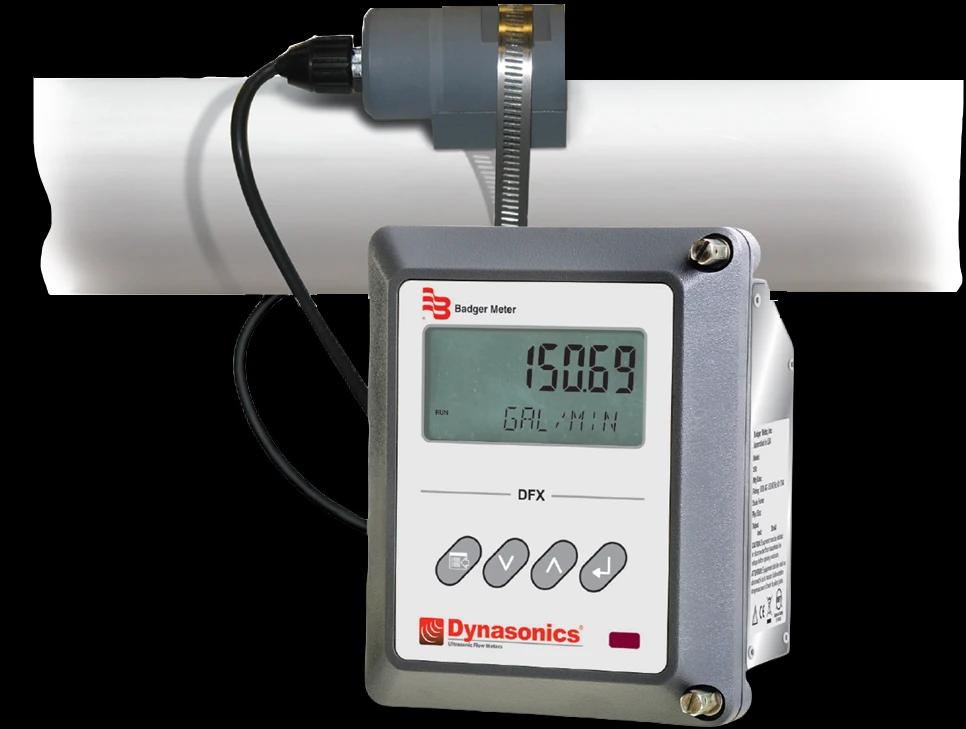
The Dynasonics DFX is Badger Meter’s clamp-on Doppler ultrasonic flow meter for the liquids a clean-fluid meter cannot read — sewage, slurries and aerated or solids-laden streams. Two DT9 transducers strap to the outside of a full pipe and send a 625 kHz burst into the flow; suspended particles and bubbles reflect it back at a shifted frequency, and that Doppler shift is proportional to velocity — so the meter measures flow with no wetted parts, no pressure drop and no moving parts on a running line. It works on pipe from 1/4 in. (6 mm) and larger over a 0.15–30 fps (0.05–9 mps) velocity range at ±2% of full scale, provided the fluid carries at least 100 ppm of sonic reflectors. A NEMA 4X transmitter offers a 4–20 mA output, a dual Form-C relay and a rate pulse, on 115/100/230 V AC or 12–28 V DC. It is the Dynasonics choice for dirty-water and slurry metering where the line stays full and cannot be opened.
Key Features & Benefits
- Reads what transit-time cannot — Doppler is the duty for solids-laden, slurry and aerated liquids — the suspended particles and bubbles are exactly what reflects the signal, so sewage and slurry that defeat a clean-fluid meter become readable
- Strap-on, full-line install — the DT9 transducers band onto the outside of a full, running pipe in minutes — no flanges, fittings, strainers or filters, no shutdown and no cut-in
- Down to quarter-inch pipe — small-pipe DT95 transducers reach 1/4 in. (6 mm) lines while the standard DT94 set carries 1 in. and larger, so one meter type spans tubing through large mains
- Nothing in the flow to wear or foul — with no wetted parts and no moving parts there is nothing in a gritty, abrasive or stringy stream to erode, clog or maintain
- Adapts to a changing stream — automatic gain control and in-field linearization let the meter hold a reading as solids loading and signal strength vary across the run
- Two I/O channels, configured to the job — each of the two output channels is ordered as 4–20 mA, a dual Form-C relay or a rate pulse — so the meter drives a SCADA loop and an alarm or pulse totalizer together
Specifications
- Measurement principle
- Clamp-on Doppler ultrasonic — a transmitting transducer sends a 625 kHz burst through the pipe wall into the liquid. Moving reflectors return the echo at a frequency offset from the transmitted tone; the size of that Doppler shift tracks the reflector speed, which the meter converts to flow rate. The transducers never contact the fluid.
- Accuracy
- ±2% of full scale, over the calibrated span — note this is a percent-of-full-scale figure, not percent-of-reading
- Minimum solids / aeration
- Needs a minimum of 100 ppm of useful sonic reflectors larger than 35 micron, with at least 25% of the particle volume above 100 micron; dissolved solids do not reflect and do not count. A clean fluid gives the Doppler nothing to read
- Flow range
- Velocity 0.15–30 fps (0.05–9 mps); the volumetric range follows from the pipe size
- Pipe sizes
- 1/4 in. (6 mm) and larger — small-pipe transducers (DT95) cover 1/4–1 in. (6–25 mm); standard transducers (DT94) cover 1 in. (25 mm) and up
- Pipe materials
- Most solid, homogeneous metal and plastic pipe; concrete pressure pipe, woodstave, PTFE-lined and fibreglass-reinforced pipe attenuate the signal and are reviewed case by case. The pipe must run completely full at the measuring point
- Transducers
- Two clamp-on DT9 transducer heads (DT94 standard pipe / DT95 small pipe), Type 6 (IP67); standard cable lengths of 20, 50 or 100 ft (6, 15 or 30 m), 78 Ω twinax, in bare cable or optional flexible armored conduit (zinc-plated steel, PVC). Optional long runs to 990 ft (297 m) on 75 Ω RG59 cable
- Compatible fluids
- Semi-clean to dirty liquids carrying suspended solids or entrained air — raw sewage and effluent, mud and mineral slurries, pulp stock, and aerated or solids-laden process streams
- Fluid temperature
- DT9 clamp-on transducers rated −40 to 194°F (−40 to 90°C); a silicone couplant (Dow 732 or Dow 111, or equivalent) acoustically couples the transducer to the pipe
- Mounting / installation
- Transducers strap to the outside of the pipe with stainless-steel bands and acoustic couplant; the transmitter is remote wall-mount — installed in minutes on a full, running line with no cut-in
- Outputs
- Two configurable I/O channels, each ordered as 4–20 mA (800 Ω max, 12-bit), an optically-isolated dual Form-C relay (rate alarm / totalizer pulse / error), or a rate pulse (to 2500 Hz); 8-digit rate and resettable 8-digit total in user-set engineering units
- Communication options
- The DFX outputs are analog / relay / pulse — there is no Modbus, BACnet or cellular AMR on this meter. For a shared pipe or manifold, a multiple-meter synchronization provision lets up to four meters interconnect, up to 100 ft (30 m) apart. Where a fieldbus or AMR is required, the transit-time TFX-5000 carries Modbus / BACnet and AquaCUE
- Enclosure / rating
- NEMA 4X (IP66) polycarbonate monitor enclosure; ambient −40 to 185°F (−40 to 85°C), 0–95% RH non-condensing; backlit 2-line LCD and 4-key tactile keypad. Agency approvals: general safety, US and Canada — certified to UL 61010-1 and CSA C22.2 No. 61010-1
- Power
- 115/100/230 V AC (50/60 Hz) or 12–28 V DC
Common Applications
- Municipal raw sewage, influent and effluent metering at treatment plants and lift stations
- Mining and mineral-processing slurries and tailings
- Pulp stock and other fibre-laden process streams
- Aerated or solids-bearing industrial process and waste streams
- Dirty cooling water and recirculation loops too laden for a clean-fluid meter
- Retrofit metering on a full line that cannot be shut down or cut into
Design & Selection Considerations
- Match the method to the fluid — transit-time vs Doppler — transit-time meters time an ultrasonic pulse sent with and against the flow, so they want a clean to lightly-laden liquid that passes sound (the TFX-5000 clamp-on and E-Series G2 inline). A Doppler meter (the DFX) does the opposite — it needs suspended solids or aeration to reflect the signal, which is what makes it the pick for sewage, slurries and aerated fluids. Use the input form to tell us how clean the fluid is and the right principle follows; the wrong one simply will not read.
- Clamp-on or inline — non-invasive vs best low-flow accuracy — a clamp-on meter straps transducers to the outside of the pipe — no cut-in, no pressure drop, no wetted parts, and it installs on a live line (the TFX-5000 / TFX-500w, and the portable DXN-5P). An inline spool (E-Series G2) is a permanent wetted body that holds the tightest low-flow accuracy and carries potable-water approval. Retrofit and survey work favour clamp-on; a permanent metered point with tight accuracy favours inline.
- Clamp-on needs a sound-friendly pipe — a clamp-on meter sends sound through the wall, so it wants a solid, sonically-conductive pipe of known material and wall thickness — metal and most plastics read well; heavy mortar lining, fibreglass, gas pockets, or badly corroded / scaled wall scatter the signal. Use the input form to give us the pipe material, OD and wall and we confirm suitability and transducer choice. The pipe is part of the meter on a clamp-on install — spec it as carefully as the fluid.
- Give the meter a developed flow profile — ultrasonic meters tolerate less straight run than a turbine, but a swirling or distorted profile off elbows, pumps and valves still biases the reading. Allow the recommended upstream / downstream straight run, or mount on the longest available run. More straight run, steadier reading — design the location, do not just clamp where it is convenient.
- Specify potable / hygienic approval where it is required — for drinking-water service the body must be lead-free and certified — the inline E-Series G2 carries a lead-free bronze body to NSF/ANSI 61 & 372. Say up front that the line is potable and we specify an approved body, not a general-purpose one. Approval is a build choice, not a field add-on.
- For heating / cooling energy, pair flow with a matched RTD pair — thermal energy is flow × the supply-return temperature difference, so an energy meter needs a matched temperature-sensor pair as well as flow. The UHC-120 integrates ultrasonic flow with the RTD pair to EN 1434, and the FC-215 computes energy from an external flow signal and RTD pair. For BTU / tenant billing, the matched sensor pair and the standard matter as much as the flow reading.
- Open channel: non-contact level or submerged area-velocity — in an open channel, flow is derived from level over a known primary device, or from velocity × area. The IS-4000 reads level non-contact over a flume or weir — nothing in the stream to foul; the IS-6000 submerges an area-velocity Doppler sensor where there is no primary device or the channel surcharges. A flume / weir site suits non-contact level; a surcharging or primary-less channel suits area-velocity.
To size & select the right Dynasonics DFX:
Use the input form to send your pipe size and material (or line size), the fluid and how clean it is, the flow range and accuracy target, and the fluid temperature — with whether you need clamp-on or inline, energy / BTU, or open-channel — and we’ll spec the right Dynasonics meter, transducers and outputs for your application.
Flow Meter Application Sheet ›Talk to an engineer directly — Scott Prater, Principal · 917-580-0878 · scott@pratertechnical.com
Specifications compiled by Prater Technical Partners from Badger Meter Dynasonics ultrasonic flow product literature.