Product Overview
The Dynasonics UHC-120 is a self-contained inline ultrasonic thermal-energy meter — it integrates an ultrasonic flow body with a matched insertion Pt 1000 RTD pair and computes heating or cooling energy to EN 1434 in one sealed device, so it both measures the flow and calculates the BTU rather than relying on an outside flow transmitter. It covers nominal flow rates of Qp 1.5 to 10.0 m³/h in threaded sizes DN15–DN40 (G3/4–G2) and 1/2 to 1-1/2 in. NPT, mounts in any position, and is rated PN16 on water from 5 to 90 °C. It reports energy in MWh, kWh, GJ, MMBTU or Gcal, logs semi-monthly totals on board, and is supplied with one of M-Bus, Modbus RTU or pulse output on a 10-year battery, 6+1-year battery or 24 V / 230 V AC power. Certified Accuracy Class 2 to EN 1434:2015 with MID and Measurement Canada approvals available, it is the Dynasonics choice for custody-grade tenant and sub-billing of heating and cooling energy.
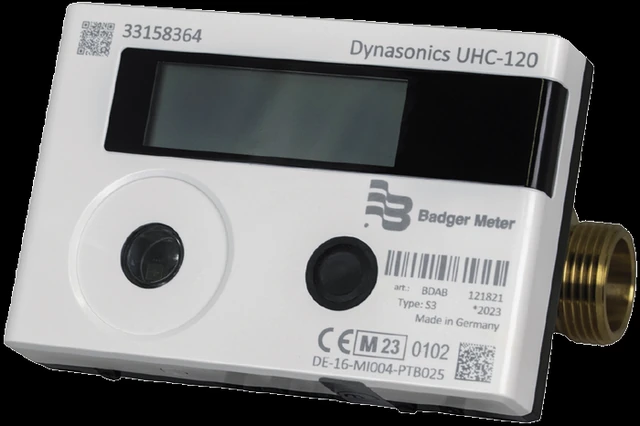
Key Features & Benefits
- Flow plus matched RTDs in one device — the ultrasonic flow body and the matched temperature-probe pair are integrated, so a single inline unit measures and computes energy — no separate flow meter to wire to a calculator
- Custody-grade for tenant billing — EN 1434 construction, with MID and Measurement-Canada approvals available, makes it defensible for heat / cool sub-billing where the reading is the invoice
- Reads heat or cool — the same platform bills heating energy, cooling energy, or both, from the supply–return temperature difference
- Battery or AC, your choice of bus — a 10-year battery M-Bus build needs no power run; Modbus RTU drops the meter on a wired energy / BMS network when an external supply is present; or take the open-collector pulse output
- Ball-valve or thermowell sensing — direct-immersion ball-valve probes give the tightest temperature reading for billing, while a thermowell pocket lets the probe be serviced without breaking into the line
- Programmable energy units — report in MWh, kWh, GJ, MMBTU or Gcal so the meter matches the building’s accounting basis out of the box
Specifications
- Function
- A self-contained inline thermal-energy meter — an ultrasonic flow body and a matched insertion RTD pair in one sealed device, computing heating / cooling energy (BTU) on the metered line itself (no separate flow transmitter needed, unlike a calculator-only unit)
- Energy-metering standard
- Built to EN 1434 for heat and cooling energy; MID-approved builds for the EU and US / Canada builds with Measurement Canada approval are offered
- Flow input
- Integral ultrasonic flow body sized to the line; nominal flow rates Qp 1.5, 2.5, 3.5, 6.0 and 10.0 m³/h with a metrological dynamic range of 1:100–1:125 (upper flow qs = 2×qp). Threaded sizes DN15–DN40 (G3/4–G2) metric and 1/2, 3/4, 1 and 1-1/2 in. NPT US / Canada; flow-sensor lengths 110–300 mm (metric) and 6.7–10.7 in. (170–273 mm) length-and-coupling for US / Canada. Rated PN16 (232 psi / 16 bar); medium temperature cooling 41–122°F (5–50°C), heating 59–194°F (15–90°C)
- Temperature inputs
- A matched Pt 1000 RTD pair, direct-insert short (DS) with an M10 screw and 26 mm insertion depth, with temperature-sensor mounting hardware included; sensor-cable lengths 1.5, 3 or 6 m
- Energy computation
- Energy is computed from the measured flow and the supply–return temperature difference read by the RTD pair; the return-side install is the recommended sensor location
- Accuracy class
- Accuracy Class 2 to EN 1434:2015 for both heating and cooling, and Measurement Canada Class 2 heating / cooling (wired M-Bus or pulse output)
- Energy units
- Field-programmable: MWh, kWh, GJ, MMBTU or Gcal
- Outputs
- Configurable pulse output, with cumulative energy, flow volume and temperature available over the digital interface
- Communication options
- One communication / output option is supplied per meter: wired M-Bus, pulse output (open-collector), or Modbus RTU (EIA-485, powered separately from a 12–24 V DC (SELV) external supply; not offered with Measurement Canada approval)
- Display
- 8-digit LCD with single-button setup and an integral data logger; protection class IP68 (meter body) and IP65 (calculator)
- Power
- 10-year battery (M-Bus) or 6+1-year battery (pulse), or an external 24 V / 230 V AC supply; the Modbus RTU interface is powered separately from a 12–24 V DC (SELV) supply
- Billing / approvals
- EN 1434 custody-grade for heat / cool tenant and sub-billing; Measurement Canada approval on approved configurations (the Modbus RTU build is not Measurement-Canada approved)
Common Applications
- Tenant and sub-billing of heating and cooling energy in multi-tenant and mixed-use buildings
- District heating and district cooling service connections
- Chilled-water and hot-water energy accounting at the riser, floor or zone
- Heat-pump and central-plant energy verification and cost allocation
- Threaded service lines DN15–DN40 / 1/2–1-1/2 in. where an inline energy meter fits the pipe
Design & Selection Considerations
- Match the method to the fluid — transit-time vs Doppler — transit-time meters time an ultrasonic pulse sent with and against the flow, so they want a clean to lightly-laden liquid that passes sound (the TFX-5000 clamp-on and E-Series G2 inline). A Doppler meter (the DFX) does the opposite — it needs suspended solids or aeration to reflect the signal, which is what makes it the pick for sewage, slurries and aerated fluids. Use the input form to tell us how clean the fluid is and the right principle follows; the wrong one simply will not read.
- Clamp-on or inline — non-invasive vs best low-flow accuracy — a clamp-on meter straps transducers to the outside of the pipe — no cut-in, no pressure drop, no wetted parts, and it installs on a live line (the TFX-5000 / TFX-500w, and the portable DXN-5P). An inline spool (E-Series G2) is a permanent wetted body that holds the tightest low-flow accuracy and carries potable-water approval. Retrofit and survey work favour clamp-on; a permanent metered point with tight accuracy favours inline.
- Clamp-on needs a sound-friendly pipe — a clamp-on meter sends sound through the wall, so it wants a solid, sonically-conductive pipe of known material and wall thickness — metal and most plastics read well; heavy mortar lining, fibreglass, gas pockets, or badly corroded / scaled wall scatter the signal. Use the input form to give us the pipe material, OD and wall and we confirm suitability and transducer choice. The pipe is part of the meter on a clamp-on install — spec it as carefully as the fluid.
- Give the meter a developed flow profile — ultrasonic meters tolerate less straight run than a turbine, but a swirling or distorted profile off elbows, pumps and valves still biases the reading. Allow the recommended upstream / downstream straight run, or mount on the longest available run. More straight run, steadier reading — design the location, do not just clamp where it is convenient.
- Specify potable / hygienic approval where it is required — for drinking-water service the body must be lead-free and certified — the inline E-Series G2 carries a lead-free bronze body to NSF/ANSI 61 & 372. Say up front that the line is potable and we specify an approved body, not a general-purpose one. Approval is a build choice, not a field add-on.
- For heating / cooling energy, pair flow with a matched RTD pair — thermal energy is flow × the supply-return temperature difference, so an energy meter needs a matched temperature-sensor pair as well as flow. The UHC-120 integrates ultrasonic flow with the RTD pair to EN 1434, and the FC-215 computes energy from an external flow signal and RTD pair. For BTU / tenant billing, the matched sensor pair and the standard matter as much as the flow reading.
- Open channel: non-contact level or submerged area-velocity — in an open channel, flow is derived from level over a known primary device, or from velocity × area. The IS-4000 reads level non-contact over a flume or weir — nothing in the stream to foul; the IS-6000 submerges an area-velocity Doppler sensor where there is no primary device or the channel surcharges. A flume / weir site suits non-contact level; a surcharging or primary-less channel suits area-velocity.
To size & select the right Dynasonics UHC-120:
Use the input form to send your pipe size and material (or line size), the fluid and how clean it is, the flow range and accuracy target, and the fluid temperature — with whether you need clamp-on or inline, energy / BTU, or open-channel — and we’ll spec the right Dynasonics meter, transducers and outputs for your application.
Flow Meter Application Sheet ›Talk to an engineer directly — Scott Prater, Principal · 917-580-0878 · scott@pratertechnical.com
Specifications compiled by Prater Technical Partners from Badger Meter Dynasonics ultrasonic flow product literature.