Product Overview
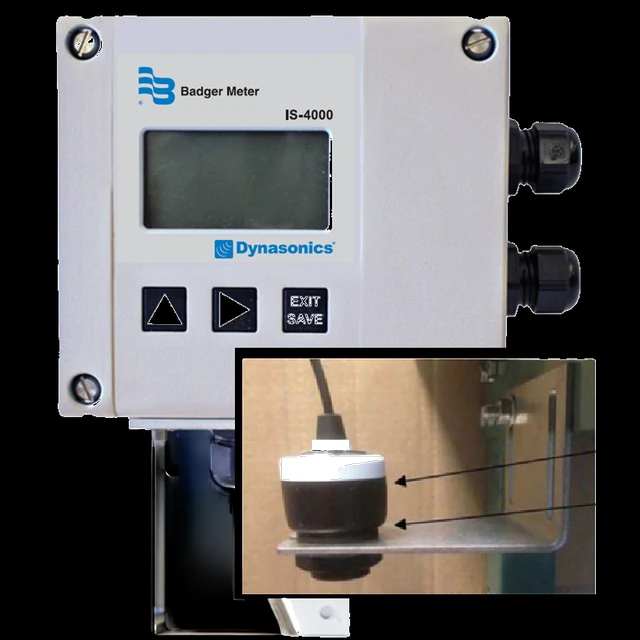
The Dynasonics IS-4000 is Badger Meter’s economical open-channel flow meter for weirs and flumes. A non-contact ultrasonic level sensor mounted above the channel measures water depth, and the meter converts that depth to flow rate and total volume from the selected primary device’s head-vs-flow table — with nothing placed in the stream to foul or corrode. Pre-programmed tables cover Parshall flumes (1, 2, 3, 6, 9, 12, 18, 24, 36, 48 and 60 in.), manhole flumes and the common weirs, and custom channels take a user table. Level reads to 19.7 ft (6 m) with the ULM53 ultrasonic sensor (up to 49.2 ft / 15 m with the C21 radar option). It reports level, flow and total over 4–20 mA, Modbus RTU and Modbus TCP/IP Ethernet, with AquaCUE connectivity and a 2 MB / 130,000-line on-board datalogger as a backup historical record. It is the Dynasonics choice for plant effluent, stormwater, irrigation channels and permit-reporting flow.
Key Features & Benefits
- Nothing in the stream — the level sensor reads from above the water, so there is no submerged element to coat, foul or corrode — well suited to channels where sediment or debris would build up on a wetted sensor
- Level, flow and total from one device — a single meter measures depth and computes flow rate and accumulated volume — no separate primary-element transmitter to integrate
- The primary devices are already in the meter — pre-programmed tables for Parshall and manhole flumes and the common weirs make setup a selection, not a hand-entered curve; odd channels take a custom table via the Flow Meter Tool
- Onto SCADA, with a local backup — a wired serial or Ethernet link carries the reading to a plant SCADA system, AquaCUE connectivity carries it to automatic meter reading, and the on-board datalogger keeps a 130,000-line historical record if the network drops
- Pump control built in — an optional level-driven pump-control function starts and stops a pump between high and low setpoints straight from the meter
- Picks the depth sensor for the channel — choose a DL10, DL24 or ULM53 ultrasonic sensor for the channel depth, with an ATEX-rated ULM70 or a long-range C21 radar where the site calls for it
Specifications
- Measurement method
- Non-contact ultrasonic level over a primary device — a sensor mounted above the channel reads water depth, which the empirical head-vs-flow table for the chosen flume or weir resolves into flow rate and accumulated volume. Nothing is placed in the stream to foul, coat or corrode.
- Primary devices
- Built-in pre-programmed tables for Parshall flumes (1, 2, 3, 6, 9, 12, 18, 24, 36, 48 and 60 in.), manhole flumes (4, 6, 8, 10 and 12 in.) and V-notch weirs (30°, 45°, 60°, 90°), plus contracted-rectangular, suppressed-rectangular and Cipoletti weirs, Manning rectangle (to 9.8 ft / 6 m) and Manning pipe; custom tables can be entered with the Flow Meter Tool software
- Sensor
- Ultrasonic level sensor selected to the depth range — DL10 (to 49.21 in. / 1250 mm), DL24 (to 9.8 ft / 3 m) or ULM53 (to 19.7 ft / 6 m); a ULM70 ATEX-rated sensor and a C21 radar sensor (to 49.2 ft / 15 m) are also available
- Level / measurement range
- Level to 19.7 ft (6 m) with the ULM53 ultrasonic sensor; up to 49.2 ft (15 m) with the C21 radar sensor
- Accuracy
- Set by the level sensor — 0.125 in. (3 mm) on the DL10, 0.25 in. (6 mm) on the DL24 and 0.35 in. (9 mm) on the ULM53
- Flow computation
- Instantaneous flow rate and a running totalizer, in field-selectable engineering units; the on-screen graphical LCD shows live flow, totals and status
- Outputs
- Level, flow rate and total over 4–20 mA (active or passive; also 0–20 / 0–10 mA), two digital open-collector outputs and a solid-state relay for pulse, min/max alarm, error or the optional pump-control function
- Data logging
- Built-in datalogger, 2 MB / up to 130,000 lines of date, level, flow rate and volume, retained on board as a backup historical record
- Communication options
- RS-485 Modbus RTU and Modbus TCP/IP Ethernet for SCADA, with AquaCUE® connectivity for automatic meter reading
- Enclosure / rating
- Die-cast powder-coated aluminium transmitter, IP67; graphical backlit LCD with three front-panel push-buttons and an IP67 mini-USB programming port; rated for −4 to 140°F (−20 to 60°C)
- Power
- 92–275 V AC (50/60 Hz), under 14 VA
Common Applications
- Effluent metering from wastewater and water-resource-recovery plants
- Flow into water-treatment plants from reservoirs
- Storm and sanitary sewer systems and stormwater outfalls
- Agricultural irrigation channels
- Industrial-discharge monitoring and permit reporting
Design & Selection Considerations
- Match the method to the fluid — transit-time vs Doppler — transit-time meters time an ultrasonic pulse sent with and against the flow, so they want a clean to lightly-laden liquid that passes sound (the TFX-5000 clamp-on and E-Series G2 inline). A Doppler meter (the DFX) does the opposite — it needs suspended solids or aeration to reflect the signal, which is what makes it the pick for sewage, slurries and aerated fluids. Use the input form to tell us how clean the fluid is and the right principle follows; the wrong one simply will not read.
- Clamp-on or inline — non-invasive vs best low-flow accuracy — a clamp-on meter straps transducers to the outside of the pipe — no cut-in, no pressure drop, no wetted parts, and it installs on a live line (the TFX-5000 / TFX-500w, and the portable DXN-5P). An inline spool (E-Series G2) is a permanent wetted body that holds the tightest low-flow accuracy and carries potable-water approval. Retrofit and survey work favour clamp-on; a permanent metered point with tight accuracy favours inline.
- Clamp-on needs a sound-friendly pipe — a clamp-on meter sends sound through the wall, so it wants a solid, sonically-conductive pipe of known material and wall thickness — metal and most plastics read well; heavy mortar lining, fibreglass, gas pockets, or badly corroded / scaled wall scatter the signal. Use the input form to give us the pipe material, OD and wall and we confirm suitability and transducer choice. The pipe is part of the meter on a clamp-on install — spec it as carefully as the fluid.
- Give the meter a developed flow profile — ultrasonic meters tolerate less straight run than a turbine, but a swirling or distorted profile off elbows, pumps and valves still biases the reading. Allow the recommended upstream / downstream straight run, or mount on the longest available run. More straight run, steadier reading — design the location, do not just clamp where it is convenient.
- Specify potable / hygienic approval where it is required — for drinking-water service the body must be lead-free and certified — the inline E-Series G2 carries a lead-free bronze body to NSF/ANSI 61 & 372. Say up front that the line is potable and we specify an approved body, not a general-purpose one. Approval is a build choice, not a field add-on.
- For heating / cooling energy, pair flow with a matched RTD pair — thermal energy is flow × the supply-return temperature difference, so an energy meter needs a matched temperature-sensor pair as well as flow. The UHC-120 integrates ultrasonic flow with the RTD pair to EN 1434, and the FC-215 computes energy from an external flow signal and RTD pair. For BTU / tenant billing, the matched sensor pair and the standard matter as much as the flow reading.
- Open channel: non-contact level or submerged area-velocity — in an open channel, flow is derived from level over a known primary device, or from velocity × area. The IS-4000 reads level non-contact over a flume or weir — nothing in the stream to foul; the IS-6000 submerges an area-velocity Doppler sensor where there is no primary device or the channel surcharges. A flume / weir site suits non-contact level; a surcharging or primary-less channel suits area-velocity.
To size & select the right Dynasonics IS-4000:
Use the input form to send your pipe size and material (or line size), the fluid and how clean it is, the flow range and accuracy target, and the fluid temperature — with whether you need clamp-on or inline, energy / BTU, or open-channel — and we’ll spec the right Dynasonics meter, transducers and outputs for your application.
Flow Meter Application Sheet ›Talk to an engineer directly — Scott Prater, Principal · 917-580-0878 · scott@pratertechnical.com
Specifications compiled by Prater Technical Partners from Badger Meter Dynasonics ultrasonic flow product literature.