Product Overview
The Dynasonics DXN-5P is the portable, hand-carried member of the Badger Meter ultrasonic line — and the only one that runs both ultrasonic principles in a single unit. Clamp-on transducers strap to the outside of the pipe and the battery-powered handheld automatically switches between transit time and Doppler as the fluid changes, so one carry case reads clean process water and solids- or gas-laden streams alike, bidirectionally, with no wetted parts and no line shutdown. Transit-time accuracy reaches ±0.5% of reading (Doppler ±2% of full scale) across 1/2 to 48 in. (12–1200 mm) of pipe, on a roughly 16-hour rechargeable battery, with a backlit graphical display, Bluetooth SoloCUE setup, 8 GB of on-board logging and a clamp-on RTD pair that turns it into a field BTU energy meter. It is the Dynasonics choice for commissioning, meter verification, troubleshooting, balancing and energy audits — a diagnostic instrument, not a fixed installation.
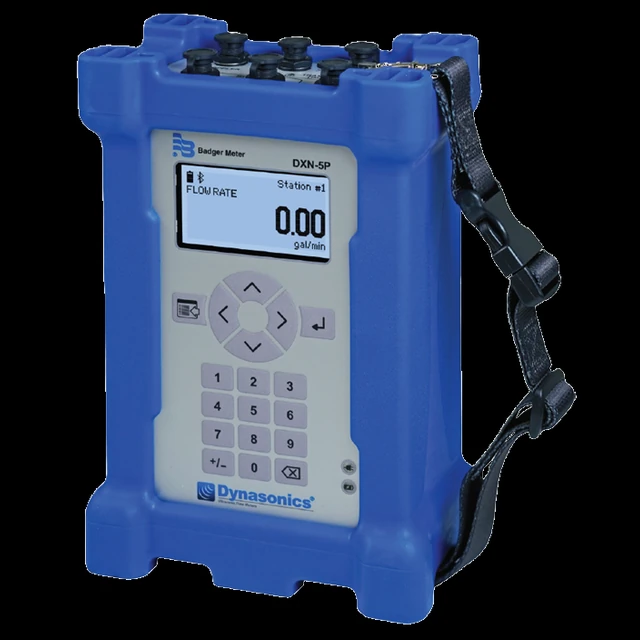
Key Features & Benefits
- One kit reads clean and dirty — the hybrid handheld runs both ultrasonic principles and switches between them automatically, so the same case handles treated water and particle- or bubble-laden service without swapping meters
- Carry it to the line, not the other way round — battery-powered and clamp-on, the DXN-5P is a hand-carried diagnostic tool — walk it from point to point, take a reading and move on, with nothing left installed
- Verify the meters already in the ground — strap it over an existing inline meter and compare — an independent non-invasive check of whether a permanent meter still reads true
- Catches entrained air — watching both the transit-time and Doppler signals flags trapped air, sand or debris in the pipe — the kind of entrained gas that quietly robs efficiency and damages pumps and valves
- Flow or BTU energy in the field — add the clamp-on RTD pair and it computes heating / cooling energy on the spot — turn a flow survey into a hydronic energy audit
- Logs a baseline you can take home — up to 8 parameters per record, 1 second to 1 day, into 8 GB of memory, pulled off over the SoloCUE app to profile usage and set baselines
Specifications
- Measurement principle
- Hybrid transit-time and Doppler clamp-on ultrasonic — transducers strap to the outside of the pipe and the handheld automatically switches between the two principles based on fluid condition: transit time (time-of-flight, with and against the flow) for clean liquids, Doppler (frequency shift off particles or bubbles) for liquids carrying solids or gas. Both methods are bidirectional and neither contacts the fluid.
- Accuracy
- Transit time ±0.5% of reading on medium and large pipe (±1% on small pipe); Doppler ±2% of full scale
- Repeatability
- Transit time ±0.2% above 1.5 ft/s
- Turndown / flow range
- Bidirectional; transit-time velocity to 40 ft/s on medium / large pipe (20 ft/s small pipe), Doppler to 30 ft/s — the working range is set by pipe size, transducer and fluid
- Pipe sizes
- 1/2–48 in. (12–1200 mm) across the transit-time transducer set; the Doppler transducer covers 1–39 in. (25–990 mm)
- Pipe materials
- PVC, CPVC, HDPE, PTFE, PVDF, stainless steel, ductile iron, aluminum, naval brass, carbon steel and copper — metal and most plastic pipe that passes sound
- Transducers
- Carried as a kit of clamp-on transducers — small-pipe (UZ, adjustable), medium-pipe (RZ), large-pipe (LZ) transit-time and a DT94 Doppler transducer — with quick-connect cables (triaxial for transit time, coaxial for Doppler); kit contents vary by sensor option (Basic, Transit Time, Hybrid, All Flow, Energy, Full)
- Compatible fluids
- Most clean liquids and liquids carrying suspended solids or gas bubbles — water, sewage, cooling water, water-glycol mixtures, alcohols and chemicals; the hybrid switching is what lets one kit read both clean and dirty service
- Fluid temperature
- Set by the transducer: the UZ small-pipe, LZ large-pipe and DT94 Doppler reach −40–194°F (−40–90°C) and the RZ medium-pipe reaches −40–250°F (−40–121°C); the clamp-on RTD kit covers −58–356°F (−50–180°C)
- Mounting / installation
- Portable / clamp-on — transducers strap onto the outside of the pipe and the hand-carried meter goes in and comes back out without cutting, draining or shutting the line down; nothing is permanently installed
- Outputs
- On-screen bidirectional flow rate and total in field-selectable engineering units (8-digit), with on-board data logging of up to 8 parameters per record at 1 second to 1 day intervals; logs transfer through the SoloCUE app
- Energy / BTU option
- With a pair of clamp-on RTDs the DXN-5P computes thermal energy (BTU) or mass flow in the field — flow plus the supply-return temperature difference — reading energy total and heating / cooling rate, ideal for hydronic heating and cooling audits
- Communication options
- USB Type-C and Bluetooth to the SoloCUE Flow Device Manager app (Windows, Android, iPhone / iPad) for configuration, calibration, troubleshooting and log transfer
- Enclosure / rating
- IP65 aluminum handheld with stainless fasteners; 4.2 lb (1.9 kg)
- Display
- Large backlit graphical display (128 × 64 pixel) with adjustable brightness and a 4-button tactile keypad for harsh field use
- Power
- Field-replaceable rechargeable battery (about 16 hours typical operation), or 9–28 V DC, or the universal 100–240 V AC adapter
- Approvals & standards
- Factory-calibrated to traceable standards; US / Canada general-safety cCSAus, FCC Part 15, ICES-003 (RSS-247, RSS-Gen); CE (EMC, Low Voltage, Radio Equipment), RoHS 3
Common Applications
- Commissioning and start-up checks — confirm a new line is flowing as designed before sign-off
- Verifying or auditing existing inline / permanent meters with an independent non-invasive reading
- Troubleshooting suspect flow and hunting entrained air in pumps, valves and process loops
- Temporary and verification surveys where no permanent meter is wanted or budgeted
- System balancing across heating and cooling zones — chilled-water, hot-water and condenser loops
- Field energy audits — flow plus a clamp-on RTD pair for BTU on the spot
Design & Selection Considerations
- Match the method to the fluid — transit-time vs Doppler — transit-time meters time an ultrasonic pulse sent with and against the flow, so they want a clean to lightly-laden liquid that passes sound (the TFX-5000 clamp-on and E-Series G2 inline). A Doppler meter (the DFX) does the opposite — it needs suspended solids or aeration to reflect the signal, which is what makes it the pick for sewage, slurries and aerated fluids. Use the input form to tell us how clean the fluid is and the right principle follows; the wrong one simply will not read.
- Clamp-on or inline — non-invasive vs best low-flow accuracy — a clamp-on meter straps transducers to the outside of the pipe — no cut-in, no pressure drop, no wetted parts, and it installs on a live line (the TFX-5000 / TFX-500w, and the portable DXN-5P). An inline spool (E-Series G2) is a permanent wetted body that holds the tightest low-flow accuracy and carries potable-water approval. Retrofit and survey work favour clamp-on; a permanent metered point with tight accuracy favours inline.
- Clamp-on needs a sound-friendly pipe — a clamp-on meter sends sound through the wall, so it wants a solid, sonically-conductive pipe of known material and wall thickness — metal and most plastics read well; heavy mortar lining, fibreglass, gas pockets, or badly corroded / scaled wall scatter the signal. Use the input form to give us the pipe material, OD and wall and we confirm suitability and transducer choice. The pipe is part of the meter on a clamp-on install — spec it as carefully as the fluid.
- Give the meter a developed flow profile — ultrasonic meters tolerate less straight run than a turbine, but a swirling or distorted profile off elbows, pumps and valves still biases the reading. Allow the recommended upstream / downstream straight run, or mount on the longest available run. More straight run, steadier reading — design the location, do not just clamp where it is convenient.
- Specify potable / hygienic approval where it is required — for drinking-water service the body must be lead-free and certified — the inline E-Series G2 carries a lead-free bronze body to NSF/ANSI 61 & 372. Say up front that the line is potable and we specify an approved body, not a general-purpose one. Approval is a build choice, not a field add-on.
- For heating / cooling energy, pair flow with a matched RTD pair — thermal energy is flow × the supply-return temperature difference, so an energy meter needs a matched temperature-sensor pair as well as flow. The UHC-120 integrates ultrasonic flow with the RTD pair to EN 1434, and the FC-215 computes energy from an external flow signal and RTD pair. For BTU / tenant billing, the matched sensor pair and the standard matter as much as the flow reading.
- Open channel: non-contact level or submerged area-velocity — in an open channel, flow is derived from level over a known primary device, or from velocity × area. The IS-4000 reads level non-contact over a flume or weir — nothing in the stream to foul; the IS-6000 submerges an area-velocity Doppler sensor where there is no primary device or the channel surcharges. A flume / weir site suits non-contact level; a surcharging or primary-less channel suits area-velocity.
To size & select the right Dynasonics DXN-5P:
Use the input form to send your pipe size and material (or line size), the fluid and how clean it is, the flow range and accuracy target, and the fluid temperature — with whether you need clamp-on or inline, energy / BTU, or open-channel — and we’ll spec the right Dynasonics meter, transducers and outputs for your application.
Flow Meter Application Sheet ›Talk to an engineer directly — Scott Prater, Principal · 917-580-0878 · scott@pratertechnical.com
Specifications compiled by Prater Technical Partners from Badger Meter Dynasonics ultrasonic flow product literature.