Product Overview
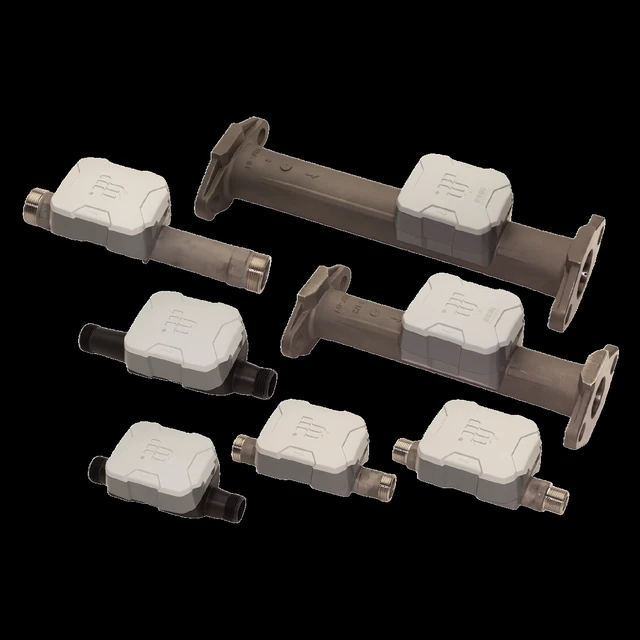
The Dynasonics U500w is Badger Meter’s inline ultrasonic cold-water submeter — a compact, one-piece electronic meter and register with an integral 9-digit LCD, in a totally encapsulated, weatherproof, UV-resistant housing. It measures by transit time with no moving parts, so it reads through the sand, particles and pressure swings that wear a mechanical register, and it is accurate to ±1.5% of reading over the normal flow range (±3.0% down to minimum flow). The line comes in two lead-free, NSF/ANSI 61-certified bodies — engineered polymer in 5/8–1 in. and 316 stainless steel in 5/8–1 in. and 1-1/2 & 2 in. — rated to 175 psi and a 34–140°F fluid range. An encoder output and in-line AquaCUE® connector make it AMR-ready, and a sealed 20-year lithium battery means no wiring. Note: the stainless-steel U500w is transitioning to the lead-free bronze E-Series G2 — which adds expanded flow ranges, increased sampling rates and 4–20 mA and pulse output options — and the stainless U500w sizes are rolling closed for new orders; the engineered-polymer E-Series continues. Use the input form to send your size and we’ll quote the current equivalent.
Key Features & Benefits
- One-piece sealed meter and register — the electronic meter and 9-digit register are integral to the body and fully potted — sealed, non-removable and tamper-protected, so the metered point cannot be opened or swapped in the field
- No moving parts to wear or foul — measurement is solid-state, and the patented metering insert keeps chemical buildup off the reflectors — so the reading holds where sand, particles and pressure fluctuations degrade a positive-displacement register
- Reads lower than a PD meter — the extended low-flow rate (down to 0.05 gpm on the small bodies) catches trickle draws and slow leaks that a mechanical submeter rolls past
- Pick the body the water and the spec call for — engineered polymer for cost-driven 5/8–1 in. points, or 316 stainless through 2 in. for reclaimed water and larger service — both lead-free and NSF/ANSI 61 certified
- Wireless-ready submeter — the encoder output and in-line AquaCUE connector drop the meter straight onto an AquaCUE AMR system — consumption read remotely without entering the space
- Twenty-year sealed battery — a non-replaceable encapsulated lithium cell powers the meter for its service life with no wiring to run and no battery to change
Specifications
- Measurement principle
- Inline transit-time ultrasonic — a pair of sensors in the flow tube send signals consecutively with and against the flow, and velocity is found from the time difference between the forward and reverse measurements; volume is computed from velocity, water temperature and bore diameter. No moving parts, so sand, suspended particles and pressure swings do not introduce wear-driven error.
- Accuracy
- New-meter consumption accurate to ±1.5% of reading over the normal flow range, and ±3.0% from the extended-low-flow rate down to the minimum flow value — stated within the datasheet’s normal water-temperature range (it varies by body; confirm the rated band for your size)
- Line sizes
- 5/8, 5/8 × 3/4, 3/4, 1, 1-1/2 and 2 in. (16–50 mm); operating ranges run 0.1–25 gpm at 5/8 in. up to 1.5–160 gpm at 2 in., with an extended low-flow rate as fine as 0.05 gpm
- Body / wetted material
- Two lead-free bodies — engineered polymer (5/8–1 in.) or 316 stainless steel (5/8–1 in., and 1-1/2 & 2 in.); the metering insert is engineered polymer and stainless steel, and the transducers are piezo-ceramic with a stainless CrNiMo wetted surface
- End connections
- Threaded NPSM coupling-nut and tailpiece connections with NPT pipe adapters (5/8–1 in.); the 1-1/2 & 2 in. stainless meters are offered as a two-bolt AWWA elliptical-flange body or a hex body with internal NPT thread
- Compatible fluids
- Potable cold water for building / property-management and industrial submetering; also suited to non-potable reclaimed irrigation water and less-than-ideal water carrying small particles
- Fluid temperature
- Measured-fluid range 34–140°F (1–60°C); the meter is fully submersible and rated 0–100% condensing humidity
- Pressure rating
- Maximum operating pressure of the meter housing 175 psi (12 bar)
- Outputs
- Integral 9-digit LCD totalizer with rate-of-flow toggle, reverse-flow indication and alarms; encoder (E5) registration output for automatic meter reading, factory-programmed in gallons, cubic feet or cubic metres
- Communication options
- Compatible with the AquaCUE® Flow Measurement Manager; an in-line connector mates the encoder to AquaCUE connectors / endpoints for AMR — the endpoint is specified with the order
- Power
- Battery powered — a non-replaceable 3.6 V lithium thionyl-chloride cell fully encapsulated in the register, with a 20-year service life; no field wiring
- Display
- Permanently sealed, tamper-protected straight-reading electronic LCD with 0.28 in. (7 mm) digits, integral to the one-piece meter and register body
- Potable-water / hygienic approvals
- NSF/ANSI 61 certified, Annex G, with a lead-free body; complies with applicable portions of ANSI/AWWA C700
- Approvals & standards
- Encoder registration with factory test to a Badger Meter standard (TS-419 through TS-424 by size); UV-resistant, weatherproof, totally encapsulated housing
Common Applications
- Building and property-management submetering — apartment, condominium and commercial-tenant cold-water billing
- Sealed, tamper-protected metered points where the register must not be opened or swapped
- Reclaimed / non-potable irrigation water, and water carrying small suspended particles
- Cost-sensitive small-line submetering, 5/8–1 in., on the engineered-polymer body
- Larger building-service points, 1-1/2 & 2 in., on the stainless elliptical-flange or hex body
- Wireless / fixed-network meter reading via the encoder output and AquaCUE connectivity
Design & Selection Considerations
- Match the method to the fluid — transit-time vs Doppler — transit-time meters time an ultrasonic pulse sent with and against the flow, so they want a clean to lightly-laden liquid that passes sound (the TFX-5000 clamp-on and E-Series G2 inline). A Doppler meter (the DFX) does the opposite — it needs suspended solids or aeration to reflect the signal, which is what makes it the pick for sewage, slurries and aerated fluids. Use the input form to tell us how clean the fluid is and the right principle follows; the wrong one simply will not read.
- Clamp-on or inline — non-invasive vs best low-flow accuracy — a clamp-on meter straps transducers to the outside of the pipe — no cut-in, no pressure drop, no wetted parts, and it installs on a live line (the TFX-5000 / TFX-500w, and the portable DXN-5P). An inline spool (E-Series G2) is a permanent wetted body that holds the tightest low-flow accuracy and carries potable-water approval. Retrofit and survey work favour clamp-on; a permanent metered point with tight accuracy favours inline.
- Clamp-on needs a sound-friendly pipe — a clamp-on meter sends sound through the wall, so it wants a solid, sonically-conductive pipe of known material and wall thickness — metal and most plastics read well; heavy mortar lining, fibreglass, gas pockets, or badly corroded / scaled wall scatter the signal. Use the input form to give us the pipe material, OD and wall and we confirm suitability and transducer choice. The pipe is part of the meter on a clamp-on install — spec it as carefully as the fluid.
- Give the meter a developed flow profile — ultrasonic meters tolerate less straight run than a turbine, but a swirling or distorted profile off elbows, pumps and valves still biases the reading. Allow the recommended upstream / downstream straight run, or mount on the longest available run. More straight run, steadier reading — design the location, do not just clamp where it is convenient.
- Specify potable / hygienic approval where it is required — for drinking-water service the body must be lead-free and certified — the inline E-Series G2 carries a lead-free bronze body to NSF/ANSI 61 & 372. Say up front that the line is potable and we specify an approved body, not a general-purpose one. Approval is a build choice, not a field add-on.
- For heating / cooling energy, pair flow with a matched RTD pair — thermal energy is flow × the supply-return temperature difference, so an energy meter needs a matched temperature-sensor pair as well as flow. The UHC-120 integrates ultrasonic flow with the RTD pair to EN 1434, and the FC-215 computes energy from an external flow signal and RTD pair. For BTU / tenant billing, the matched sensor pair and the standard matter as much as the flow reading.
- Open channel: non-contact level or submerged area-velocity — in an open channel, flow is derived from level over a known primary device, or from velocity × area. The IS-4000 reads level non-contact over a flume or weir — nothing in the stream to foul; the IS-6000 submerges an area-velocity Doppler sensor where there is no primary device or the channel surcharges. A flume / weir site suits non-contact level; a surcharging or primary-less channel suits area-velocity.
To size & select the right Dynasonics U500w:
Use the input form to send your pipe size and material (or line size), the fluid and how clean it is, the flow range and accuracy target, and the fluid temperature — with whether you need clamp-on or inline, energy / BTU, or open-channel — and we’ll spec the right Dynasonics meter, transducers and outputs for your application.
Flow Meter Application Sheet ›Talk to an engineer directly — Scott Prater, Principal · 917-580-0878 · scott@pratertechnical.com
Specifications compiled by Prater Technical Partners from Badger Meter Dynasonics ultrasonic flow product literature.