Product Overview
The Blancett 1100 is Badger Meter’s rugged axial-turbine flow meter for clean, low-viscosity liquids — originally developed for secondary oil recovery, and at home on water-flood, injection and production fields, in-situ mining, offshore and general industrial liquid flow. A helical rotor turns in proportion to flow through integral inlet straighteners, and a magnetic pickup converts blade passage into an AC pulse train whose frequency tracks volumetric flow — held to ±1% of reading at ±0.1% repeatability over a 10:1 range, with a NIST-traceable water calibration and unique K-factor on every meter. Built in 316 stainless with a CD4MCu rotor and tungsten-carbide bearings to take corrosive, mildly abrasive service, it spans 3/8–10 in. and 0.6–5,000 gpm with NPT, BSP, grooved, flange and hose-barb end connections, and is available in a Class I, Division 1 explosion-proof construction for hazardous areas. Field-replaceable repair kits recalibrate to a new K-factor without swapping the whole meter, and the 1100 pairs with Blancett monitors, converters and scalers for rate, total and analog output.
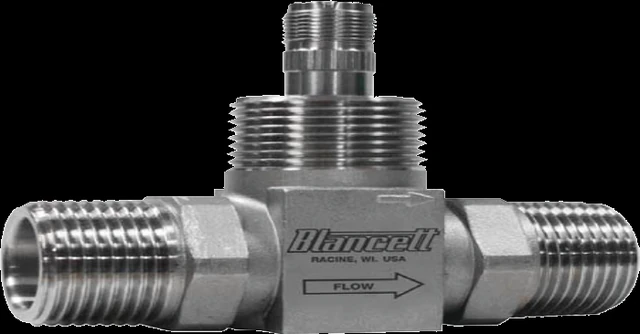
One meter, two build options
The 1100 is one turbine series ordered in a standard build for general industrial service or in an explosion-proof construction for classified areas. Same rotor, accuracy, sizes and electronics — the explosion-proof option adds the area classification and takes a hazardous-area pickup.
- NPT, BSP, Victaulic (grooved), ANSI flange or hose-barb ends
- Standard magnetic pickup (p/n B111109); alternate pickups available for special service
- 5,000 psi through 2 in.; 800 psi on 3–10 in. builds
- Explosion-proof construction rated Class I, Division 1, Groups C and D
- Takes a hazardous-area magnetic pickup; certified components installed per applicable codes
- Confirm the exact approval and marking with Badger before ordering
Key Features & Benefits
- ±1% of reading — at ±0.1% repeatability across a 10:1 range, with a NIST-traceable K-factor on every meter
- Integral flow straighteners — built-in inlet straightening conditions the profile so the rotor reads true
- Rugged stainless build — 316 SS housing, CD4MCu rotor and tungsten-carbide bearings for oilfield and process duty
- Standard or explosion-proof — an explosion-proof build (Class I, Div 1, Groups C & D) for hazardous-area liquid measurement, water flood and secondary oil recovery
- Wide size & connection range — 3/8–10 in. with NPT, BSP, grooved, flange or hose-barb ends
- Magnetic-pickup options — standard p/n B111109 plus alternate pickups for special service
- Field-replaceable repair kits — internals swap out and recalibrate to a new K-factor without replacing the whole meter
- Pairs with Blancett electronics — rate/total monitors, IFC converters and K-factor scalers complete the loop
Specifications
- Measurement principle
- Precision axial turbine — a helical rotor driven by the fluid through integral inlet flow straighteners; a magnetic pickup generates an AC pulse per blade passage, so output frequency is proportional to volumetric flow.
- Accuracy
- ±1% of reading on 7/8 in. and larger bores; ±1% over the upper 70% of range on 3/8, 1/2 and 3/4 in. bores
- Repeatability
- ±0.1%
- Turndown (rangeability)
- 10:1
- Line sizes
- 3/8–10 in. bore (1/2–10 in. pipe)
- Flow range
- 0.6–5,000 gpm
- Compatible fluids
- Clean, low-viscosity liquids — process, custody-transfer, water-flood and secondary-oil-recovery service
- Process / fluid temperature
- −150…350°F (−101…177°C)
- Pressure rating
- 5,000 psi on builds through 2 in.; 800 psi on 3–10 in. builds
- Housing material
- 316 stainless steel (304 SS flanges on flanged builds)
- Rotor
- CD4MCu stainless
- Shaft & bearings
- Tungsten-carbide shaft and journal bearings
- End connections
- NPT, BSP, Victaulic (grooved), ANSI flange or hose-barb
- Hazardous-area rating
- Explosion-proof construction available — rated Class I, Division 1, Groups C and D; confirm the exact approval and marking with Badger
- Pickup (rotor sensing)
- Magnetic — standard p/n B111109, −150…330°F; alternate pickups available (confirm the option with Badger)
- Signal output
- AC sine-wave pulse, frequency proportional to flow, scaled by the meter’s unique K-factor (pulses/gal)
- Compatible monitors & electronics
- B3000, B2900 and B3100 monitors, the explosion-proof B3150, IFC converters and K-factor scalers
- Calibration (standard)
- NIST-traceable water calibration with a unique K-factor; custom-viscosity calibration available
Common Applications
- Custody transfer of clean, low-viscosity liquids
- Secondary oil recovery and water-flood injection
- Chemical and process-liquid measurement
- Hazardous-area liquid metering (explosion-proof build)
- Water and plant-utility flow measurement
- OEM and skid integration
Design & Selection Considerations
- Keep the fluid clean — and low-viscosity — an axial turbine reads a clean, thin liquid (or gas): suspended solids abrade the rotor and the tungsten-carbide bearings, and rising viscosity pulls the K-factor off. For viscous, dirty, or variable-viscosity fluids reach for the B1750 positive-displacement meter instead. Clean, thin fluid in, accurate pulse out — filter dirty service and confirm the fluid suits a turbine before sizing.
- Give the rotor a developed flow profile — swirl and a distorted profile off elbows, pumps and valves bias a turbine reading. The 1100 carries integral inlet flow straighteners; the wafer styles still want adequate straight run upstream and down. Design the run in — a turbine measures what the velocity profile gives it.
- Size to the 10:1 turndown band — a Blancett turbine holds its rated accuracy across roughly a 10:1 range; run it in that band and avoid sustained over-speed, which wears the bearings. Size to the actual flow, not the pipe. Pick the bore for the flow — over-ranging is a bearing-wear problem, not just an accuracy one.
- Choose the pickup — and remember the K-factor — the rotor is sensed by a magnetic pickup that puts out an AC pulse per blade passage; the meter’s unique K-factor (pulses per gallon) converts that to flow. Standard, high-temperature and pre-amplified pickups are available to suit temperature and signal-distance needs. Match the pickup to the service, and scale the readout to the meter’s K-factor.
- Match the build to the service — area class and hygiene included — wetted parts are 316 stainless, a CD4MCu rotor and tungsten-carbide shaft and bearings; choose the end connection and pressure class for the line. For a hazardous area specify the explosion-proof build; for food, beverage and hygienic service specify the B16N FloClean sanitary meter; for gas, the Gas QuikSert. Spec the material, rating and certification to the installation, not just the flow.
- Plan the electronics chain — the meter outputs a pulse; what reads it depends on the duty. A flow monitor (B3000 / B2900 / B3100, or the explosion-proof B3150) gives rate and total in the field; a K-factor scaler or IFC converter scales the pulse to engineering units or a 4–20 mA signal for a PLC / DCS. Choose the readout for the job — local rate / total, or scaled analog into a control system.
- Calibration and the K-factor tag — every Blancett turbine ships with a NIST-traceable water calibration and a unique K-factor; higher-accuracy and custom-viscosity calibrations are available when the process fluid differs from water. The standard cal is referenced to water — order a custom-fluid calibration when your service fluid is different.
To size & select the right Blancett 1100:
Use the input form to send your fluid, flow range, line size and accuracy target — with the process temperature, pressure and any hazardous-area or sanitary requirement — and we’ll spec the meter, pickup, monitor and calibration for your application.
Flow Meter Application Sheet ›Talk to an engineer directly — Scott Prater, Principal · 917-580-0878 · scott@pratertechnical.com
Specifications compiled by Prater Technical Partners from Badger Meter Blancett flow-metering product literature.