Product Overview
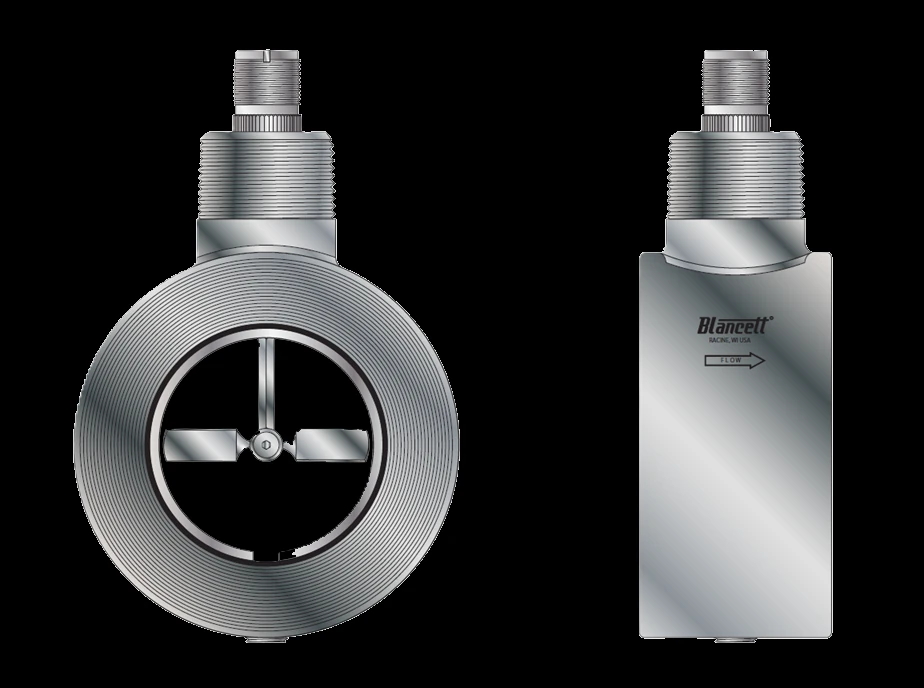
The Blancett Gas QuikSert is the dedicated gas member of the QuikSert wafer family — a 2 in. axial-turbine meter built for clean gas rather than a liquid turbine adapted to it. The rotor sits in a between-the-flange wafer body sized to the 2 in. ASME B16.5 pattern and dimensionally interchangeable with Cameron / NuFlo gas-meter wafers, so it drops straight into an existing 2 in. gas-meter installation. A matched magnetic pickup reads blade passage and outputs an AC pulse whose frequency tracks actual volumetric flow, scaled by the meter’s unique K-factor. It measures 7–350 ACFM at ±2% of reading and ±0.5% repeatability, is rated to 2,220 psig, and is offered with intrinsically-safe and explosion-proof builds for Class I, Division 1 areas — common on flare-gas service where the meter earns its keep. It ships with a factory NIST-traceable calibration and pairs with Blancett monitors, converters and scalers for rate, total and analog output.
Key Features & Benefits
- Built for gas — a dedicated gas-rotor axial turbine, not a liquid meter pressed into gas duty — ±2% of reading at ±0.5% repeatability on clean gas, 7–350 ACFM
- Drop-in wafer body — a 2 in. wafer that clamps between ASME B16.5 flanges and matches the Cameron / NuFlo wafer footprint for a like-for-like swap
- Rated to 2,220 psig — handles compressed-air and process-gas line pressures up to its maximum working rating
- Hazardous-area builds — intrinsically-safe and explosion-proof builds are available for Class I, Div 1 areas — we confirm the exact approval and marking with Badger for your site
- Magnetic gas pickup — a matched magnetic pickup reads the rotor and outputs an AC pulse scaled to the meter’s unique K-factor
- Pairs with Blancett electronics — a flow monitor adds rate / total in the field; IFC converters and K-factor scalers feed a PLC or DCS
Specifications
- Measurement principle
- Dedicated gas axial turbine in a 2 in. wafer body clamped between ASME B16.5 flanges; the rotor is read by a magnetic pickup, so output frequency is proportional to actual volumetric gas flow.
- Accuracy
- ±2% of reading
- Repeatability
- ±0.5%
- Line sizes
- 2 in. wafer
- Flow range
- 7–350 ACFM (ACFM — actual ft³/min)
- Compatible fluids
- Clean gas — compressed air, process gas, flare gas
- Pressure rating
- 2,220 psig maximum
- End connections
- 2 in. wafer between ASME B16.5 flanges; dimensionally compatible with Cameron / NuFlo 2 in. wafer gas-meter installations
- Hazardous-area rating
- Intrinsically-safe and explosion-proof builds available for Class I, Division 1 areas; confirm the exact approval and marking with Badger for your installation
- Pickup (rotor sensing)
- Matched magnetic pickup; output frequency proportional to flow
- Signal output
- AC pulse, frequency proportional to flow, scaled by the meter’s unique K-factor
- Compatible monitors & electronics
- Blancett flow monitors for rate / total, IFC converters and K-factor scalers
- Calibration (standard)
- Factory NIST-traceable flow calibration; each meter ships with its own unique K-factor
Common Applications
- Flare-gas measurement on oil & gas sites
- Clean compressed-air metering
- Process-gas and utility-gas measurement
- Fuel-gas measurement on burners and engines
- Drop-in replacement for Cameron / NuFlo 2 in. wafer gas installations
- Skid and OEM gas-flow integration
Design & Selection Considerations
- Keep the fluid clean — and low-viscosity — an axial turbine reads a clean, thin liquid (or gas): suspended solids abrade the rotor and the tungsten-carbide bearings, and rising viscosity pulls the K-factor off. For viscous, dirty, or variable-viscosity fluids reach for the B1750 positive-displacement meter instead. Clean, thin fluid in, accurate pulse out — filter dirty service and confirm the fluid suits a turbine before sizing.
- Give the rotor a developed flow profile — swirl and a distorted profile off elbows, pumps and valves bias a turbine reading. The 1100 carries integral inlet flow straighteners; the wafer styles still want adequate straight run upstream and down. Design the run in — a turbine measures what the velocity profile gives it.
- Size to the 10:1 turndown band — a Blancett turbine holds its rated accuracy across roughly a 10:1 range; run it in that band and avoid sustained over-speed, which wears the bearings. Size to the actual flow, not the pipe. Pick the bore for the flow — over-ranging is a bearing-wear problem, not just an accuracy one.
- Choose the pickup — and remember the K-factor — the rotor is sensed by a magnetic pickup that puts out an AC pulse per blade passage; the meter’s unique K-factor (pulses per gallon) converts that to flow. Standard, high-temperature and pre-amplified pickups are available to suit temperature and signal-distance needs. Match the pickup to the service, and scale the readout to the meter’s K-factor.
- Match the build to the service — area class and hygiene included — wetted parts are 316 stainless, a CD4MCu rotor and tungsten-carbide shaft and bearings; choose the end connection and pressure class for the line. For a hazardous area specify the explosion-proof build; for food, beverage and hygienic service specify the B16N FloClean sanitary meter; for gas, the Gas QuikSert. Spec the material, rating and certification to the installation, not just the flow.
- Plan the electronics chain — the meter outputs a pulse; what reads it depends on the duty. A flow monitor (B3000 / B2900 / B3100, or the explosion-proof B3150) gives rate and total in the field; a K-factor scaler or IFC converter scales the pulse to engineering units or a 4–20 mA signal for a PLC / DCS. Choose the readout for the job — local rate / total, or scaled analog into a control system.
- Calibration and the K-factor tag — every Blancett turbine ships with a NIST-traceable water calibration and a unique K-factor; higher-accuracy and custom-viscosity calibrations are available when the process fluid differs from water. The standard cal is referenced to water — order a custom-fluid calibration when your service fluid is different.
To size & select the right Blancett Gas QuikSert:
Use the input form to send your fluid, flow range, line size and accuracy target — with the process temperature, pressure and any hazardous-area or sanitary requirement — and we’ll spec the meter, pickup, monitor and calibration for your application.
Flow Meter Application Sheet ›Talk to an engineer directly — Scott Prater, Principal · 917-580-0878 · scott@pratertechnical.com
Specifications compiled by Prater Technical Partners from Badger Meter Blancett flow-metering product literature.