About this category
Industrial Turbo is Badger Meter's industrial turbine flow meter — a rugged, in-line-serviceable meter for high-volume industrial fluids, from water to oils, solvents, and acids. A ceramic-bearing rotor turns in proportion to flow behind straightening vanes and a nose cone that condition the stream, giving accuracy of ±0.5% to ±1.5% with 0.25% repeatability and low pressure loss. It comes in 2, 3, 4, and 6 in sizes, with a cast-iron (125-lb) or 316 stainless (150-lb) housing and a bronze or stainless head, and reads out through a mechanical RCDL totalizer, pulse or 4-20 mA transmitters, ER-series electronic registers, or a PC-200 process controller — meter-mounted or remote. Match it with a bronze strainer to protect the rotor upstream. Prater Technical Partners configures the size, materials, and register to your fluid and flow and ships through our Brooklyn facility as an authorized Badger Meter distributor.
The Industrial Turbo Meter
Click any Series box for details →
Built to run, built to service
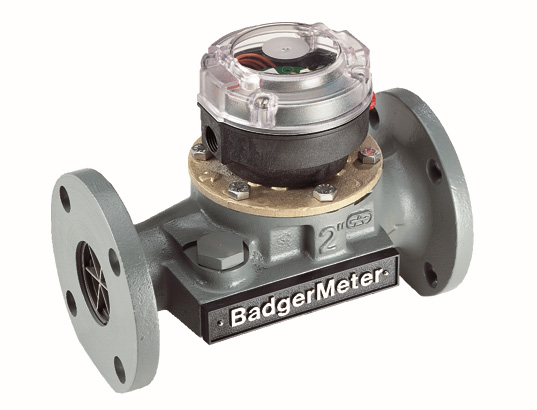
The Industrial Turbine is a straight-through turbine meter: a ceramic-bearing rotor turns in proportion to flow, conditioned by inlet straightening vanes and a nose cone, in a flanged cast-iron or 316 stainless body sized 2 to 6 in.
 1
2
3
4
1
2
3
4
- 1Register / output — A mechanical RCDL totalizer, an ER-9 / ER-420 electronic register, or a pulse / 4-20 mA transmitter mounts here — meter-mounted or remote.
- 2Bronze (or stainless) head — Lifts out for inspection and rotor service without breaking the flanged body out of the pipe.
- 3Cast-iron or 316SS housing — Straight-through flow body — 316SS straightening vanes, a nose cone, and a ceramic-bearing Ryton rotor inside.
- 4ANSI flanges — 125-lb flat-face (cast iron) or 150-lb raised-face (stainless), in 2, 3, 4, or 6 in.
Industrial Turbine, Turbo Model (2 in shown). Configured to your size, materials, and register.
Why the Turbo meter
Wide-range accuracy — ±0.5% over the prime range, ±1.5% across the extended range, with 0.25% repeatability — high turndown from one meter.
Low pressure loss — A straight-through profile with straightening vanes and a nose cone keeps head loss low even at high flow.
Serviceable in-line — Pull the head and rotor for service without removing the meter body from the pipe — the spool stays put, downtime stays short.
Long-life ceramic bearings — Ceramic bearings and a Ryton rotor stand up to continuous high-flow duty.
Handles tough fluids — Water, oils, solvents, and acids — Buna-N, EPR, or Viton seals and a cast-iron or 316 stainless housing matched to the fluid.
High-volume service — Built for water treatment, tanker and rail-car loading/unloading, batching, and process inventory where volume and flow run high.
Read it your way — Mechanical totalizer or digital LCD register, plus scaled/unscaled pulse, 4-20 mA, or PC-200 batch control — meter-mounted or remote.
Protected by a matched strainer — Badger 2–6 in bronze (NSF) external-plate strainers keep grit off the rotor and bearings.
Registers, outputs & control
RCDL mechanical totalizer — A local, non-resettable totalizer (to 250°F) for a straight visual read with no power.
Pulse transmitters — PFT-3 / PFT-3E (reed or electronic) and the NEMA 6P RST-6P send an unscaled pulse to a PLC or SCADA; the PFT-4E is a scaled pulse.
4-20 mA analog — The PFT-420/2 adds a 4-20 mA loop alongside pulse for analog rate into a controller or DCS.
ER-9 / ER-420 electronic registers — Scaleable rate-and-total display with scaled pulse (ER-9) or 4-20 mA in AC, DC, or loop-powered form (ER-420).
PC-200 process controller — On-board batch and relay control with pulse output, panel-, wall-, or meter-mounted.
Meter-mounted or remote — Any register, transmitter, or controller mounts on the meter or remotely where access or environment calls for it.
Typical applications
Water treatment
Tanker & rail-car loading
Batching systems
Process-fluid inventory
Cooling & condenser water
Oils & solvents
Acids & chemicals
High-flow plant water
Industries Served
Water & Wastewater
Chemical Processing
Oil & Gas
Power Generation
Food & Beverage
Mining & Minerals
OEM & Custom Equip.
Pulp & Paper
FAQ: Industrial Turbine Flow Meters
What is the Industrial Turbo meter, and how does it measure flow?
It is Badger Meter’s industrial turbine meter — a volumetric flow meter whose rotor spins at an angular velocity proportional to the fluid moving through it. Straightening vanes and a nose cone on the inlet condition the flow onto the rotor, electronic (or mechanical) pickups read the rotor, and the meter puts out an open-collector pulse (or a mechanical/electromechanical register reading). The straight-through profile and long-life ceramic bearings give a high level of accuracy over a wide flow range with low pressure loss. It comes in 2, 3, 4, and 6 in line sizes.
What fluids and applications is it for?
A wide range of industrial fluids — from water to oils, solvents, and acids — wherever high volume or high flow rates come up. Typical uses are water-treatment systems, loading and unloading of tankers or rail cars, batching systems, and process-fluid inventory control. It is an industrial process meter, not a potable-water utility meter; the seal material (Buna-N, EPR, or Viton) and housing are matched to your fluid.
What sizes, flow ranges, and accuracy does it cover?
Four sizes, each with a high-accuracy prime range and a wider extended range. At ±0.5%: 2 in reads 20–160 gpm, 3 in 60–350, 4 in 100–1000, and 6 in 250–2000 gpm. At ±1.5% the ranges widen to 8–200, 10–450, 25–1250, and 40–2500 gpm respectively. Repeatability is 0.25%. The meter runs 32–250°F, needs only 7 psi minimum, and is rated to 125 psi (cast-iron, 125-lb flat-face flanges) or 150 psi (stainless, 150-lb raised-face). Size to the flow rate, not the pipe — tell us your normal and peak flow and we pick the size.
What is it made of?
The housing is cast iron or 316 stainless steel; the head is bronze or stainless; the rotor and nose cone are Ryton; the bearings are ceramic; the straightening vanes are 316 stainless; and the O-ring/Tetraseal is Buna-N, EPR, or Viton (with a matched nitrile or chloroprene head gasket). Two housing materials let you put a cast-iron meter on plant water and a 316SS meter on a corrosive or higher-purity fluid.
How do I read it — what registers and outputs are available?
A full accessory line, meter-mounted or remote. A mechanical RCDL totalizer gives a local non-resettable read; pulse transmitters (PFT-3 / PFT-3E reed or electronic, RST-6P NEMA 6P) feed a PLC or SCADA; the PFT-4E is a scaled pulse; and the PFT-420/2 adds a 4-20 mA analog loop. Electronic registers — the ER-9 (scaleable rate/total with scaled pulse) and ER-420 (with 4-20 mA, in AC, DC, or loop-powered) — give a digital display plus outputs, and the PC-200 process controller adds on-board batch/relay control. Any of these can be remote-mounted away from the meter.
Can the meter be serviced without taking it out of the line?
Yes — that is a core feature. The head/measuring element lifts out for inspection or rotor service without breaking the flanged body out of the pipe, which keeps the spool in place and downtime short. Replacement head assemblies are stocked as a line item.
Does it need a strainer or straight pipe run?
A turbine meter wants reasonably clean fluid — grit and debris wear the rotor and bearings — so an upstream strainer is good practice; Badger offers matched 2–6 in bronze (NSF) external-plate strainers for the line. The built-in straightening vanes and nose cone reduce sensitivity to upstream disturbance, but for best accuracy still allow a straight run ahead of the meter. We spec the strainer and placement with the meter.
How do I buy it, and can it run at a remote site?
Industrial Turbo is a regional Badger Meter line — Prater Technical is the authorized distributor for Northern and Central New Jersey and New York. It is configured to your size, materials, and register/output and quoted to the application — not sold on the webstore; we ship through our Brooklyn facility, and offer meter programming and commissioning as an optional, quoted service. For a remote or off-grid point, the meter’s pulse or 4-20 mA output backhauls through a Telog cellular RTU powered from a SunWize solar supply. Contact us for a quote, current availability or lead time.
Have an application question? Talk to Scott — send directly to Scott Prater at scott@pratertechnical.com, or call him directly at 917-580-0878 during business hours.
Territory Coverage
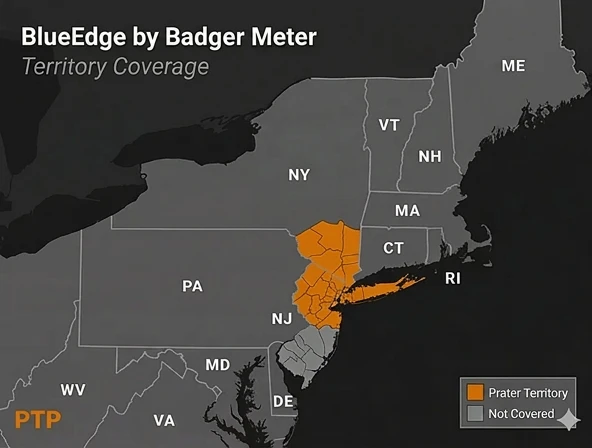
New York: New York City (all boroughs), Long Island, and the Hudson Valley — Westchester, Rockland, Putnam, Orange, Ulster, Dutchess, and Sullivan (ZIP 10000–11999 and 12400–12799). And Greene and Delaware counties that fall within ZIP 12400–12799
New Jersey: Northern NJ (07000–07999) and Central NJ (08500–08999)
New Jersey: Northern NJ (07000–07999) and Central NJ (08500–08999)
Territory above applies to Industrial Turbo as a regional Badger Meter line. Other Badger lines have their own coverage — see the Badger Meter family page.
Specifications compiled by Prater Technical Partners from Industrial Turbo product datasheets.