About this industry
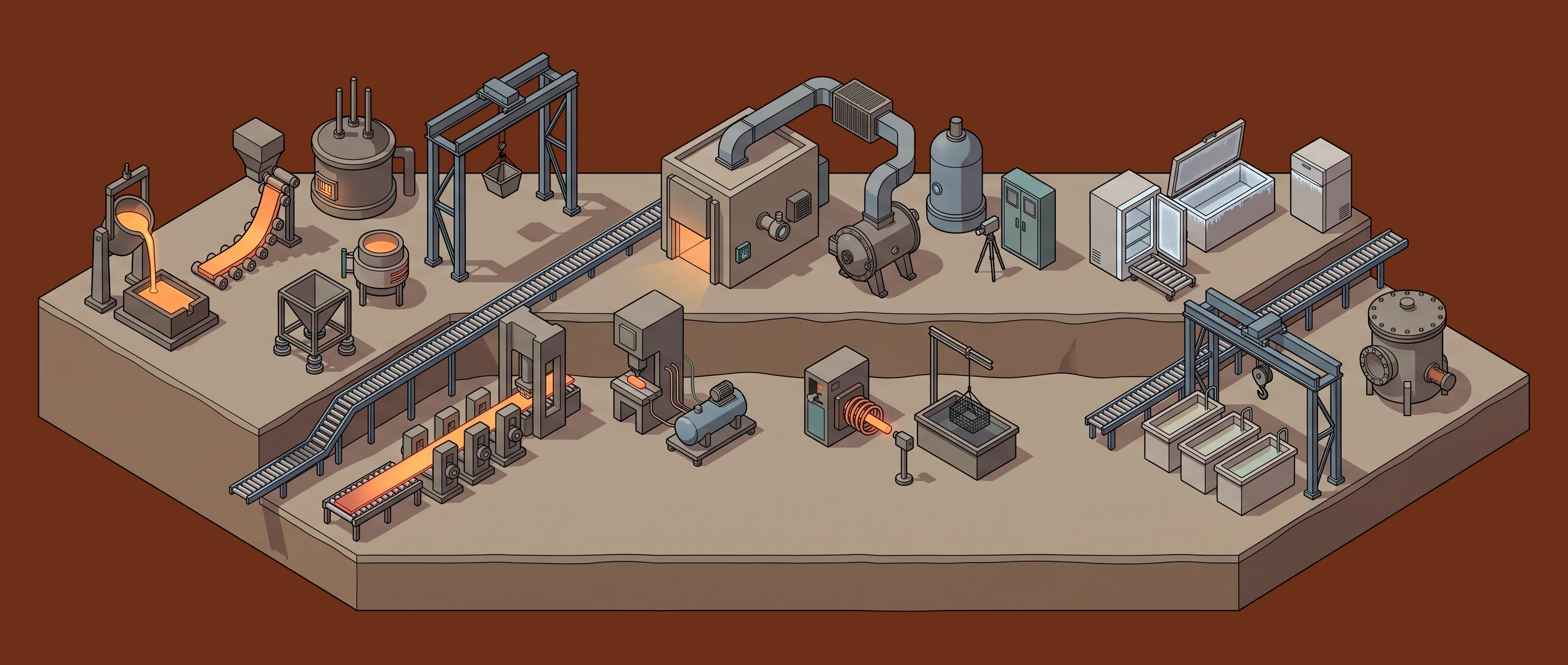
From the ladle to the last cold-treat cycle, a metals plant runs on temperature you cannot touch — molten streams and glowing billets read by infrared, strip profiled across the full mill width, furnace atmospheres and quench tanks held to spec, and finished parts taken down to −120 °F to finish the transformation the furnace started. Prater Technical Partners supplies that layer across the Fluke Process Instruments / Raytek / Ircon pyrometer and line-scanner families, Aspeq electric heating (Indeeco, Heatrex, Accutherm), CSZ industrial freezers for cryogenic treatment, plus Hedland fire-resistant-fluid flow meters, WIKA-ST load cells, ATi GasSens gas detection, and Reuland crane and press motors. Prater Technical works with you to spec each one from the target, the sight path, and the duty cycle.
- Die & platen heating on metal-forming and die-casting tooling—Accutherm Tubular & Finned
- Tight inter-roll & inter-stand gaps on a rolling mill—FPI Endurance Fiber-Optic
- Cold-treating tool steels, dies & gauges to lock in dimensional stability—CSZ T-Series
- Oil, parts-wash & process tanks held at temperature—Heatrex Over-the-Side
- Iron, steel & metal-refining temperature surveys on foot—Raytek Raynger 3i Plus
FAQ: instrumentation for metals & heat treat
How do you measure molten metal and hot billets through smoke, steam, and scale?
That is what the Fluke Process Instruments Endurance line is built for — including 2-color ratio models that keep reading through a dirty sight path, plus sight-tube mounting for furnace interior targets. Fiber-optic Endurance versions put a small head in the hot zone with the electronics out of the heat, and the Raynger 3i Plus handheld covers safe-standoff spot checks of molten and red-hot targets at 250:1 D:S. Start at the IR pyrometers page.
Can you profile strip temperature across the full width of a hot-rolling mill?
Yes — the MP line scanners build a full-width thermal profile of the moving strip, and the ES150 application software is the hot-rolling-mill system built on that platform. For fixed-view monitoring of press hardening or a furnace shell, the ThermoView TV30 thermal imager watches the whole scene continuously. Both live on the Fluke Process Instruments page.
What do you supply for cryogenic cold treatment of heat-treated parts?
The CSZ industrial freezer line — cold processing to −120 °F to transform retained austenite to martensite and stabilize dimensions. The T-Series is the high-throughput top-loading workhorse, the TF-Series front-loader mates with charge-car heat-treat lines for in-line processing, and the V-Series covers small-batch cold-treating. See the CSZ page.
Can you heat the ovens, quench tanks, and finishing tanks too?
Yes — Indeeco, Heatrex, and Accutherm process air heaters handle heat-treating and annealing ovens, and over-the-side immersion heaters maintain quench, plating, rinse, and cleaning tanks at temperature. Accutherm also builds custom-formed plate heaters for die-casting crucibles and explosion-proof heaters for Class II metal-powder dust areas. Most of it is engineered to order — start at the electric heating page.
We still run legacy Raytek Marathon and Ircon Modline sensors — can you support them?
Yes. Prater Technical Partners maintains migration references for the legacy Raytek and Ircon lines, mapping each installed sensor family to its current Fluke Process Instruments equivalent while preserving the measurement principle — a ratio instrument stays a ratio instrument, a single-color stays single-color. Bring your installed model list and we will work the crossover with you; see the Fluke Process Instruments page.
Working a furnace instrumentation spec, a mill upgrade, or a cold-treat capacity question? Talk to Scott — send directly to Scott Prater at scott@pratertechnical.com, or call him directly at 917-580-0878 during business hours.
Compiled by Prater Technical Partners.