About this industry
From the intake tower to the outfall, a water or wastewater system runs on measurement — compliance-grade flow at the plant fence, gas detection where chlorine and digester methane put people at risk, pressure and sewer telemetry across a network that mostly sits underground, and heat and power at sites the grid never reaches. Prater Technical Partners supplies that instrument layer across the Badger Meter family (flow, gas detection, telemetry), Aspeq electric heating, Reuland Electric gate-hoist motors, and SunWize remote solar power. Prater Technical works with you to spec each one from the pipe, the permit, and the site conditions.
Where the system starts. Motor-driven hoists work the spillway and sluice gates, ultrasonic meters totalize the raw water leaving the intake tower, recorders log reservoir level, and packaged solar runs the SCADA at sites beyond the last power pole.
Explore Source & Intake ›Behind one master connection, a campus or multi-tenant building is its own water system. Submeters size to each account, encoded registers read over cellular AMR instead of a walk to every pit, mag and clamp-on meters watch the mains and risers that feed it all, and pressure recorders catch zone trouble.
Explore Submetering & Building Systems ›From headworks to digester, the train runs on measurement: influent and in-plant flow metering, meters rated for the classified areas around the digester, methane build-up warning, immersion heat on digesters and chemical-feed tanks, and hydraulic diagnostics for gate and valve actuators.
Explore Wastewater Treatment Train ›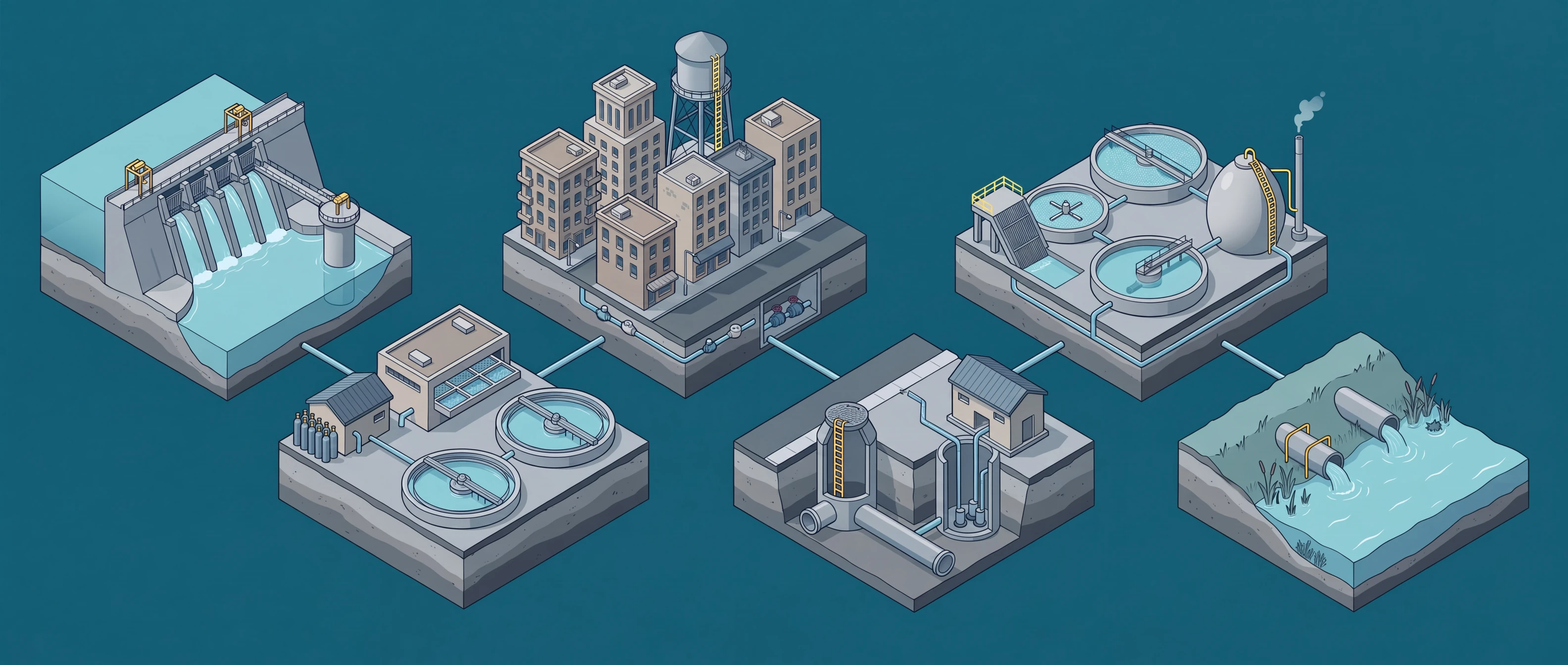
Inside the plant fence, chemistry does the work — and gets watched. Gas detection guards the chlorine, chlorine dioxide, and ozone rooms; feed meters totalize hypochlorite, polymer, and coagulant dosing; and electric immersion heat keeps chemical-feed tanks and cold-season process water at temperature.
Explore Drinking-Water Treatment ›Most of the collection system is underground and unwired. Battery-powered monitors measure open-channel sewer flow and rainfall for I&I studies, gas detection watches for H₂S above the wet well, meters totalize what the pumps move, and unit heaters and packaged solar keep remote stations running.
Explore Collection System & Lift Station ›The discharge permit is proven here. Compliance-grade meters totalize treated effluent where the plant meets the river, and battery-powered open-channel monitors cover interceptor and stormwater flows.
Explore Effluent & Stormwater Outfall ›- Potable-water branch metering on PVC & small metal lines—Impeller PVC Tee·Impeller Metal Tee
- Below-grade municipal & groundwater monitoring—Impeller Series 200·Impeller Tee 735
- Potable submetering in lead-free bronze (NSF 61, AWWA C715)—E-Series Ultrasonic G2
- Clamp-on retrofit metering in flooded vaults—Dynasonics TFX-500w
- Battery-powered chemical-feed totalizing at unwired points—IOG ER-500A Register
- Chemical-injection skid metering in stainless—IOG Stainless Oval Gear
- Freeze protection of outdoor valves, enclosures & piping—Hi-Heat Freeze Protection·Indeeco Heat Trace·Heatrex Enclosure Heaters
- Multi-kilowatt off-grid plant power & grid-outage backup—SunWize Power Station·SunWize Power Online
- Debris protection upstream of turbine & compound meters—RecordALL Plate Strainers
FAQ: instrumentation for water & wastewater
Which flow meter fits raw sewage and sludge lines?
Solids-laden flow is electromagnetic-meter territory — a full-bore mag meter such as the ModMAG M1000 or the M4000 has no parts in the stream to foul and handles raw sewage, mixed liquor, and sludge. For clean to lightly loaded lines, a clamp-on ultrasonic meter like the Dynasonics TFX-5000 mounts on the outside of the pipe with no shutdown. We match the meter to the fluid, the line size, and the straight run you actually have — start at the flow meters page.
Can Prater Technical supply gas detection for treatment plants?
Yes — the ATi GasSens line covers the gases treatment works handle day to day: chlorine and chlorine dioxide at disinfection, ozone near generators, hydrogen sulfide above wet wells and headworks, and combustible methane around digesters. Fixed receivers, remote sensors, and alarm relays are on the ATi GasSens page.
Do you handle water submetering and automated meter reading?
Yes — for commercial, industrial, and tenant submetering. RecordALL disc, compound, turbine, and fire-service meters cover AWWA C700–C702 metering from small service lines to fire mains; HR-E encoders put the register on the wire, and AquaCUE cellular AMR reads commercial and industrial accounts without drive-by routes. See the RecordALL and AquaCUE pages.
How do you monitor sewers and pressure zones without wiring anything?
Telog battery-powered recorders are built for exactly that: the Raven-Eye 2 measures open-channel sewer flow from above the stream, the HPR captures pressure transients on hydrants and mains, and the RG-32a adds rainfall for I&I correlation — all reporting over cellular. At sites that need more power than a battery, a SunWize packaged solar system supplies the array, sized to the load and the site's sun-hours. See Telog and SunWize.
Can you heat digesters, chemical-feed tanks, and outdoor piping?
Yes — Indeeco flanged-immersion and over-the-side heaters handle digester and chemical-feed duty, Heatrex screw-plug heaters cover smaller tanks, and Indeeco heat trace with Hi-Heat wraps protect outdoor valves, enclosures, and piping from freezing. Most of it is engineered to order from your tank drawing and fluid — start at the electric heating page.
Working a plant upgrade, a metering spec, or a remote-site problem? Talk to Scott — send directly to Scott Prater at scott@pratertechnical.com, or call him directly at 917-580-0878 during business hours.
Compiled by Prater Technical Partners.