About this category
Cox is Badger Meter's precision turbine line — a rotor spun by the flow stream and read by radio-frequency (RF) carrier pickoffs, the configuration that earns aerospace fuel-flow, custody-transfer, chemical-batching, and R&D-loop accuracy. Selection follows fluid, accuracy target, and line size, not model number: the dual-rotor Cox Exact (CDL remote / CDX integral, 1/2–4 in) holds ±0.1% with Strouhal-Roshko viscosity compensation; the single-rotor Precision CPT (1/2–2 in, hybrid ceramic bearings, −450 to +450°F) covers wide-temperature service; the Precision LoFlo CLF (3/8 in, six ranges) reaches ultra-low flow — with EC80, FC-5000, or FC30 flow computers downstream. Prater Technical works with you to spec the meter, computer, and 10-point MIL-PRF-7024 calibration, or per your calibration requirements, and as an authorized Badger Meter distributor configures each meter to your fluid before it ships.
Cox Series
Click any Series box for details →
 Badger Meter — precision turbine, to ±0.1%
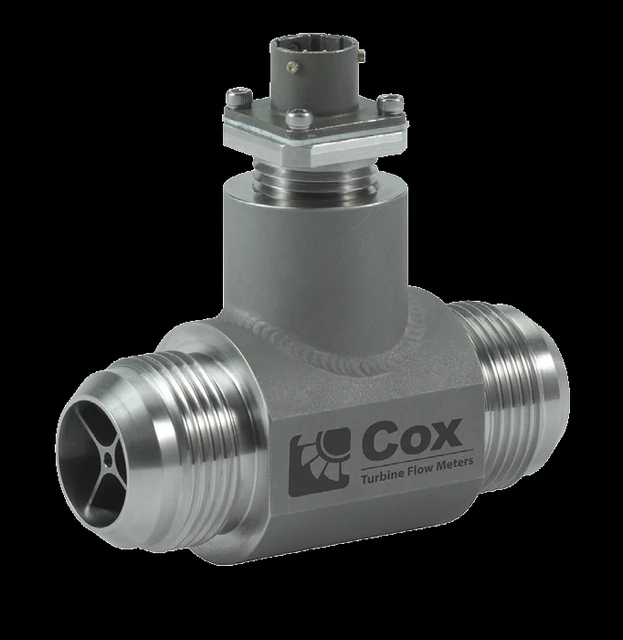
Cox Exact CDL / CDX
Dual rotor, ±0.1% · remote (CDL) or integral (CDX)
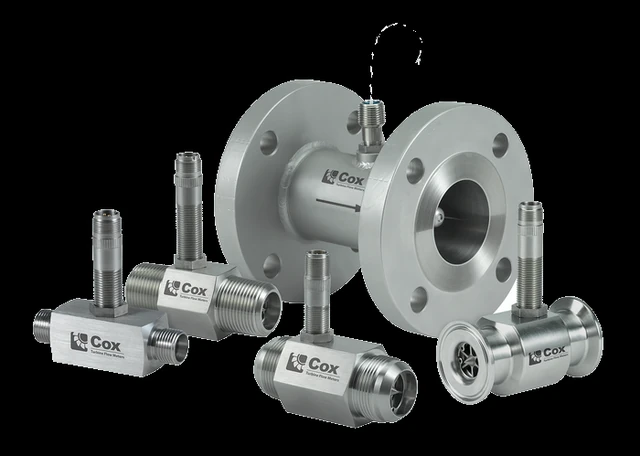
Cox Precision CPT
Single rotor, 1/2–2 in, ceramic bearings
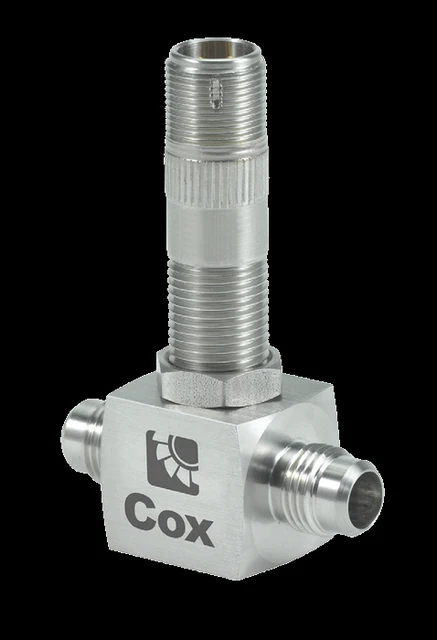
Cox Precision LoFlo CLF
3/8 in — ultra‑low flow, six ranges
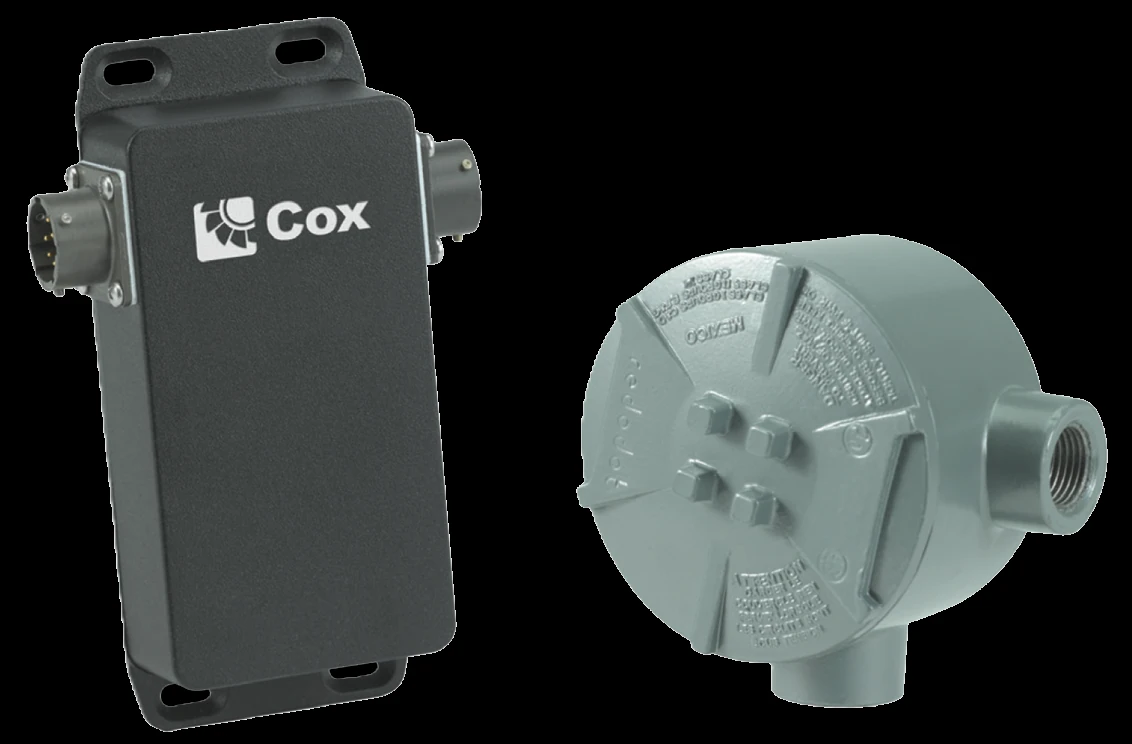
EC80 Flow Processor
Rate & total · meter‑mount or remote
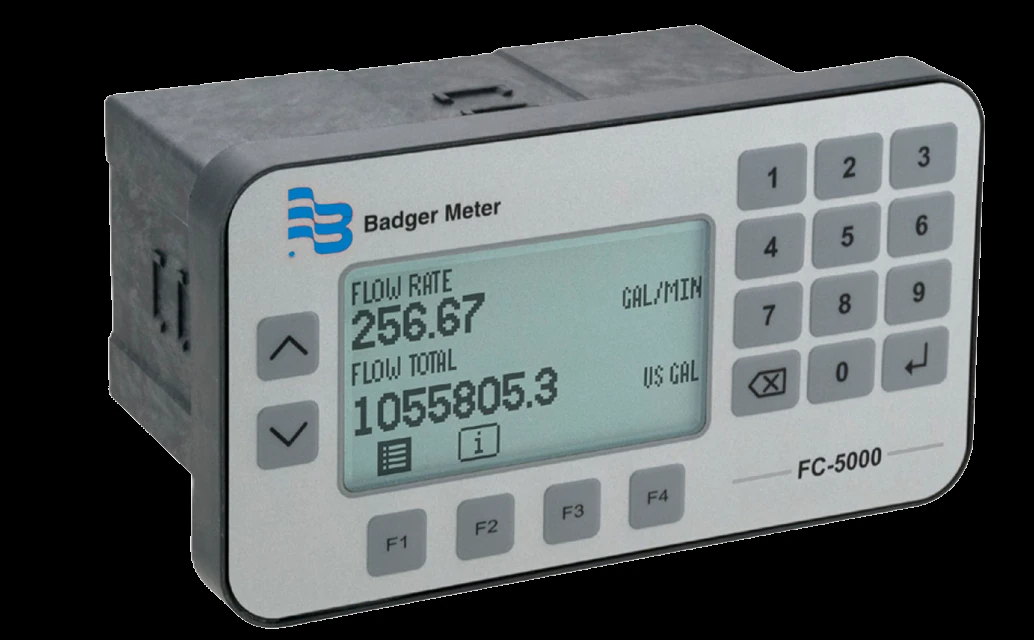
FC-5000 Flow Computer
Single/dual channel · UVC temp‑comp · batching & BTU
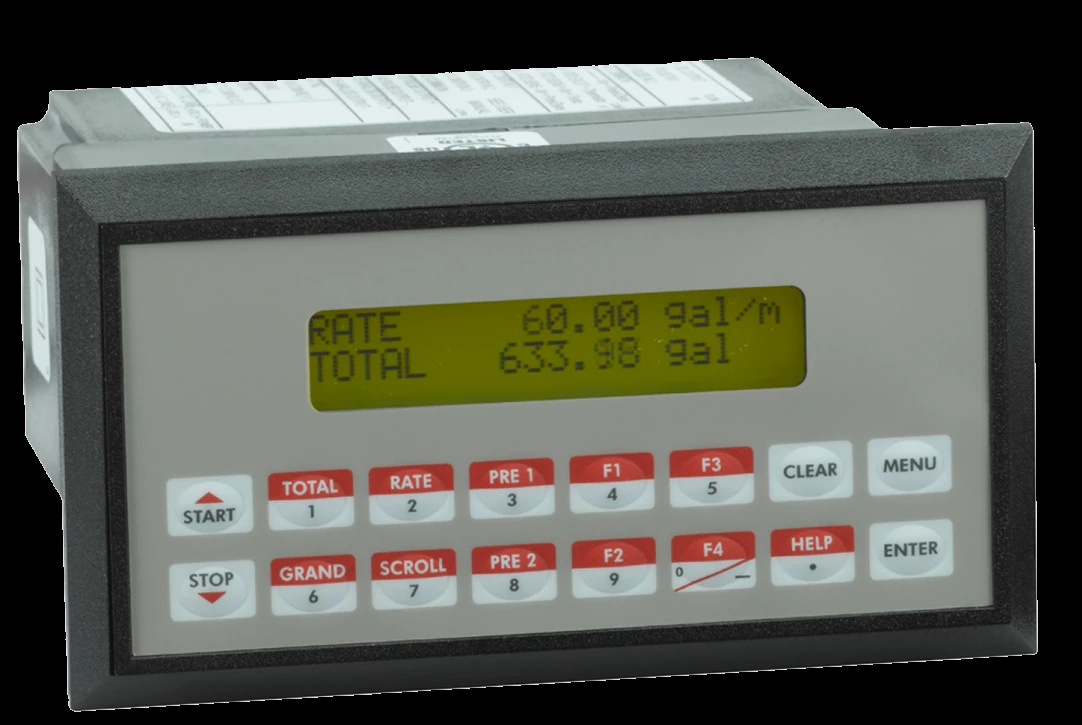
FC30 Flow Computer
Compact panel · 40‑pt linearization · serial comms
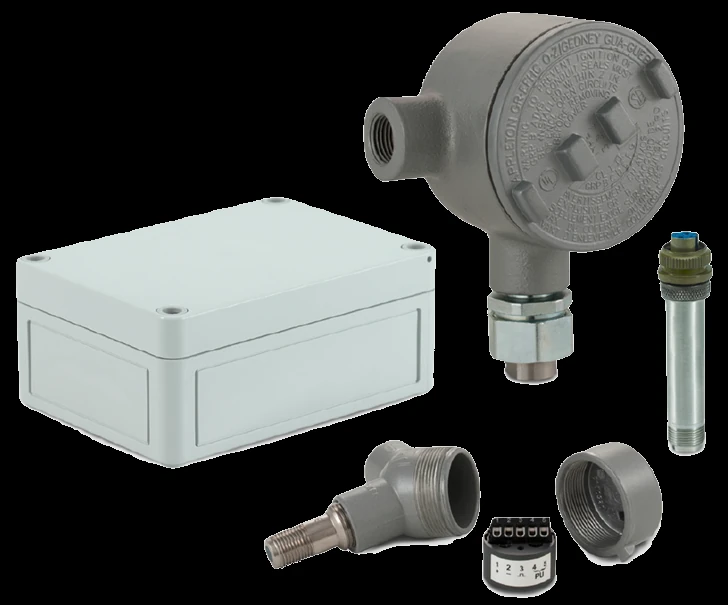
Signal Conditioners & D/A Converters
SCA pulse amplifiers · DAC 4–20 mA converters
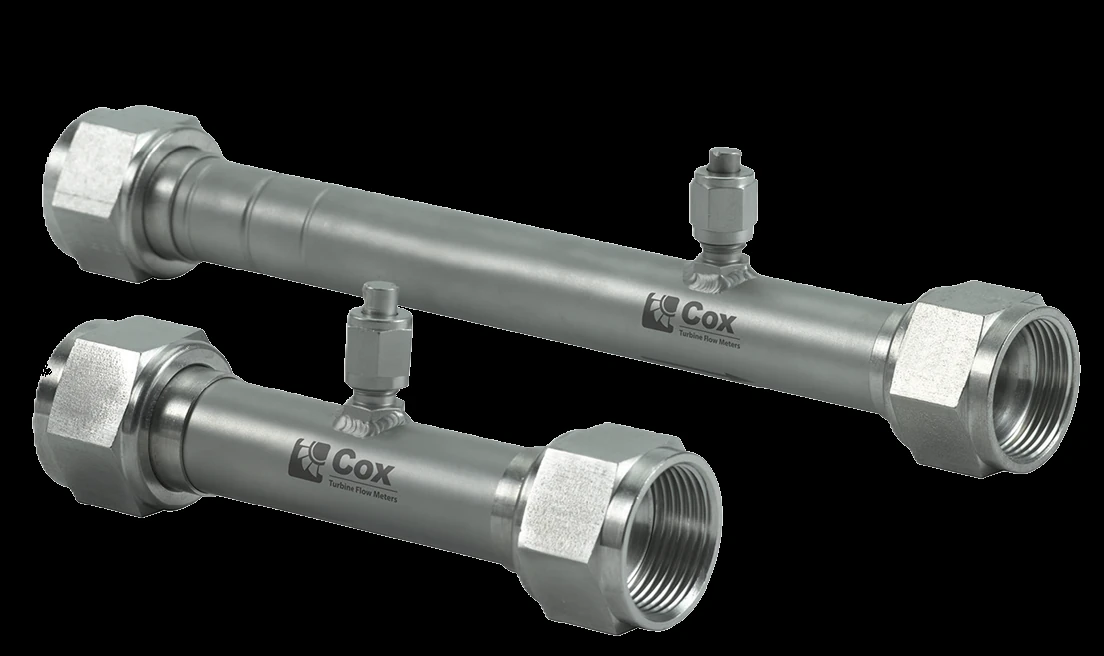
Flow Straighteners
AN & 150# flange — where space is tight
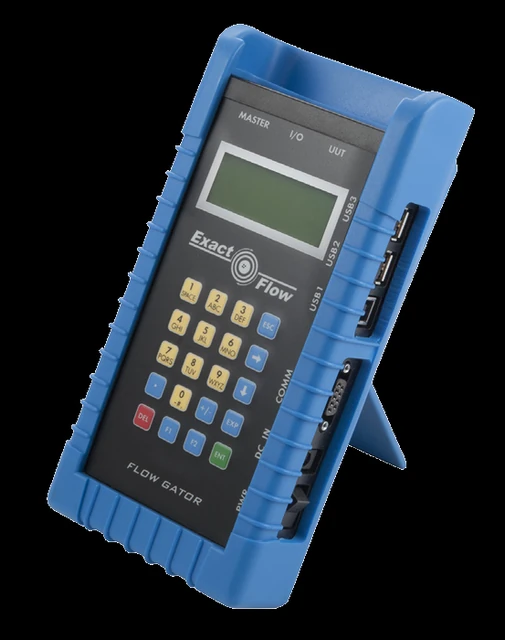
MIL-PRF-7024 Calibration
10‑point · multi‑viscosity & custom fluid
Industries Served
Aerospace & Defense
Test & Measurement
Oil & Gas
Chemical Processing
Research & Labs
Power Generation
Food & Beverage
OEM & Custom Equip.
FAQ: Precision Turbine Flow Meters
What makes Cox turbine meters accurate to ±0.1%?
Cox is built to aerospace test-stand standards, and three things combine to get there. Each meter reads its rotor with a radio-frequency (RF) carrier pickoff that senses the blades without magnetically dragging on the rotor, so the rotor spins essentially friction-free and stays linear well down into low flow. It turns on low-friction hybrid ceramic ball bearings. And every meter ships with a multi-point wet calibration traceable to NIST. The dual-rotor Cox Exact holds ±0.1% of reading with a flow computer, at ±0.02% repeatability; the single-rotor Precision (CPT) reaches its rated accuracy across its calibrated range with flow-computer correction.
Cox Exact (dual-rotor) or Precision CPT (single-rotor) — which do I need?
The dual-rotor Exact (CDL remote / CDX integral) hydraulically couples two counter-rotating helical rotors. Averaging the two cancels swirl — so it usually needs no flow straightener — and extends turndown dramatically: 120:1 on the smallest meter up to 500:1 on the larger ones, with the viscosity curve blending over a 60:1 range. That span often replaces a costly multi-meter manifold, and the ratio between the two rotors doubles as a built-in bearing-health check. The single-rotor Precision (CPT, 1/2–2 in) is the lighter-cost choice for steadier service, with expanded mechanical linearity that limits viscosity/temperature drift. For ultra-low flow, the Precision LoFlo (CLF, 3/8 in) comes in six flow-range variants. Rule of thumb: variable viscosity or the widest single-meter range → Exact; stable conditions or budget → CPT; very small rates → LoFlo.
What is an RF (carrier) pickoff, and why does Cox use it?
A conventional magnetic pickoff tugs on the rotor each time a blade passes, which loads the rotor and hurts low-flow accuracy. Cox’s RF pickoff senses the blades through a radio-frequency field with no magnetic pull, so the rotor turns nearly friction-free — a big part of how a turbine meter holds linearity at low flow. The pickoff is embedded and immune to vibration, which is why Cox meters go onboard vehicles and aircraft. Magnetic (MAG) pickoffs are available where an application calls for one.
How does Cox handle changing fluid viscosity and temperature?
A turbine meter’s output shifts with viscosity, and viscosity shifts with temperature. Cox characterizes each meter across multiple viscosities to build a Universal Viscosity Curve (UVC); a flow computer then tracks process temperature and applies that curve, so the reading holds as the fluid warms or cools. The dual-rotor Exact reduces the dependence further by self-compensating hydraulically. Tell us the fluid and its temperature range and the meter is calibrated to match.
What calibration comes with a Cox meter?
Every Cox meter ships with a 10-point MIL-PRF-7024 wet calibration and a unique K-factor, run on primary-standard calibrators at an NVLAP-accredited lab and traceable to NIST (calibrator uncertainty ±0.05% of reading, ±0.02% repeatability). Calibrations use blended solvent and oil to simulate your actual fluid; multi-viscosity UVC and custom-fluid calibrations are available when the process fluid differs from the standard. Recalibrate on the interval your quality system or custody-transfer standard requires.
Which flow computer do I pair with a Cox meter — EC80, FC-5000, or FC30?
The meter outputs pulses; the flow computer turns them into rate, total, and viscosity-corrected flow. The EC80 is the embedded rate-and-total processor — Strouhal-Roshko viscosity/temperature compensation with a 4-20 mA or EIA-485 output, well suited to OEM and panel builds. The FC-5000 is the full-featured unit — Strouhal-Roshko compensation, batching, BTU/energy, and wider protocol and I/O — when you need batching, energy metering, or system integration; its communications are standard, while the scaled-output form, relay function, and mounting are specified at order-time, so we configure it to your needs at time of quote. The FC30 is a compact single-channel panel-mount flow computer — 40-point linearization, Strouhal-Roshko temperature compensation, batching, and serial communications, factory-programmed to your application.
Can Cox meters handle cryogenic or high-temperature fluids?
Yes — the hybrid ceramic ball bearings are the enabler: harder, lighter, and more dimensionally stable across temperature than steel, and they run in non-lubricating fluids, so they handle cryogenics through hot oils. The Precision CPT covers −450 to +450 °F; the Exact’s standard range is −150 to +330 °F (wider on request), with a 3000 psig standard pressure rating. Wetted parts are stainless (316 body, 17-4 PH rotors), which is why Cox is a routine choice for aerospace fuel-flow and high-pressure test stands.
How do I buy Cox, and how is it configured?
Cox is handled under authorized Badger Meter distribution: send your application and calibration requirements to Prater Technical, we configure the meter, flow computer, and calibration to your fluid, and we ship to you with the calibration documentation. Engineered builds — special calibrations, custom fittings, high-pressure or cryogenic service — are all configured at time of quoting.
Have an application question? Talk to Scott — send directly to Scott Prater at scott@pratertechnical.com, or call him directly at 917-580-0878 during business hours.
Territory Coverage
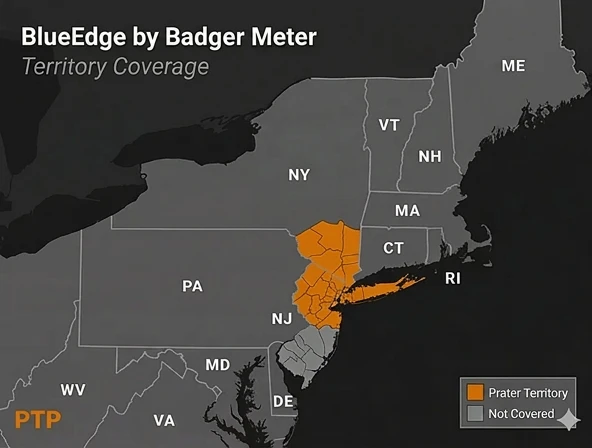
New York: New York City (all boroughs), Long Island, and the Hudson Valley — Westchester, Rockland, Putnam, Orange, Ulster, Dutchess, and Sullivan (ZIP 10000–11999 and 12400–12799). And Greene and Delaware counties that fall within ZIP 12400–12799
New Jersey: Northern NJ (07000–07999) and Central NJ (08500–08999)
New Jersey: Northern NJ (07000–07999) and Central NJ (08500–08999)
Territory above applies to Cox as a regional Badger Meter line. Prater Technical’s other product lines have their own coverage — see each brand’s page.
Specifications compiled by Prater Technical Partners from Cox product datasheets.