About this category
ModMAG is Badger Meter's electromagnetic flow line — full-bore mag meters that read conductive liquids by Faraday's law through an unobstructed bore, so they add no pressure loss and have no moving parts to wear, and they measure water, liquid food ingredients, chemicals, wastewater, and dirty or abrasive slurries that defeat inferential meters. The selection is by fluid and installation, not model number: conductivity and chemistry set the liner and electrode (PFA / PTFE / hard-rubber; 316 SS, Alloy C, tantalum, or Pt/Rh), line size and area classification set the meter — the M1000 for water and industrial service (NSF-61, to ±0.3%), the multi-protocol M2000 transmitter, the Class I Div 2 M3000 and Div 1 M4000 for hazardous areas, the battery-powered M5000 off-grid — and the host system sets the M2000 transmitter's output. Prater Technical Partners works with you to spec the meter, liner, electrode, and transmitter to your conditions, ships through our Brooklyn facility, and verifies calibration in-line with the handheld Field Verification Device — with programming and commissioning available as an optional, quoted service.
ModMAG Series
Click any Series box for details →
 Badger Meter — electromagnetic flow
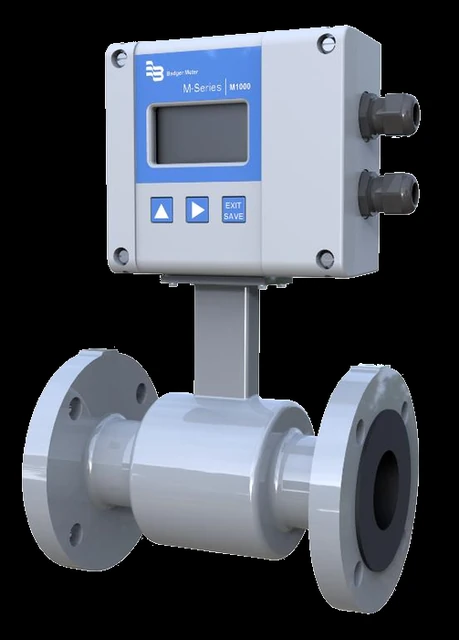
ModMAG M1000
1/4–20 in water & industrial, ±0.3%, NSF 61
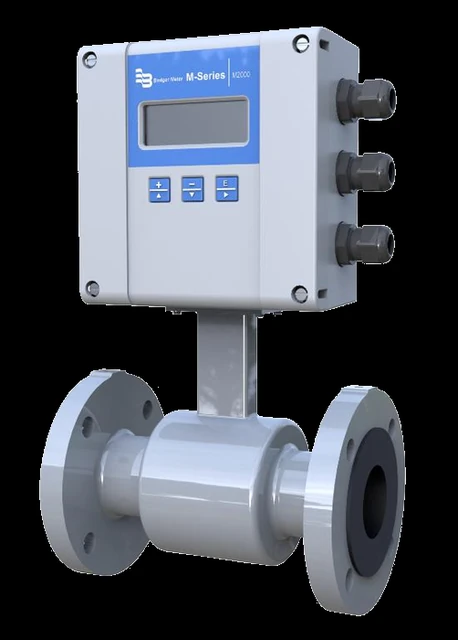
ModMAG M2000
Flexible transmitter — multi‑protocol daughterboards
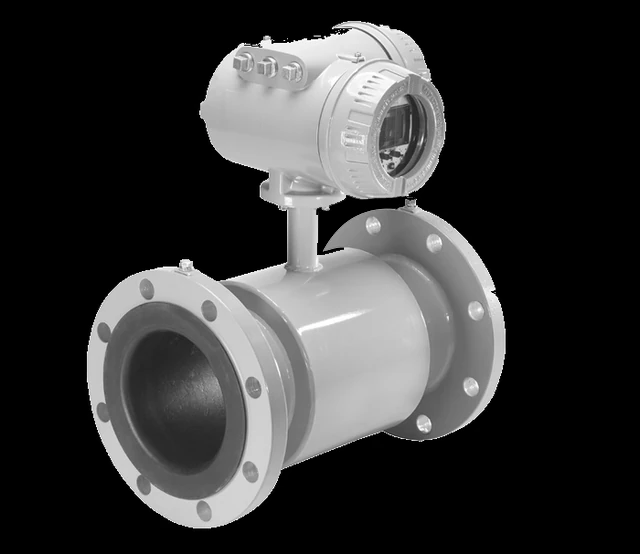
ModMAG M3000
1/4–24 in oil/gas, Class I Div 2, ±0.20%
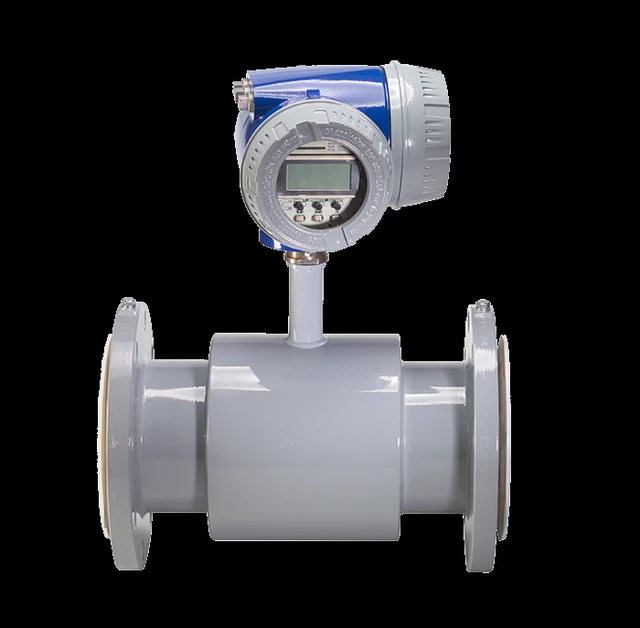
ModMAG M4000
1/4–12 in, Class I Div 1 hazardous areas
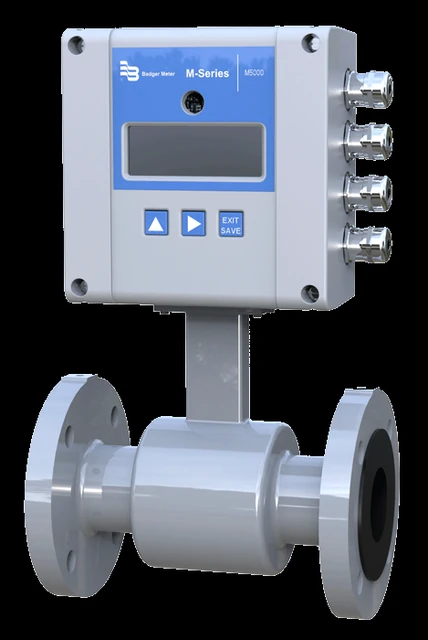
ModMAG M5000
Battery‑powered — remote/off‑grid installations
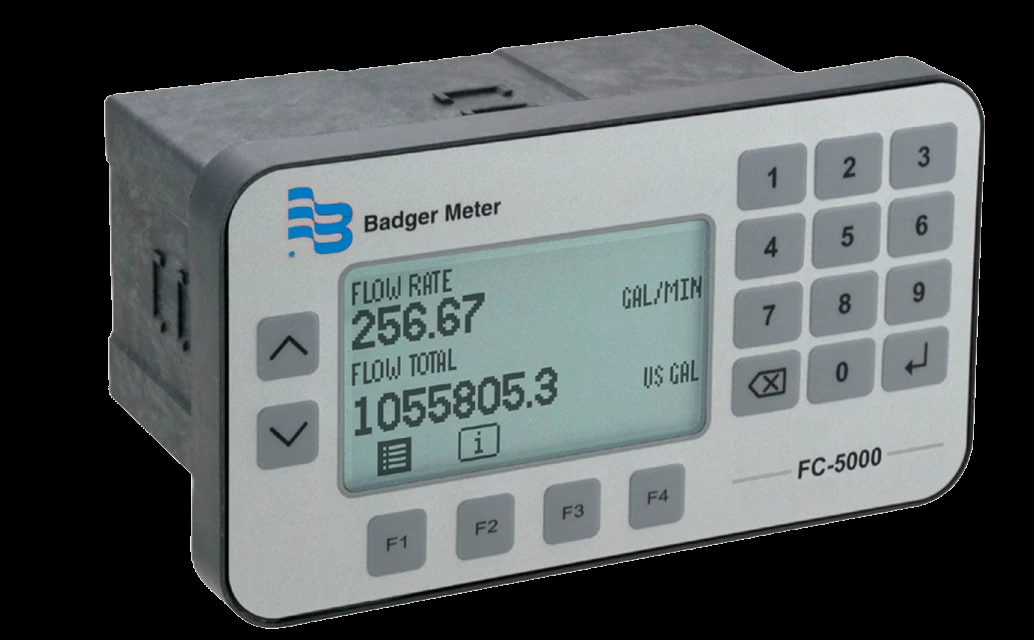
FC-5000 Flow Computer
Flow & BTU/energy monitoring — one configurable device
Industries Served
Water & Wastewater
Building
Chemical Processing
Food & Beverage
Oil & Gas
Power Generation
Pulp & Paper
Mining & Minerals
FAQ: Electromagnetic Flow Meters
When is a magnetic flow meter the right choice over a turbine or ultrasonic meter?
Use a mag meter when the fluid conducts electricity and you want nothing in the flow path. It reads by Faraday’s law across a clear full-bore tube, so there are no moving parts to wear, no pressure loss, and nothing to foul — which makes it the meter of choice for dirty, abrasive, or solids-laden liquids that punish turbines: wastewater, sludge, slurries, pulp stock, and chemicals, as well as clean and potable water. The one requirement is conductivity: the M-Series needs at least 5 µS/cm (20 µS/cm for demineralized water), so it cannot meter oils, fuels, hydrocarbons, gases, or ultra-pure water — those go to a turbine, positive-displacement, Coriolis, or ultrasonic meter instead.
How do I choose the liner and electrode?
Chemistry and abrasion set both. The liner is what the fluid touches: PFA or PTFE for aggressive chemicals and clean or potable water, hard rubber for abrasive slurries and wastewater, and Halar for specific chemical duties. The electrode has to resist the same fluid: 316 stainless for general water and industrial service, Alloy C for corrosives, tantalum for aggressive acids, and platinum/rhodium for special chemistries. Tell us the fluid, temperature, and any solids loading and we spec the liner and electrode to match — and for drinking water we confirm the NSF/ANSI 61 listing.
M1000, M3000, or M4000 — which mag meter do I need?
Line size, accuracy, and area classification decide it. The M1000 is the water and general-industrial meter — 1/4 to 20 in, ±0.3%, NSF/ANSI 61 drinking-water listed — for non-hazardous locations. The M3000 steps up to ±0.20% over 1/4 to 24 in, with PFA/PTFE/hard-rubber/Halar liners and a NEMA 4X/6P housing, rated for oil, gas, and industrial service in Class I, Division 2 hazardous areas. The M4000 carries the same performance into Class I, Division 1 (the most hazardous classified areas), 1/4 to 12 in. If the install is in a classified area, the area rating drives the model; otherwise the M1000 covers most water and process work.
What does the M2000 transmitter add, and which protocols does it speak?
The M2000 is the flexible transmitter — it lets one meter integrate into almost any control system without changing the sensor. Over a base of Modbus RTU (RS-232) and encoder output, it takes plug-in fieldbus daughterboards for eight protocols: Modbus RTU (RS-485), BACnet MS/TP, BACnet/IP, Modbus TCP/IP, EtherNet/IP, HART, Profibus DP, and M-Bus. An optional data-logger kit records flow on board. Standard 4–20 mA analog and scaled pulse/frequency outputs are on every model.
Can I run a ModMAG at a remote or off-grid site?
Yes — the right setup depends on what the site needs, which is exactly where the meter choice comes in, and there are three paths. Where you only need periodic totals with no power and no live data feed, the battery-powered M5000 stands alone: roughly ten years on internal lithium, logging on board, nothing else to install. For remote sub-metering applications — tenant billing, cost allocation, district consumption — pair an AquaCUE-ready meter with AquaCUE, Badger’s cellular endpoint and cloud, which carries the reads to a web dashboard with no wiring back to a control room. And for industrial remote installations that need control-grade accuracy, a live 4–20 mA or fieldbus signal, and/or hazardous-area service — the capabilities a battery meter gives up — run a line-powered M1000, M2000, M3000, or M4000 on its DC supply (the M1000 draws just 4 W) from a SunWize solar power system, and backhaul the meter output through a Telog cellular RTU to the Telog RM cloud for real-time monitoring and alarming. As the factory-authorized SunWize distributor and your Badger source, Prater Technical scopes the meter, power, and telemetry together — tell us the site, the load, and how you want the data.
Does a mag meter need straight pipe runs and special grounding?
Only a short straight run — a few pipe diameters upstream and downstream — far less than a turbine or differential-pressure meter needs, because the meter averages velocity across the whole bore. Grounding matters more: it measures a millivolt-level signal referenced to the fluid, so the meter must be bonded to the liquid. On metal pipe the flanges usually suffice; on plastic or lined pipe you add grounding rings (or grounding electrodes) so the reading stays stable. Empty-pipe detection and automatic zero stability are built in, so the meter reads a true zero — not noise — when the line drains.
Do I have to pull the meter to verify calibration?
No. Every ModMAG ships with a NIST-traceable wet-flow factory calibration, and the handheld Field Verification Device checks an installed M1000, M2000, or M5000 in place — confirming the meter still reads within spec without removing it from the line or interrupting service. That turns a recalibration shutdown into a quick field check. A full factory recalibration is available when an application or audit calls for it.
Is the M1000 listed for drinking water, and how do I buy ModMAG?
Yes — the M1000 is listed to NSF/ANSI 61 and 372 for drinking-water contact, with WRAS, ACS, and KTW/DVGW approvals as well, so it suits potable-water and municipal service. ModMAG is a regional Badger Meter line: Prater Technical Partners is the authorized distributor for Northern and Central New Jersey and New York. We spec the meter, liner, electrode, and transmitter to your application, ship it through our Brooklyn facility, with programming and commissioning available as an optional, quoted service. Contact us for a quote, current availability, or lead time.
Have an application question? Talk to Scott — send directly to Scott Prater at scott@pratertechnical.com, or call him directly at 917-580-0878 during business hours.
Territory Coverage
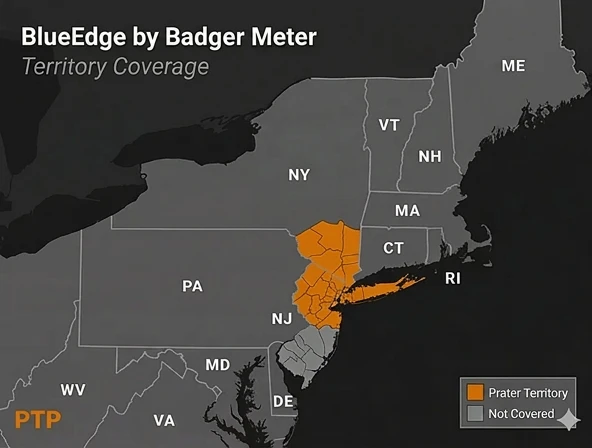
New York: New York City (all boroughs), Long Island, and the Hudson Valley — Westchester, Rockland, Putnam, Orange, Ulster, Dutchess, and Sullivan (ZIP 10000–11999 and 12400–12799). And Greene and Delaware counties that fall within ZIP 12400–12799
New Jersey: Northern NJ (07000–07999) and Central NJ (08500–08999)
New Jersey: Northern NJ (07000–07999) and Central NJ (08500–08999)
Territory above applies to ModMAG as a regional Badger Meter line. Other Badger lines have their own coverage — see the Badger Meter family page.
Specifications compiled by Prater Technical Partners from ModMAG product datasheets.