About this category
Vortex is Badger Meter's vortex-shedding flow line — dual piezoelectric sensors in CNC-precision-machined welded stainless steel, with no moving parts and no recalibration required after startup. They measure saturated and superheated steam, compressed air, and process gas — and derive mass-flow and BTU/energy from an internal RTD. The selection is by installation: the VN2000 Inline for full-bore service (3/4–8 in, flanged ANSI 150/300 or wafer, at ±0.7% of reading); the VN2000 Insertion meters for larger lines (2–36 in — the hot-tap installed and removed under pressure, or the lower-cost 2–24 in compact, both at ±1.0%); and the RVL non-metallic meter in PVDF or CPVC (1/4–3 in, liquid only, ±1% of full scale) for ultra-pure water, RO/DI, and chemical injection. The host system determines the needed output — the VN2000 offers 4–20 mA, pulse, Modbus RTU, and BACnet MS/TP; the RVL is 4–20 mA and pulse. Prater Technical works with you to spec Vortex with Badger Meter's Vortex sizing software, ships it through our Brooklyn facility configured to your process, with programming and commissioning available as an optional, quoted service.
Vortex Series
Click any Series box for details →
 Badger Meter — vortex shedding
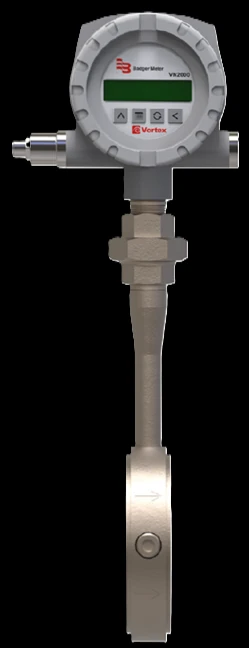
VN2000 Inline
Flanged ANSI 150/300 or wafer · 3/4–8 in · ±0.7%
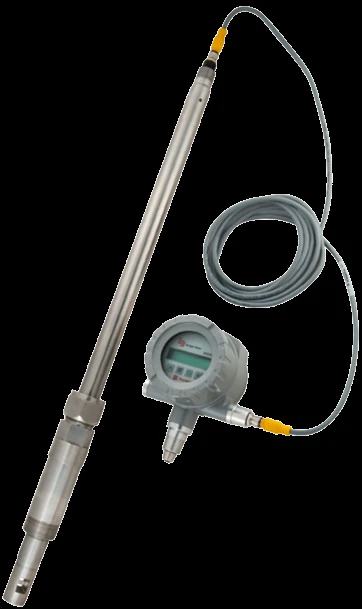
VN2000 Hot-Tap Insertion
2–36 in — install/remove under pressure · ±1.0%
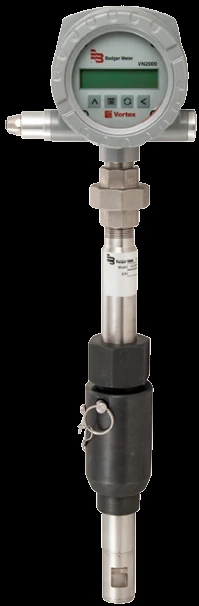
VN2000 Compact Insertion
2–24 in · fixed‑depth pin mount · ±1.0%
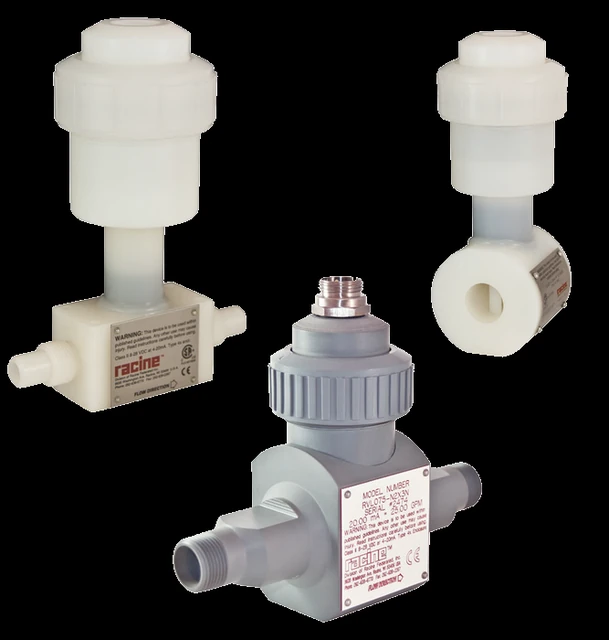
RVL Non-Metallic (PVDF/CPVC)
1/4–3 in · ultra‑pure water, RO/DI, chemical injection · ±1% FS
Industries Served
Building
Power Generation
Chemical Processing
Oil & Gas
Food & Beverage
Pharmaceutical
Pulp & Paper
Manufacturing & Process
FAQ: Vortex Flow Meters
What is the VN2000 vortex meter, and why does it have no moving parts?
The VN2000 measures steam, gas, or liquid by vortex shedding: as flow passes a fixed bluff body — a shedder bar — it sheds vortices alternately off each side at a frequency proportional to velocity, and dual ceramic piezoelectric sensors bonded inside a one-piece CNC-precision-machined stainless element count them. Nothing spins or wears: no rotor, no bearings, no internal O-rings or seals, and the sensors never touch the process fluid, so the element has an almost unlimited life and needs no recalibration after startup. An RTD embedded in the sensor compensates for temperature to return true mass flow, and with a second external RTD the meter totals BTU/energy across a heat exchanger. Tell us the fluid and the line and we size it.
How do I choose among the Vortex meters?
Start with how the meter meets the pipe. The VN2000 Inline is a full-bore meter you bolt into the line — flanged (ANSI 150/300) or wafer, 3/4 to 8 in — and it is the most accurate at ±0.7% of reading; choose it when the line can be opened and you want the tightest number. The VN2000 Insertion meters tap a single hole into a larger pipe (2 to 36 in) at ±1.0%: the Hot-Tap version installs and removes under pressure through an isolation valve, so a critical line never shuts down, while the lower-cost Compact version is a fixed-depth probe that drops into a welded mounting assembly after the line is depressurized. The RVL is a non-metallic, liquid-only meter for clean or aggressive fluids. Tell us the pipe size, the fluid, and whether the line can be shut down and we point you to the right one.
Can it measure steam, compressed air, and gas — and give mass flow or BTU?
Yes — that is the core of the line. The VN2000 handles saturated and superheated steam, compressed air, and process gas with no moving parts to foul in wet or dirty service. Order the mass-flow/temperature option and the internal RTD compensates the volumetric reading to true mass flow for steam or gas; order the BTU/energy option and a second external RTD lets it total heat across a heat exchanger — the basis for campus and building steam submetering and chilled-water BTU. For meaningful gas and steam numbers, specify mass flow and give us the line pressure and temperature with the flow range.
How accurate is it, and how much straight pipe run does it need?
The Inline VN2000 reads ±0.7% of reading with ±0.25% repeatability; the Hot-Tap and Compact insertion meters read ±1.0% with the same repeatability; the RVL is ±1% of full scale on its 4–20 mA output (±2% on pulse). Like any meter that reads velocity, a vortex meter needs a settled flow profile: plan on 10 pipe diameters of straight run upstream and 5 downstream, with no more than one 90° elbow just before the meter. Range matters too — the VN2000 works across a wide Reynolds band (roughly 10,000 to 7,000,000) but loses the bottom of its range at very low velocity. Tell us the worst-case flow, pressure, and temperature and we run it through Badger Meter’s Vortex sizing software to confirm the meter holds its accuracy at your conditions.
Can I install or service the meter without shutting the line down?
On larger lines, yes — that is what the Hot-Tap Insertion meter is for. It rides in a stainless seal assembly with a 1-1/2 in NPT or ANSI 150/300 flange connection to your isolation valve, and with the optional insertion/extraction tool it goes in and comes back out under pressure (the element withstands 1000 psi, though insertion or removal is not recommended above 400 psi). The Compact Insertion meter is the lower-cost route when the line can be depressurized: its mounting assembly welds to the pipe and an alignment pin sets the depth and locks it in. A full-bore Inline meter needs the line open to install. Tell us whether the line can be taken down and we steer the selection.
What outputs and communications does it offer?
Every VN2000 ships with a 4–20 mA loop and a scalable pulse output, a local 2×16 reflective display with totalizer, and an EIA-485 port for either Modbus RTU or BACnet MS/TP — so it drops straight onto a building-automation or process network. The transmitter mounts on the meter or remotely up to 30 ft away. The RVL is simpler by design: 4–20 mA or a frequency pulse, no fieldbus, in a NEMA 4X (IP66) enclosure. Tell us the control system and we set the output and protocol.
What is the RVL, and when do I use it instead of the VN2000?
The RVL is a non-metallic vortex meter for liquids only: its flow path is solid CPVC or PVDF with no metal wetted parts, gaskets, or elastomers, so it suits ultra-pure water distribution, RO/DI skids, cooling water, chemical injection, and nonabrasive slurries where a stainless meter would contaminate the fluid or corrode. It comes in NPT, butt-end, or wafer bodies from 1/4 to 3 in, reads ±1% of full scale, carries a NEMA 4X enclosure, and is field-recalibratable. It is liquid-only and runs at modest pressure and temperature (to 150 psig, to 203 °F on the high-temperature option), so it is not a steam or gas meter. Tell us the fluid chemistry, line size, and flow range and we pick the body material and fittings.
How do I buy Vortex, and is it calibrated and configured?
Vortex is a regional Badger Meter line — Prater Technical Partners is the authorized distributor for Northern and Central New Jersey and New York, and it is configured and quoted rather than sold on the webstore. We size the meter on Badger Meter’s Vortex sizing software, set the measurement, output, fluid, and connection, and ship through our Brooklyn facility after inspection. The VN2000 element is precision-machined and tested to verify signal rather than wet-calibrated in production, with factory calibration available on request; the RVL is calibrated on tap water; and PTP programming and commissioning are available as an optional, quoted service. Tell us the fluid, pipe size, flow range, pressure, and temperature and we confirm the meter and the price.
Have an application question? Talk to Scott — send directly to Scott Prater at scott@pratertechnical.com, or call him directly at 917-580-0878 during business hours.
Territory Coverage
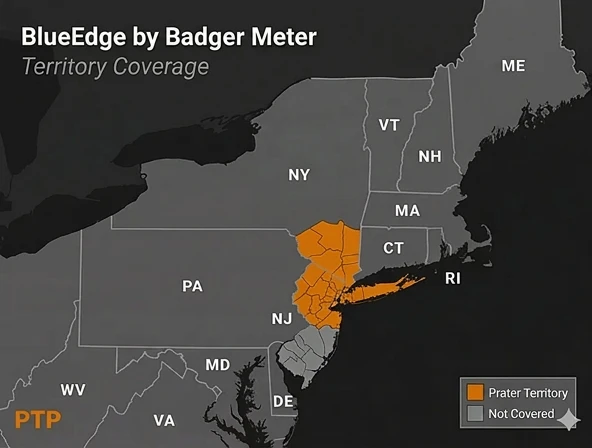
New York: New York City (all boroughs), Long Island, and the Hudson Valley — Westchester, Rockland, Putnam, Orange, Ulster, Dutchess, and Sullivan (ZIP 10000–11999 and 12400–12799). And Greene and Delaware counties that fall within ZIP 12400–12799
New Jersey: Northern NJ (07000–07999) and Central NJ (08500–08999)
New Jersey: Northern NJ (07000–07999) and Central NJ (08500–08999)
Territory above applies to Vortex as a regional Badger Meter line. Other Badger lines have their own coverage — see the Badger Meter family page.
Specifications compiled by Prater Technical Partners from Vortex product datasheets.