About this industry
A crane drive is not a general-purpose motor in a bigger frame — it starts and reverses under load, inches a bridge into position, holds a suspended load on every stop, and runs duty cycles that would overheat a standard machine. Prater Technical Partners supplies that drive layer from Reuland Electric — overhead crane & hoist motors, AC wound-rotor, integrated brake, NEMA Design D high-slip, and mil-spec marine winch drives — alongside WIKA-ST load pins and functional-safety force sensors that tell the control system what is actually on the hook. The same lines carry from port container terminals and mill crane bays to shipboard winch decks and load-test stands. Prater Technical works with you to spec each drive and each measuring point from the duty cycle, the reeving, and the load chart.
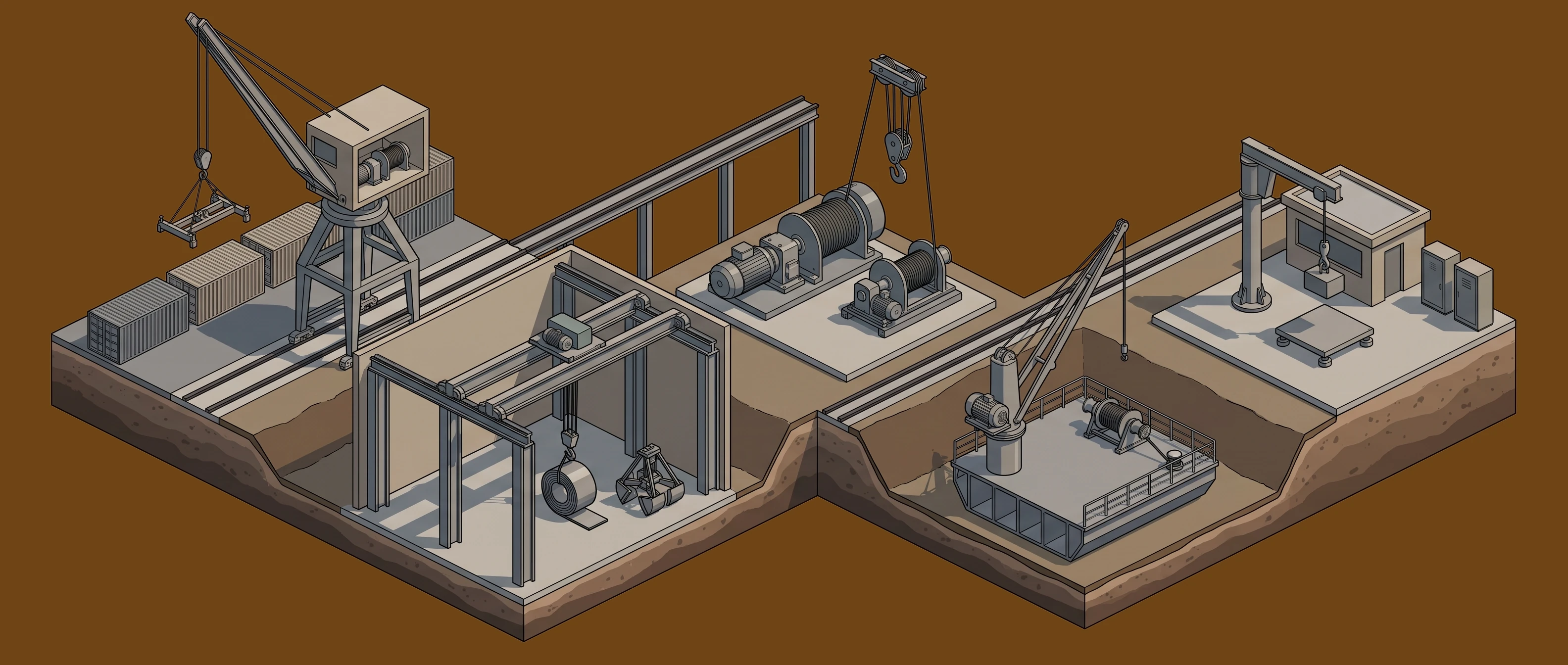
- Fabrication-shop overhead bridge & gantry cranes—Reuland Crane & Hoist Motors
- Monorail hoists & bulk-material movers—Reuland Crane & Hoist Motors
- Re-powering cranes whose original motor is obsolete or discontinued—Reuland Crane & Hoist Motors
FAQ: crane, hoist & lifting drives and load monitoring
Which motors are actually built for overhead crane and hoist duty?
Crane duty is its own motor class — frequent starts, reversals under load, inching, and intermittent or continuous ratings. Reuland builds overhead crane & hoist motors for bridge, gantry, jib, and monorail drives (including SS-100 inverter-duty motors for VFD bridge and trolley moves), AC wound-rotor motors where starting-torque and inching control matter, and NEMA Design D high-slip motors for drives started and reversed under load. Start at the Reuland Electric page.
How does a hoist hold the load when the drive stops?
With an integrated brake motor — Reuland builds the spring-set magnetic disc brake into the motor package, so the brake sets whenever the drive stops or loses power and the suspended load stays put. It is the standard package for hoist and trolley drives that must hold position between moves; see Reuland Electric.
Can we add load monitoring to a crane that is already in service?
Usually, yes — a WIKA-ST load pin replaces an existing sheave, equalizer, or shackle pin, so the crane's own geometry becomes the measuring point without redesigning the reeving. Wireless and CANbus outputs cover moving structures like winches and draw-works, IP67-sealed versions handle outdoor and marine exposure, and ELMS1 specialty force sensors add a functional-safety output rated to ISO 13849-1 PL d for overload systems. See the WIKA-ST page.
What do you supply for SOLAS verified gross mass container weighing?
Four-corner load-pin arrays on the spreader bar — a WIKA-ST load pin at each corner sums the container weight for SOLAS verified-gross-mass documentation right at the terminal, with sealed and wireless versions built for quayside exposure. The Force & Pressure page covers the load-pin and force-sensor lines.
Do you cover shipboard and military winch and crane drives?
Yes — Reuland's mil-spec marine and military motors drive shipboard winches, cranes, and hoists on military and commercial vessels, and WIKA-ST wireless load pins monitor winch and line tension on a moving structure. Reuland motors are custom-built and quote-only; Reuland Electric has the full line and territory.
Working a crane re-power, an overload-monitoring retrofit, or a new hoist drive spec? Talk to Scott — send directly to Scott Prater at scott@pratertechnical.com, or call him directly at 917-580-0878 during business hours.
Compiled by Prater Technical Partners.