About this industry
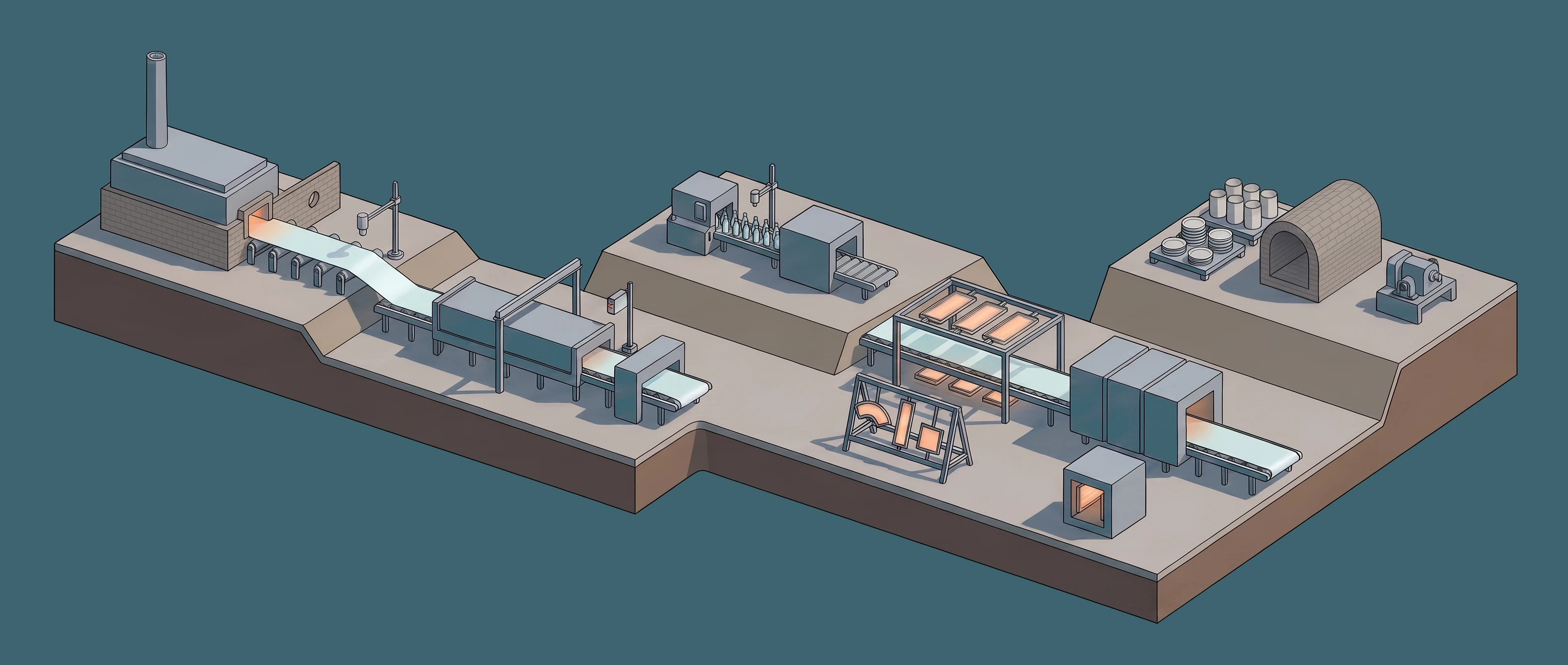
Glass and ceramics are made at temperatures only optics can read — and made well only when that heat is measured across the ribbon, tracked through the lehr, and applied deliberately at the furnace bank. Prater Technical Partners supplies that layer across Fluke Process Instruments pyrometry — Endurance fiber-optic sensors, Thermalert 4.0 glass heads, and MP line scanners running the GS150 and GS150-LE glass software — plus Solar Products infrared panel heaters (electric IR panels for tempering, bending, and annealing furnace banks — not photovoltaics) and Reuland synchronous motors for converting machinery. Plants still running legacy Ircon Modline, Mirage, ScanIR II, or Raytek MM sensors have documented migration paths to current instruments. Prater Technical works with you to spec each one from the process, the glass, and the line.
- Fixed glass-surface temperature points (dedicated 5 µm G5 head)—Raytek Mi3
- Re-paneling legacy tempering furnace banks — drop-in infrared replacements—Solar Legacy Panel Retrofit
- Heating plastics alongside glass — fast short-wave-like response (V Series)—Solar M / G / V Series
FAQ: temperature measurement & heating for glass & ceramics
How do you measure glass temperature when the target sits behind a furnace wall or window?
With a fiber-optic pyrometer — the Fluke Process Instruments Endurance fiber-optic series is built for exactly that, sighting glass-forming targets behind a protective wall or window while keeping the electronics out of the heat. For direct-view flat and container glass, Thermalert 4.0 G-series heads read the surface at the dedicated 5 µm glass wavelength. Start at the IR pyrometers page.
We still run Ircon Modline sensors and a ScanIR II glass profiler — what replaces them?
Both brands carry documented migration references. The Ircon legacy reference maps 5 µm Modline and Mirage glass sensors and ScanIR II glass profilers to their current equivalents, and the Raytek legacy reference does the same for MM G5 heads and GS100-software scanners. We work the crossover model by model so the measurement stays equivalent — see the Fluke Process Instruments page.
How do we see temperature distribution across the ribbon in annealing, tempering, and bending?
With an MP line scanner running the dedicated glass application software: GS150 builds the cross-ribbon thermal profile for annealing, tempering, and bending lines, and GS150-LE is the version for Low-E coated glass. Both run on the same Ircon / Raytek MP scanner platform — details on the Fluke Process Instruments page.
Is Solar Products a solar-energy company?
No — Solar Products builds electric infrared panel heaters; nothing photovoltaic. For glass work that means panel banks for tempering, bending, and annealing furnaces: the standard F, FBA, Q, and T series, the specialty M / G / V series, multi-zone infrared oven systems, custom OEM panels, and drop-in re-paneling of legacy furnace banks. See Solar Products.
What do you offer for ceramics processing, as opposed to glass?
Ceramics process spot measurement is Raynger 3i Plus territory — a portable short-wavelength handheld for walk-up temperature checks at kilns and hot processes without installing a fixed sensor. For fixed measurement points and for slip-free drives on converting machinery, we spec from the same Fluke Process Instruments and Reuland Electric lines case by case — start at the IR pyrometers page.
Working a lehr instrumentation spec, a furnace re-panel, or a legacy glass-sensor migration? Talk to Scott — send directly to Scott Prater at scott@pratertechnical.com, or call him directly at 917-580-0878 during business hours.
Compiled by Prater Technical Partners.