About this industry
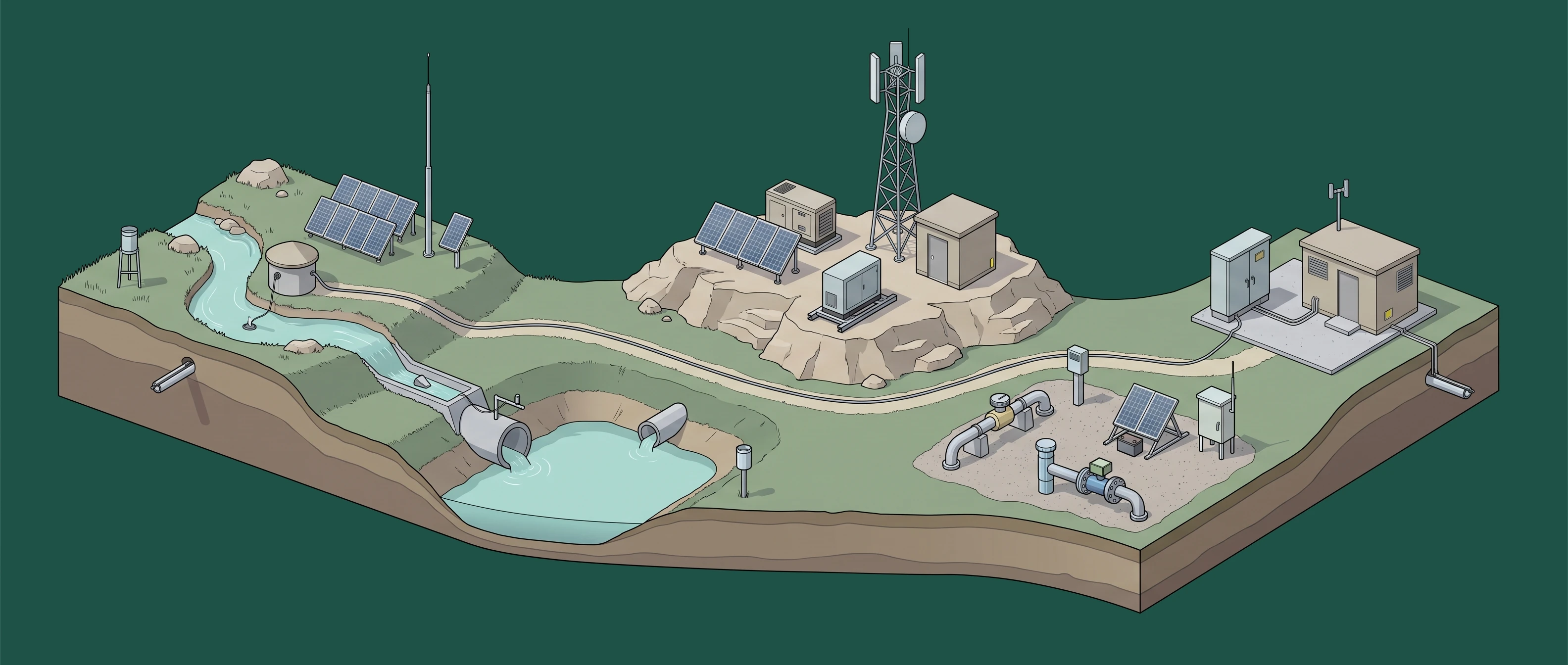
An environmental or remote-monitoring network lives where the grid does not — rain gauges and stream recorders in the watershed, permit meters at stormwater outfalls, repeaters on a ridge, and instrument cabinets that must sit out the winter unattended. Prater Technical Partners supplies that layer end to end: Telog battery-powered recorders and cellular RTUs, Dynasonics, ModMAG, and Blancett flow meters that log on-board between site visits, SunWize packaged off-grid solar power, and Indeeco, Heatrex, and Hi-Heat enclosure heating that keeps electronics dry and above freezing. The pieces are built to pair — Telog RTUs are solar-ready, and SunWize supplies the array sized to the load and the site’s sun-hours. Prater Technical works with you to spec each one from the sensor list, the duty cycle, and the site conditions.
- Telecommunications battery qualification before deployment—CSZ Battery Test Chambers
- Emergency & disaster-response monitoring and communications power—SunWize Rapid Deploy
- High-load installations that outgrow a practical PV-only system—SunWize Hybrid Systems
- Week-long sunless-weather ride-through for critical stations—SunWize Power Ready
- Unattended-site logging read out over USB or Modbus between visits—Blancett B3100
FAQ: instrumentation for environmental & remote monitoring
Do Telog recorders and RTUs come with solar power?
No — they're solar-ready. Telog recorders run for years on internal batteries, and the RS-45 above-ground RTU accepts a DC input from a customer-supplied solar array for higher-duty telemetry. SunWize supplies that array as a packaged, sized system — from a 40–60 W PVK kit at a single sensor site up to skid-mounted plants. See Telog and SunWize.
How do I meter a stormwater outfall or discharge point for permit reporting?
The Dynasonics IS-4000 covers stormwater outfalls and discharge-permit reporting with about 130,000 lines of on-board datalogging; the IS-6000 adds surcharge-capable measurement and roughly 12 months of SD-card logging with Modbus SCADA backhaul. Above the stream, the Telog Raven-Eye 2 radar sensor measures open-channel flow without touching the water. Start at Dynasonics and Telog.
What can totalize flow at a site with no power?
Blancett turbine electronics are built for exactly that: the B3150 runs about three years on a lithium battery where no power reaches the meter run, and the B3100 logs interval, daily, and event data on-board so an unattended site reads out over USB or Modbus between visits. The ModMAG M5000 covers ground-water and continuous-flow monitoring with about 7,000 records of on-board logging. See Blancett and ModMAG.
How do you keep outdoor cabinets and equipment shelters from freezing or sweating?
Two ways, often together: Indeeco and Heatrex enclosure heaters carry the space load across wide ambient swings, while Hi-Heat flexible heaters — silicone rubber, polyester film, or wire-wound — bond to the cabinet wall or the component itself for freeze protection and anti-condensation duty. Most of it is built from your cabinet drawing. Start at the electric heating page.
How do you size power for a remote telecom or monitoring site?
From the load and the site's sun-hours. A PVK kit (40–60 W) powers a single sensor station; Power Ready custom systems carry critical monitoring stations with up to 7 days of autonomy; the skid-mounted Power Station handles multi-kilowatt loads in one forklift-set unit; and Hybrid solar-plus-generator or fuel-cell systems cover 800 W–5 kW repeater and microwave-link sites that outgrow a practical PV-only array. See SunWize.
Standing up a monitoring network, powering a ridge site, or closing out an outfall permit spec? Talk to Scott — send directly to Scott Prater at scott@pratertechnical.com, or call him directly at 917-580-0878 during business hours.
Compiled by Prater Technical Partners.