About this industry
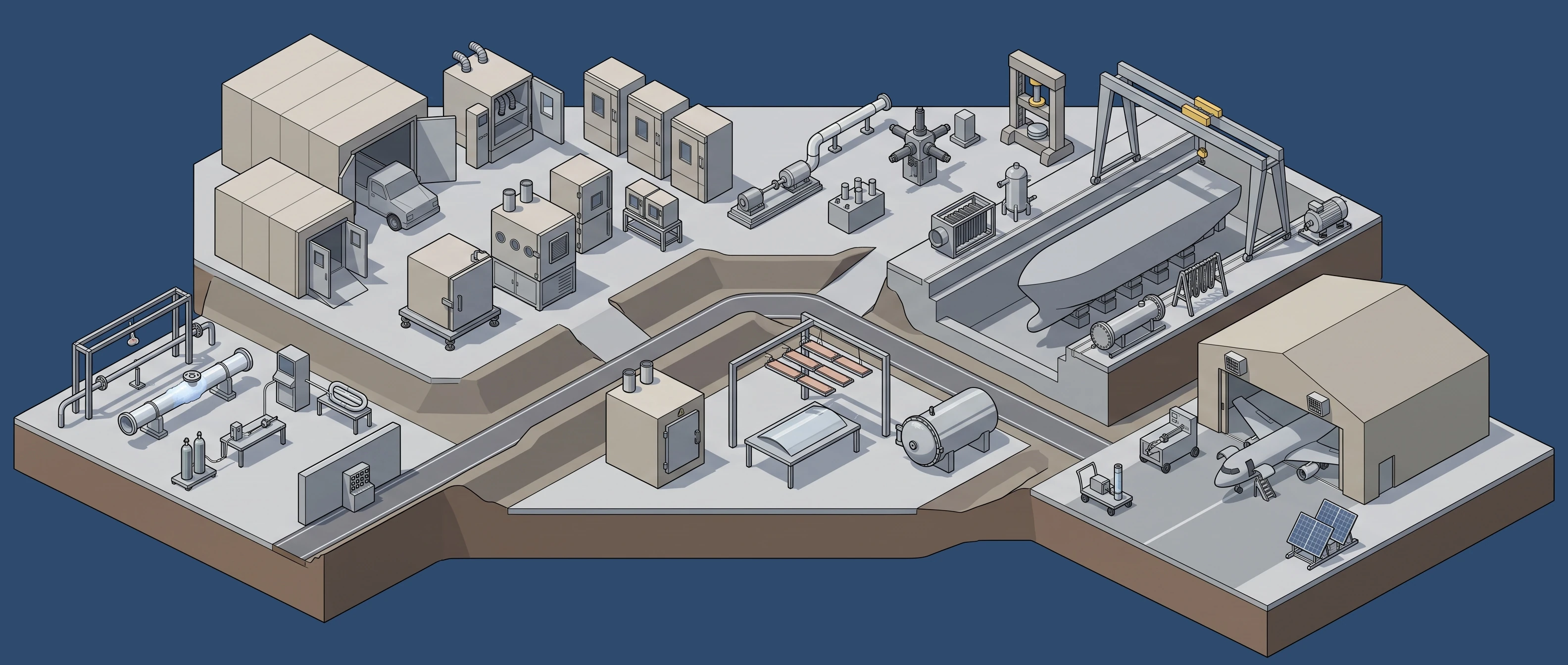
An aerospace or defense program lives on proof — environmental qualification to the governing test standard, fuel-flow measurement a certificate can stand behind, force and pressure data from the test cell, and hardware built and documented to the spec that governs the platform. Prater Technical Partners supplies that layer across CSZ environmental test chambers, Cox precision turbine flow meters with MIL-PRF-7024 calibration, WIKA-ST force and dynamic-pressure sensors, Reuland Electric mil-spec and test-stand motors, Aspeq electric heating (Accutherm, Indeeco, Heatrex, Solar Products), Hi-Heat flexible heaters, and SunWize rapid-deploy solar power. Prater Technical works with you to spec each one from the test standard, the governing spec, and the duty cycle.
- Aerospace component heating with uniform heat & tight resistance tolerance—Hi-Heat Etched-Foil
- Low-outgassing vacuum-chamber component heating (polyimide, to 260 °C / 500 °F)—Hi-Heat Polyimide (Kapton)
- H₂O₂ vapor decontamination-cycle validation for defense programs—ATi IsoMon H2O2 Monitor
- Meter-run conditioning on AN-flare aerospace fuel plumbing—Cox Flow Straighteners
FAQ: instrumentation for aerospace & defense
Which chambers cover MIL-STD-810 and DO-160 qualification?
The CSZ line was built around exactly that work: AGREE chambers combine temperature, humidity, and vibration for MIL-STD-810 and RTCA/DO-160 qualification, altitude chambers add DO-160E rapid-decompression testing, thermal-shock chambers run MIL-STD-883 Method 1011 transitions, and HALT/HASS chambers compress reliability screening of defense electronics. Walk-in chambers take large aerospace components in on racks or carts. Start at the CSZ page.
What do you supply for engine and rocket test-stand fuel flow?
Cox precision turbine meters — the Exact CDL/CDX for engine test cells and on-board fuel-flow testing, the LoFlo CLF for attitude-control rocket engines and exotic propellants such as N₂O₄, UDMH, MMH, and hydrazine, and the Precision CPT for cryogenic-through-hot stands across a −450 to +450 °F window. Every meter can ship with a MIL-PRF-7024 calibration, which is the proof of accuracy at acceptance testing. See the Cox page.
Can you cover mil-spec shipboard heating and motors?
Yes — that is the Accutherm and Reuland side of the portfolio. Accutherm builds finned-tubular marine air heaters, Monel-wetted marine circulation heaters, and explosion-proof immersion heaters to the governing spec with documentation and traceability. Reuland mil-spec motors serve shipboard and submarine auxiliary systems qualified to MIL-STD-901 shock and MIL-STD-167-1 vibration. See Accutherm and Reuland Electric.
Do you have heaters for avionics, instruments, and vacuum chambers?
Hi-Heat flexible heaters handle direct component heating: etched-foil elements deliver uniform heat with tight resistance tolerance for precision instruments and optics, and polyimide (Kapton) heaters add a low-outgassing substrate for vacuum-chamber and aerospace component work up to 260 °C / 500 °F. Both are built to your drawing — see the Hi-Heat page.
How do you power surveillance and communications at forward sites?
SunWize Rapid Deploy systems are relocatable 1 kW packaged solar power units built for surveillance, border-security, and military communications loads at sites with no grid — sized to the load and the site's sun-hours, and moved when the mission moves. See the SunWize page.
Working a qualification program, a test-stand build, or a governing-spec hardware package? Talk to Scott — send directly to Scott Prater at scott@pratertechnical.com, or call him directly at 917-580-0878 during business hours.
Compiled by Prater Technical Partners.